## Line Charts: Performance Comparison of LLM-SR and PiT-PO
### Overview
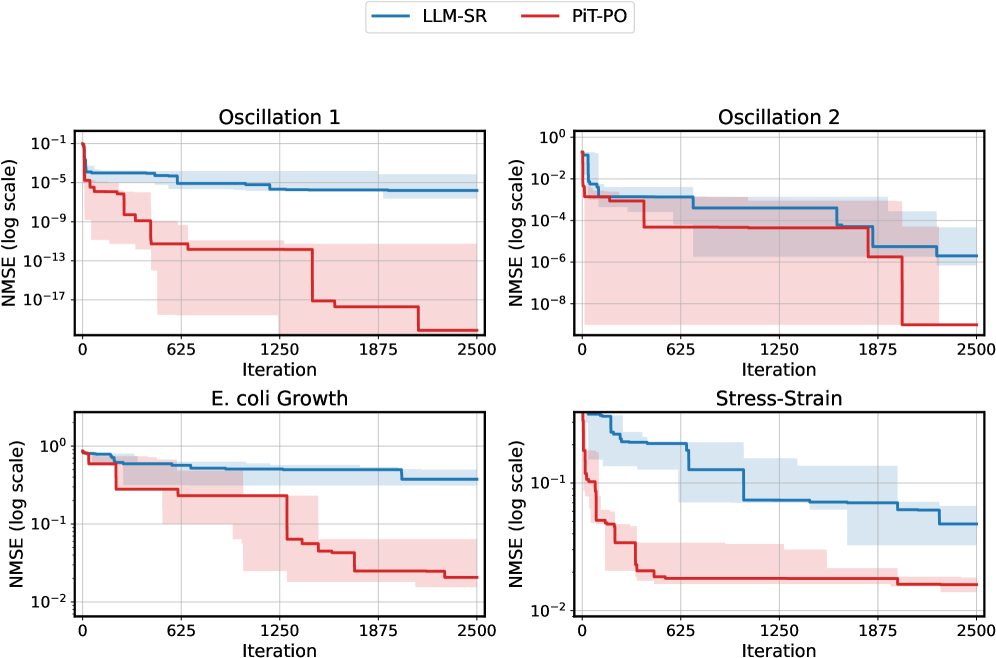
The image presents four line charts comparing the performance of two methods, LLM-SR (blue) and PiT-PO (red), across different scenarios: "Oscillation 1", "Oscillation 2", "E. coli Growth", and "Stress-Strain". Each chart plots the NMSE (Normalized Mean Squared Error) on a logarithmic scale against the iteration number. The charts show how the NMSE decreases with increasing iterations for both methods, with shaded regions indicating variability or uncertainty.
### Components/Axes
* **Title:** The image contains four subplots, each with a title: "Oscillation 1", "Oscillation 2", "E. coli Growth", and "Stress-Strain".
* **X-axis:** All charts share the same x-axis label: "Iteration". The x-axis ranges from 0 to 2500, with tick marks at 0, 625, 1250, 1875, and 2500.
* **Y-axis:** All charts share the same y-axis label: "NMSE (log scale)". The y-axis scale varies between charts.
* Oscillation 1: ranges from 10^-17 to 10^-1
* Oscillation 2: ranges from 10^-8 to 10^0
* E. coli Growth: ranges from 10^-2 to 10^0
* Stress-Strain: ranges from 10^-2 to 10^1
* **Legend:** Located at the top of the image, the legend identifies the two methods:
* LLM-SR: Represented by a blue line with a light blue shaded region.
* PiT-PO: Represented by a red line with a light red shaded region.
### Detailed Analysis
**Oscillation 1**
* **LLM-SR (Blue):** The line starts at approximately 10^-1 and decreases to around 10^-5, then remains relatively stable.
* **PiT-PO (Red):** The line starts at approximately 10^-5 and decreases significantly to around 10^-18 in a step-wise fashion.
* The shaded regions around each line indicate the variability in the NMSE for each method.
**Oscillation 2**
* **LLM-SR (Blue):** The line starts at approximately 10^0 and decreases to around 10^-6, then remains relatively stable.
* **PiT-PO (Red):** The line starts at approximately 10^-2 and decreases significantly to around 10^-9 in a step-wise fashion.
* The shaded regions around each line indicate the variability in the NMSE for each method.
**E. coli Growth**
* **LLM-SR (Blue):** The line starts at approximately 10^0 and decreases to around 10^-1, then remains relatively stable.
* **PiT-PO (Red):** The line starts at approximately 10^0 and decreases significantly to around 10^-2 in a step-wise fashion.
* The shaded regions around each line indicate the variability in the NMSE for each method.
**Stress-Strain**
* **LLM-SR (Blue):** The line starts at approximately 10^1 and decreases to around 10^-1, then remains relatively stable.
* **PiT-PO (Red):** The line starts at approximately 10^0 and decreases significantly to around 10^-2 in a step-wise fashion.
* The shaded regions around each line indicate the variability in the NMSE for each method.
### Key Observations
* In all four scenarios, both LLM-SR and PiT-PO show a decrease in NMSE as the number of iterations increases, indicating that both methods are converging towards a solution.
* PiT-PO generally achieves a lower NMSE than LLM-SR in all scenarios, suggesting that it may be a more effective method for these specific problems.
* The step-wise decrease in NMSE for PiT-PO suggests that it may be making discrete improvements at certain iterations.
* The shaded regions indicate that there is some variability in the NMSE for both methods, but the overall trend is still clear.
### Interpretation
The charts provide a comparative analysis of the performance of LLM-SR and PiT-PO across different problem domains. The data suggests that PiT-PO generally outperforms LLM-SR in terms of achieving a lower NMSE. This could be due to the specific algorithms used by each method, or the way in which they are optimized for these particular problems. The step-wise decrease in NMSE for PiT-PO could indicate that it is using a more aggressive or adaptive optimization strategy. The variability in NMSE, as indicated by the shaded regions, suggests that there may be some sensitivity to initial conditions or other factors. Overall, the data suggests that PiT-PO is a promising method for these types of problems, but further investigation may be needed to understand its behavior in more detail.