\n
## Diagram: Multi-Head Attention Tree Structure with Search Space
### Overview
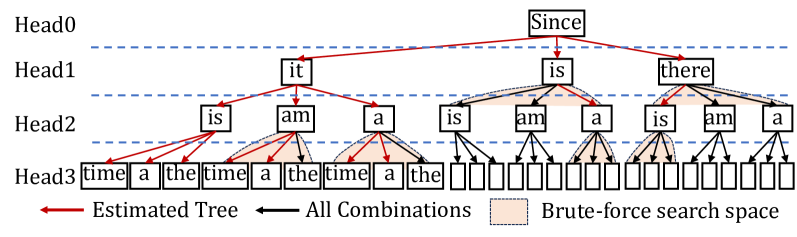
The image is a technical diagram illustrating a hierarchical tree structure, likely representing a parsing or search process in natural language processing or a related computational field. It visualizes how different "heads" (possibly attention heads in a transformer model) generate or explore combinations of words, distinguishing between an estimated optimal path and the full combinatorial space.
### Components/Axes
* **Vertical Layers (Heads):** The diagram is organized into four horizontal layers, labeled on the left side:
* **Head0** (Top layer)
* **Head1**
* **Head2**
* **Head3** (Bottom layer)
These layers are separated by horizontal dashed blue lines.
* **Nodes:** Each layer contains rectangular boxes (nodes) with text inside. The nodes represent words or tokens.
* **Connections (Arrows):** Directed arrows connect nodes from a higher layer to nodes in the layer directly below it.
* **Legend (Bottom of image):**
* **Red Arrow:** Labeled "Estimated Tree"
* **Black Arrow:** Labeled "All Combinations"
* **Peach-colored shaded rectangle:** Labeled "Brute-force search space"
### Detailed Analysis
**1. Tree Structure and Node Content:**
* **Head0:** Contains a single root node with the text "**Since**".
* **Head1:** Contains three nodes connected from "Since":
* Left: "**it**"
* Center: "**is**"
* Right: "**there**"
* **Head2:** Contains nodes connected from each Head1 node:
* From "**it**": Two nodes - "**is**" (left), "**am**" (right).
* From "**is**": Three nodes - "**is**" (left), "**am**" (center), "**a**" (right).
* From "**there**": Three nodes - "**is**" (left), "**am**" (center), "**a**" (right).
* **Head3:** Contains the final layer of nodes. The structure here is more complex:
* From Head2's "**is**" (under "it"): Connects to three nodes - "**time**", "**a**", "**the**".
* From Head2's "**am**" (under "it"): Connects to three nodes - "**time**", "**a**", "**the**".
* From Head2's "**a**" (under "it"): Connects to three nodes - "**time**", "**a**", "**the**".
* From Head2's "**is**" (under "is"): Connects to three nodes - "**time**", "**a**", "**the**".
* From Head2's "**am**" (under "is"): Connects to three **empty boxes**.
* From Head2's "**a**" (under "is"): Connects to three **empty boxes**.
* From Head2's "**is**" (under "there"): Connects to three **empty boxes**.
* From Head2's "**am**" (under "there"): Connects to three **empty boxes**.
* From Head2's "**a**" (under "there"): Connects to three **empty boxes**.
**2. Connection Types and Search Space:**
* **Estimated Tree (Red Arrows):** A specific path is highlighted with red arrows, tracing a single route from the root:
`Since` (Head0) -> `it` (Head1) -> `is` (Head2) -> `time` (Head3).
This represents a hypothesized or most likely sequence/parse.
* **All Combinations (Black Arrows):** All other connections are shown with black arrows, representing the full set of possible transitions between nodes across layers.
* **Brute-force Search Space (Peach Shading):** A peach-colored shaded area encompasses the sub-tree originating from the Head1 node "**is**". This includes all its descendants in Head2 (`is`, `am`, `a`) and Head3 (the nodes and empty boxes connected to them). This visually demarcates a region where an exhaustive ("brute-force") search might be applied, as opposed to following the single "estimated" path.
### Key Observations
1. **Asymmetry in Detail:** The left side of the tree (under Head1's "it") is fully populated with specific words in Head3. The right side (under Head1's "is" and "there") transitions to empty boxes in Head3, suggesting these branches are either incomplete, pruned, or represent potential slots for tokens not shown.
2. **Search Space Demarcation:** The diagram explicitly contrasts a single, efficient "estimated" path (red) with the vastly larger combinatorial space of "all combinations" (black), and further isolates a specific sub-region for brute-force analysis.
3. **Repetitive Structure:** The pattern of three child nodes (`is`, `am`, `a`) in Head2 repeats under each Head1 node, indicating a consistent branching factor at that level of the hierarchy.
### Interpretation
This diagram is a conceptual visualization of a **structured prediction or search problem**, common in areas like syntactic parsing, sequence generation, or attention mechanism analysis. It demonstrates the challenge of navigating a combinatorial explosion of possible structures (the "All Combinations" black arrows).
* **The "Estimated Tree"** represents the output of a model or heuristic that predicts a single, plausible structure (e.g., "Since it is time...").
* **The "Brute-force search space"** highlights a specific, problematic region where the model or algorithm might need to exhaustively evaluate multiple possibilities (e.g., deciding between "is", "am", or "a" after "Since is..."), which is computationally expensive.
* The **empty boxes** in Head3 likely signify that the full token vocabulary or possible continuations are not enumerated, emphasizing the open-ended nature of the search space.
The core message is the trade-off between efficient, guided search (following the red "estimated" path) and the necessity to sometimes explore larger, defined subspaces (the peach region) to ensure accuracy or handle ambiguity. It effectively maps abstract computational concepts onto a spatial, hierarchical layout.