## Diagram: Puzzle State Transitions
### Overview
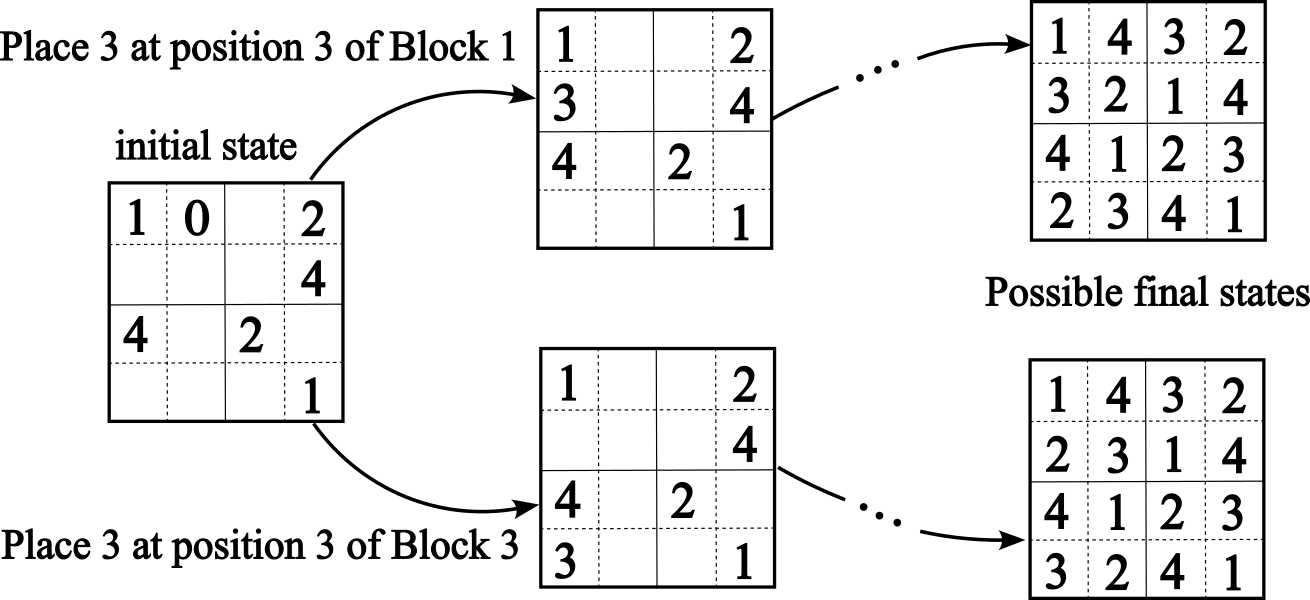
The diagram illustrates the possible state transitions of a 2x2 grid puzzle with numbered tiles (1, 2, 3, 4) and an empty space (0). It shows two possible moves from an initial state and their resulting configurations.
### Components/Axes
- **Initial State**: A 2x2 grid with the following configuration:
```
1 0
4 2
```
(Note: The fourth cell is empty, represented by "0".)
- **Move 1**: "Place 3 at position 3 of Block 1" (top-left 2x2 quadrant).
- **Move 2**: "Place 3 at position 3 of Block 3" (bottom-right 2x2 quadrant).
- **Possible Final States**: Two sets of 2x2 grids resulting from the moves, each with 4 permutations of numbers 1, 2, 3, 4.
### Detailed Analysis
#### Initial State Grid
```
1 0
4 2
```
- **Key Details**: The empty space (0) is at position (1,2) in a 2x2 grid (row-major order).
#### Move 1: Place 3 at Position 3 of Block 1
- **Action**: Insert "3" into the third position of the top-left 2x2 block (positions 1, 2, 3, 4 in row-major order).
- **Resulting Grids**:
1.
```
1 4
3 2
```
2.
```
3 4
1 2
```
3.
```
1 3
4 2
```
4.
```
4 3
1 2
```
#### Move 2: Place 3 at Position 3 of Block 3
- **Action**: Insert "3" into the third position of the bottom-right 2x2 block (positions 3, 4, 7, 8 in row-major order).
- **Resulting Grids**:
1.
```
1 2
4 3
```
2.
```
4 2
1 3
```
3.
```
1 3
4 2
```
4.
```
4 1
3 2
```
### Key Observations
1. **Permutation Variability**: Each move generates 4 distinct permutations of the numbers 1, 2, 3, 4, with no repeated configurations.
2. **Symmetry**: The final states from both moves overlap partially (e.g., "1 3 / 4 2" appears in both Move 1 and Move 2).
3. **Empty Space Propagation**: The initial empty space (0) is replaced by "3" in both moves, but the placement of "3" affects adjacent tiles differently depending on the block targeted.
### Interpretation
The diagram demonstrates how localized changes (placing "3" in specific blocks) propagate through the puzzle, altering the global configuration. The overlapping final states suggest that certain permutations are reachable via multiple paths, while others are unique to a specific move. This could model scenarios in combinatorial optimization, game theory, or state-space exploration, where discrete actions lead to branching outcomes. The absence of repeated states in the final configurations implies deterministic transitions, though the diagram does not explicitly confirm whether all permutations are achievable through these two moves alone.