## Vector Diagram: Relationship Between Velocity Components and Vertical Acceleration
### Overview
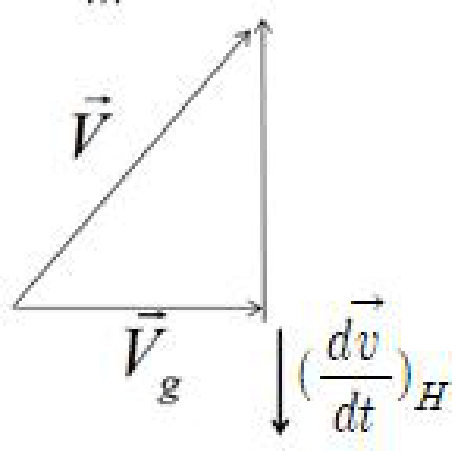
The image depicts a right triangle representing vector relationships in a physical system. The triangle's sides correspond to velocity vectors and a vertical acceleration term. Key elements include labeled vectors and a derivative expression.
### Components/Axes
- **Vectors**:
- **V**: Hypotenuse of the triangle, labeled with an arrow indicating direction.
- **Vg**: Horizontal base of the triangle, labeled with an arrow.
- **(dv/dt)_H**: Vertical component of acceleration, labeled with an arrow pointing downward, positioned adjacent to the triangle.
- **Orientation**:
- The triangle is oriented with **Vg** along the horizontal axis (base) and the vertical side representing **(dv/dt)_H**.
- **V** spans diagonally from the origin to the apex of the triangle.
### Detailed Analysis
- **Vector Relationships**:
- **V** is the resultant vector, combining **Vg** (horizontal velocity) and the vertical acceleration term **(dv/dt)_H**.
- The vertical side of the triangle explicitly represents the time derivative of velocity **(dv/dt)_H**, suggesting a focus on vertical acceleration.
- **Notation**:
- All vectors are denoted with boldface and arrows, indicating directionality.
- The derivative term **(dv/dt)_H** is written vertically, emphasizing its role as a vertical component.
### Key Observations
- The diagram emphasizes the decomposition of **V** into horizontal (**Vg**) and vertical acceleration components.
- The vertical acceleration term **(dv/dt)_H** is isolated, suggesting its significance in the system's dynamics.
- No numerical values or scales are provided, limiting quantitative analysis.
### Interpretation
This diagram illustrates the vector decomposition of velocity (**V**) into horizontal motion (**Vg**) and vertical acceleration **(dv/dt)_H**. The vertical acceleration term implies a gravitational or external force acting perpendicular to **Vg**, consistent with projectile motion or free-fall scenarios. The absence of numerical data prevents precise calculations but highlights the directional relationship between velocity components and acceleration. The use of **(dv/dt)_H** instead of standard gravitational acceleration (**g**) may indicate a context-specific acceleration (e.g., non-uniform gravity or a constrained system). The diagram serves as a foundational representation for analyzing motion in two dimensions.