## Text Analysis: Case Study on Critical Tokens
### Overview
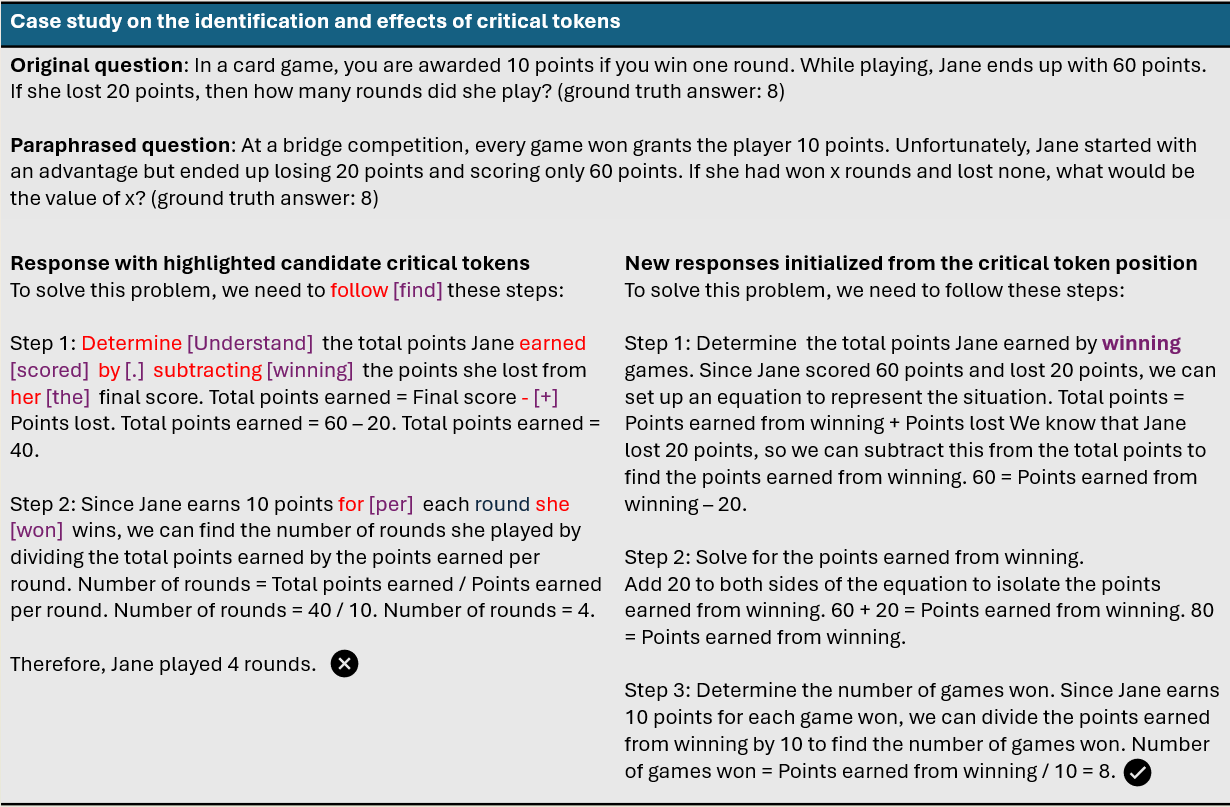
The image presents a case study focused on identifying and utilizing critical tokens in problem-solving. It includes an original question, a paraphrased question, and two different approaches to solving the problem. One approach highlights candidate critical tokens, while the other initializes responses from the critical token position.
### Components/Axes
The image is structured into the following sections:
1. **Title:** "Case study on the identification and effects of critical tokens"
2. **Original Question:** A word problem about Jane playing a card game.
3. **Paraphrased Question:** A similar word problem set in a bridge competition context.
4. **Response with highlighted candidate critical tokens:** A step-by-step solution to the problem, with certain words highlighted.
5. **New responses initialized from the critical token position:** An alternative step-by-step solution.
### Detailed Analysis or ### Content Details
**Original Question:**
* Problem: "In a card game, you are awarded 10 points if you win one round. While playing, Jane ends up with 60 points. If she lost 20 points, then how many rounds did she play?"
* Ground truth answer: 8
**Paraphrased Question:**
* Problem: "At a bridge competition, every game won grants the player 10 points. Unfortunately, Jane started with an advantage but ended up losing 20 points and scoring only 60 points. If she had won x rounds and lost none, what would be the value of x?"
* Ground truth answer: 8
**Response with highlighted candidate critical tokens:**
* Step 1: Determine [Understand] the total points Jane earned [scored] by [.] subtracting [winning] the points she lost from her [the] final score.
* Total points earned = Final score - [+] Points lost.
* Total points earned = 60 - 20.
* Total points earned = 40.
* Step 2: Since Jane earns 10 points for [per] each round she [won] wins, we can find the number of rounds she played by dividing the total points earned by the points earned per round.
* Number of rounds = Total points earned / Points earned per round.
* Number of rounds = 40 / 10.
* Number of rounds = 4.
* Conclusion: Therefore, Jane played 4 rounds. (Incorrect, marked with an "X")
**New responses initialized from the critical token position:**
* Step 1: Determine the total points Jane earned by winning games. Since Jane scored 60 points and lost 20 points, we can set up an equation to represent the situation.
* Total points = Points earned from winning + Points lost
* We know that Jane lost 20 points, so we can subtract this from the total points to find the points earned from winning.
* 60 = Points earned from winning - 20.
* Step 2: Solve for the points earned from winning.
* Add 20 to both sides of the equation to isolate the points earned from winning.
* 60 + 20 = Points earned from winning.
* 80 = Points earned from winning.
* Step 3: Determine the number of games won. Since Jane earns 10 points for each game won, we can divide the points earned from winning by 10 to find the number of games won.
* Number of games won = Points earned from winning / 10 = 8.
* (Correct, marked with a checkmark)
### Key Observations
* The "Response with highlighted candidate critical tokens" arrives at an incorrect answer (4 rounds) because it misinterprets the problem's initial conditions. It fails to account for the points lost.
* The "New responses initialized from the critical token position" correctly solves the problem by considering the points lost and working backward to find the points earned from winning.
* The highlighted words in the first solution are intended to represent "critical tokens," but their selection does not guarantee a correct solution.
### Interpretation
The case study illustrates the importance of correctly identifying and interpreting critical tokens in problem-solving. Highlighting keywords alone is insufficient; a deeper understanding of the problem's context and relationships between variables is necessary. The incorrect solution demonstrates how a superficial analysis of tokens can lead to flawed reasoning. The correct solution emphasizes a more holistic approach, starting from the final score and working backward to account for all relevant factors. The example highlights the potential pitfalls of relying solely on keyword identification without a thorough understanding of the underlying problem.