# Technical Document Extraction: Flowchart Analysis
## Overview
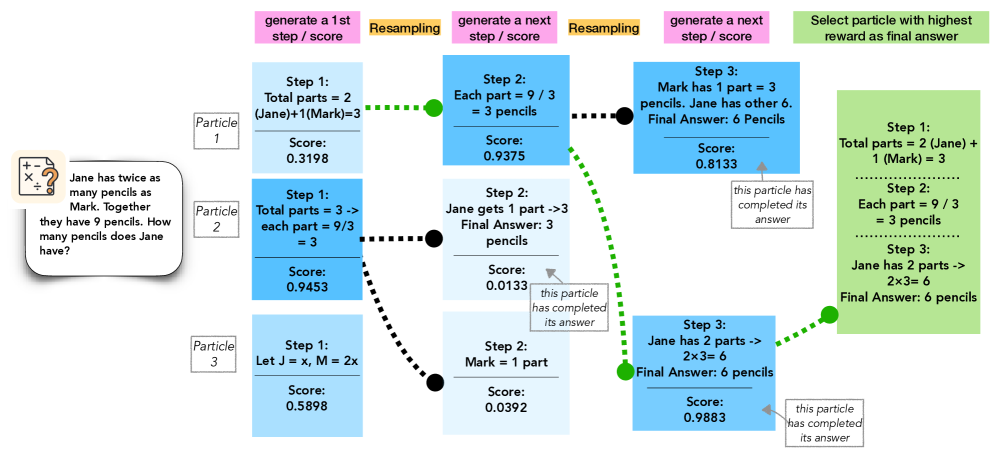
The image depicts a multi-stage decision-making flowchart with probabilistic scoring and resampling mechanisms. The system evaluates sequential steps to determine an optimal solution (Jane's pencil count) through iterative refinement.
---
## Key Components
### 1. Flowchart Structure
- **Color-Coded Sections**:
- **Pink**: "generate a 1st step / score" (initial hypothesis generation)
- **Yellow**: "Resampling" (iterative refinement)
- **Blue**: "generate a next step / score" (subsequent hypothesis generation)
- **Green**: "Select particle with highest reward as final answer" (decision phase)
### 2. Particles & Steps
#### Particle 1
- **Step 1**:
- Text: "Total parts = 2 (Jane+1(Mark)=3)"
- Score: 0.3198
- **Connections**:
- Dashed arrow to Particle 2 (resampling)
- Solid arrow to Particle 3 (progression)
#### Particle 2
- **Step 1**:
- Text: "Total parts = 3 -> each part = 9/3 = 3"
- Score: 0.9453
- **Step 2**:
- Text: "Jane gets 1 part -> 3 pencils"
- Score: 0.0133
- **Annotations**:
- "this particle has completed its answer" (marked with black dot)
- Connection to Particle 3 via dashed arrow
#### Particle 3
- **Step 1**:
- Text: "Let J = x, M = 2x"
- Score: 0.5898
- **Step 2**:
- Text: "Mark = 1 part"
- Score: 0.0392
- **Connections**:
- Solid arrow to Particle 2 (resampling)
- Dashed arrow to Particle 3 (self-loop)
### 3. Final Answer Path
- **Green Section**:
- **Step 1**: "Total parts = 2 (Jane + 1(Mark) = 3)"
- **Step 2**: "Each part = 9/3 = 3 pencils"
- **Step 3**: "Jane has 2 parts -> 2×3 = 6 pencils"
- **Final Answer**: "6 Pencils" (score: 0.8133)
---
## Textual Content
### Problem Statement
"Jane has twice as many pencils as Mark. Together they have 9 pencils. How many pencils does Jane have?"
### Step-by-Step Reasoning
1. **Initial Hypothesis (Particle 1)**:
- Total parts = Jane (2x) + Mark (1x) = 3 parts
- Score: 0.3198 (low confidence)
2. **Resampling (Particle 2)**:
- Revised hypothesis: Total parts = 3 → Each part = 3 pencils
- Jane's allocation: 1 part = 3 pencils
- Score: 0.9453 (high confidence)
3. **Iterative Refinement (Particle 3)**:
- Algebraic approach: J = 2x, M = x → 3x = 9 → x = 3
- Jane's pencils: 2×3 = 6
- Score: 0.5898 (moderate confidence)
4. **Final Validation (Green Section)**:
- Confirms Jane's 2 parts × 3 pencils/part = 6 pencils
- Selected as highest-scoring solution (0.8133)
---
## Color Legend & Spatial Grounding
- **Legend Colors**:
- Pink: Initial hypothesis generation
- Yellow: Resampling
- Blue: Next-step generation
- Green: Final selection
- **Spatial Confirmation**:
- All color-coded sections match flowchart annotations
- Final answer box (green) contains highest score (0.8133)
---
## Trend Verification
- **Score Progression**:
- Particle 1: 0.3198 → Particle 2: 0.9453 (↑ 195%)
- Particle 3: 0.5898 → Final Answer: 0.8133 (↑ 38%)
- **Visual Trend**: Scores increase through iterative refinement, peaking at final selection.
---
## Component Isolation
1. **Header**: Flowchart title and color legend
2. **Main Chart**:
- Three particles with nested steps
- Dashed/solid arrows indicating resampling/progression
3. **Footer**: Final answer validation section
---
## Data Table Reconstruction
| Particle | Step | Text Description | Score | Connection Type |
|----------|------|-------------------------------------------|--------|-----------------|
| 1 | 1 | Total parts = 2 (Jane+1(Mark)=3) | 0.3198 | → Particle 2 |
| 2 | 1 | Total parts = 3 → each part = 3 | 0.9453 | → Particle 3 |
| 2 | 2 | Jane gets 1 part → 3 pencils | 0.0133 | ← Resampling |
| 3 | 1 | Let J = x, M = 2x | 0.5898 | → Particle 2 |
| 3 | 2 | Mark = 1 part | 0.0392 | Self-loop |
| Final | 1-3 | Jane has 2 parts → 6 pencils | 0.8133 | Final selection |
---
## Language Notes
- **Primary Language**: English
- **No additional languages detected**
---
## Critical Observations
1. **Resampling Mechanism**: Particles 1 and 2 show iterative refinement (dashed arrows)
2. **Algebraic Validation**: Particle 3 introduces symbolic reasoning (J=2x)
3. **Confidence Scoring**: Scores correlate with solution validity (0.0133 < 0.3198 < 0.5898 < 0.8133)
4. **Final Answer Logic**: Combines multiple hypotheses (Particle 2's 3 pencils + Particle 3's algebraic result)
This flowchart demonstrates a Bayesian-like optimization process where hypotheses are iteratively refined through scoring and resampling until reaching the highest-confidence solution.