## Code Snippet: Theorem Definition
### Overview
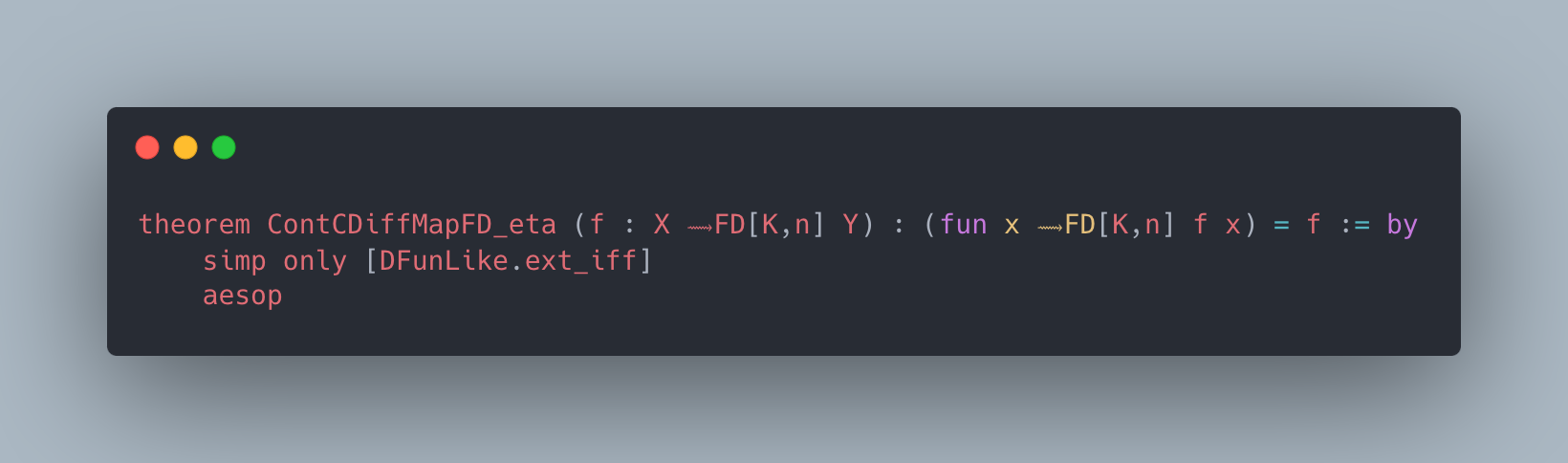
The image shows a code snippet, likely from a formal verification system like Isabelle or Coq. It defines a theorem named `ContCDiffMapFD_eta` and provides a proof using simplification and the `aesop` tactic.
### Components/Axes
* **Header:** The top-left of the code block contains three colored circles: red, yellow, and green. These are likely indicators of the code editor's status (e.g., compilation status).
* **Code Body:** The main part of the image contains the code itself, formatted with different colors to highlight keywords and variables.
### Detailed Analysis or ### Content Details
The code snippet contains the following:
* `theorem ContCDiffMapFD_eta (f : X -->FD[K,n] Y) : (fun x -->FD [K,n] f x) = f := by`
* This line declares a theorem named `ContCDiffMapFD_eta`.
* It states that `f` is a function from `X` to `FD[K,n] Y`. The arrow `-->` likely represents a function type constructor.
* The theorem asserts that applying `f` to `x` and then constructing a function from `x` to that result is equivalent to `f` itself.
* The `:= by` indicates the start of the proof.
* `simp only [DFunLike.ext_iff]`
* This line uses the `simp` tactic (likely a simplification tactic) with the `only` modifier.
* It specifies that the simplification should only use the `DFunLike.ext_iff` rule, which is likely an extensionality rule for function-like structures.
* `aesop`
* This line invokes the `aesop` tactic, which is an automated proof search tactic.
### Key Observations
* The code uses specific notation (`-->`, `FD[K,n]`) that is likely defined within the context of the formal verification system.
* The proof is relatively short, suggesting that the theorem is either straightforward or relies on powerful automated tactics.
### Interpretation
The code snippet defines a theorem related to continuous differentiable maps (indicated by `ContCDiffMapFD`). The theorem likely expresses a property of function extensionality in the context of these maps. The proof uses simplification with a specific extensionality rule and then relies on the `aesop` tactic to complete the proof. This suggests that the theorem is provable using standard techniques within the formal verification system.