\n
## Diagram: AI Model Performance Comparison
### Overview
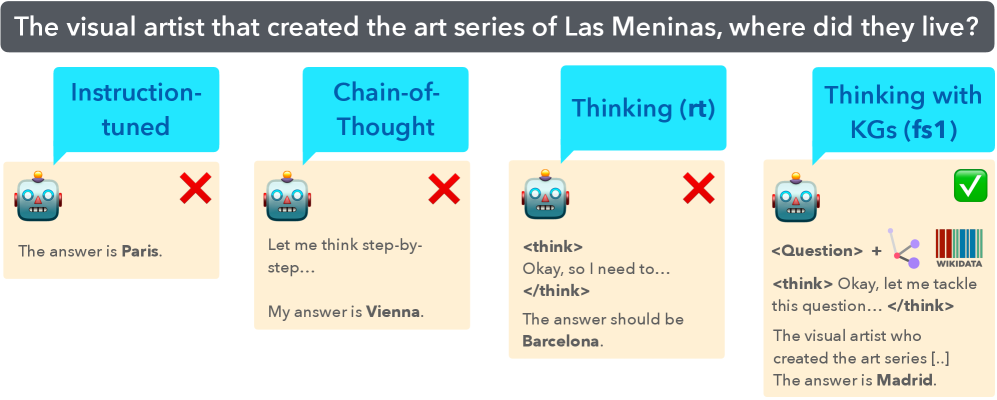
This diagram compares the performance of four different AI models (Instruction-tuned, Chain-of-Thought, Thinking (rt), and Thinking with KGs (fs1)) in answering the question: "The visual artist that created the art series of Las Meninas, where did they live?". Each model's attempt at an answer is presented within a rounded rectangle, along with a visual indicator (red 'X' or green checkmark) of whether the answer is correct.
### Components/Axes
The diagram consists of four main sections, each representing a different AI model. Each section includes:
* **Model Name:** (Instruction-tuned, Chain-of-Thought, Thinking (rt), Thinking with KGs (fs1)) – displayed in a light blue banner at the top of each section.
* **Robot Icon:** A small robot icon is present in each section, likely representing the AI model.
* **Performance Indicator:** A red 'X' indicates an incorrect answer, while a green checkmark indicates a correct answer.
* **Model Output:** The text generated by the model as its answer to the question.
* **Wikidata Logo:** A Wikidata logo is present in the "Thinking with KGs (fs1)" section.
The overall diagram is framed by a light green banner at the top containing the question: "The visual artist that created the art series of Las Meninas, where did they live?".
### Detailed Analysis or Content Details
Here's a breakdown of each model's performance:
1. **Instruction-tuned:**
* Answer: "The answer is Paris."
* Performance: Incorrect (Red 'X')
2. **Chain-of-Thought:**
* Answer: "Let me think step-by-step…\nMy answer is Vienna."
* Performance: Incorrect (Red 'X')
3. **Thinking (rt):**
* Answer: `\nThe answer should be Barcelona."`
* Performance: Incorrect (Red 'X')
4. **Thinking with KGs (fs1):**
* Answer: `<question> + <Wikidata Logo>\n\nThe visual artist who created the art series […] The answer is Madrid."`
* Performance: Correct (Green Checkmark)
### Key Observations
* Three out of the four models (Instruction-tuned, Chain-of-Thought, and Thinking (rt)) provided incorrect answers.
* The "Thinking with KGs (fs1)" model was the only one to provide the correct answer (Madrid).
* The "Thinking with KGs (fs1)" model utilizes external knowledge from Wikidata, as indicated by the logo.
* The "Thinking (rt)" model uses `` tags to denote its thought process.
* The "Chain-of-Thought" model explicitly states its reasoning process ("Let me think step-by-step…").
### Interpretation
This diagram demonstrates the effectiveness of incorporating Knowledge Graphs (KGs) into AI models for question answering. The "Thinking with KGs (fs1)" model, leveraging Wikidata, was able to correctly identify the birthplace of the artist who created "Las Meninas," while the other models failed. This suggests that access to external knowledge significantly improves the accuracy of AI responses, particularly for questions requiring factual information. The other models, relying solely on their internal training data, were prone to errors. The use of tags like `<think>` suggests an attempt to model a reasoning process, but this alone isn't sufficient for accurate results. The diagram highlights the importance of grounding AI models in reliable knowledge sources.