## Flowchart: Comparison of AI Reasoning Methods for Art History Question
### Overview
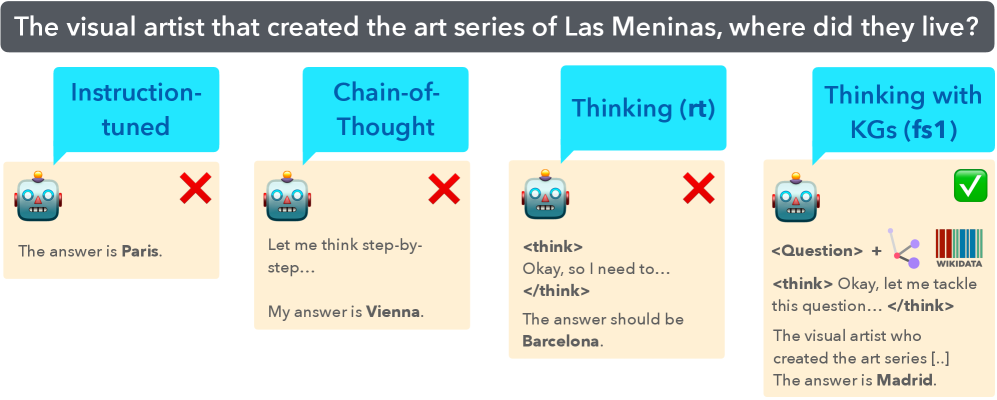
The image presents a comparative analysis of four AI reasoning approaches to answer the question: "The visual artist that created the art series of Las Meninas, where did they live?" Each method is represented by a robot icon with a speech bubble containing its response, followed by a red X (incorrect) or green checkmark (correct). The correct answer is Madrid, as indicated by the final section.
### Components/Axes
1. **Methods Tested**:
- Instruction-tuned
- Chain-of-Thought
- Thinking (rt)
- Thinking with KGs (fs1)
2. **Result Indicators**:
- Red X: Incorrect answer
- Green checkmark: Correct answer
3. **Textual Content**:
- Speech bubbles contain reasoning processes or final answers
- Wikidata logo appears in the final method, indicating external knowledge integration
### Detailed Analysis
1. **Instruction-tuned**:
- Response: "The answer is Paris."
- Result: ❌ Incorrect
2. **Chain-of-Thought**:
- Response: "Let me think step-by-step... My answer is Vienna."
- Result: ❌ Incorrect
3. **Thinking (rt)**:
- Response:
```
The answer should be Barcelona.
```
- Result: ❌ Incorrect
4. **Thinking with KGs (fs1)**:
- Response:
```
<Question> + Wikidata
The visual artist who created the art series [...] The answer is Madrid.
```
- Result: ✅ Correct
### Key Observations
- **Accuracy Correlation**: Only the KGs-integrated method (fs1) provides the correct answer (Madrid), while others fail despite varying reasoning approaches.
- **Knowledge Dependency**: The final method explicitly references Wikidata, suggesting external knowledge integration is critical for accuracy.
- **Reasoning Flaws**: Non-KG methods exhibit either:
- Direct incorrect answers (Instruction-tuned, Chain-of-Thought)
- Incomplete reasoning loops (Thinking (rt))
### Interpretation
This diagram demonstrates the limitations of pure instruction tuning and chain-of-thought reasoning in knowledge-intensive tasks. The KGs-augmented approach (fs1) achieves accuracy by:
1. Structuring queries for knowledge retrieval (`<Question> + Wikidata`)
2. Maintaining reasoning context (`