# Technical Document Extraction: Kapoho Point Board and Loihi 2 Architecture
## 1. Kapoho Point Board Overview

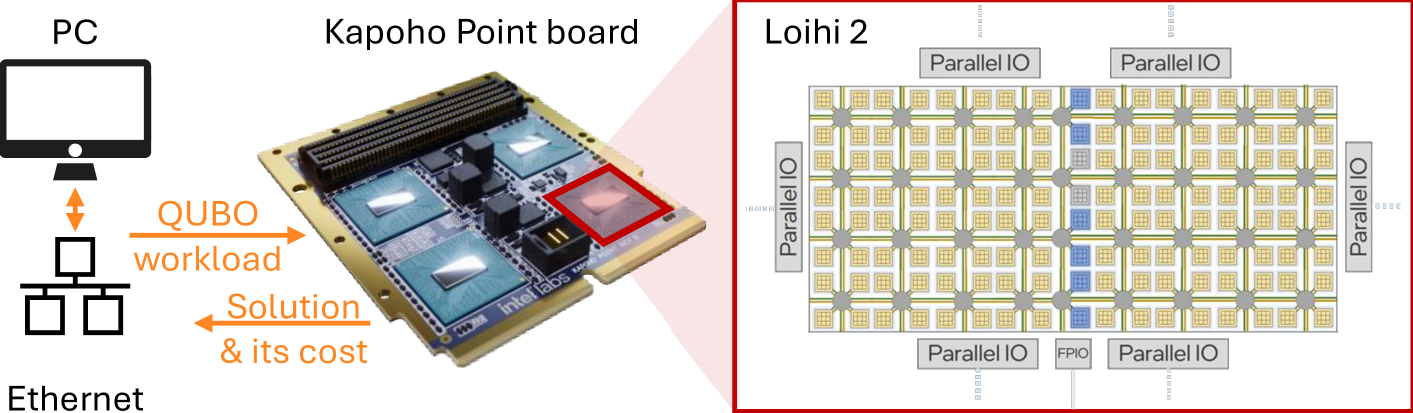
*Diagram showing hardware architecture and workflow*
### Key Components:
- **PC**: Connected via Ethernet to the Kapoho Point board
- **Ethernet**: Communication link between PC and board
- **QUBO Workload**: Input/output flow indicated by orange bidirectional arrow
- **Solution & Cost**: Output flow from board to PC
- **Intel Loihi 2 Chips**: Four visible on the board (highlighted by red box)
## 2. Loihi 2 Core Architecture

*Detailed chip architecture visualization*
### Core Layout:
- **Grid Structure**: 8x8 array of cores (64 total)
- **Parallel IO**: Label on all four sides of the chip
- **FPGA**: Central processing unit (labeled "FPGA" in diagram)
- **Core States**:
- **Active Cores**: Blue squares (exact count unspecified)
- **Inactive Cores**: Gray squares (exact count unspecified)
### Spatial Relationships:
- **Core Coordinates**:
- X-axis: Left to Right (8 columns)
- Y-axis: Top to Bottom (8 rows)
- **FPGA Position**: Center of the 8x8 grid
## 3. Workflow Diagram Analysis
### Data Flow:
1. **Input**: QUBO workload from PC → Ethernet → Kapoho Point board
2. **Processing**:
- Distributed across Intel Loihi 2 chips
- FPGA coordinates core operations
3. **Output**: Solution and cost metrics returned to PC
## 4. Color Coding Legend
*Note: Legend colors not visually distinguishable in provided image. Labels used for identification:*
- **Blue**: Active cores (Parallel IO)
- **Gray**: Inactive cores (Parallel IO)
- **Red Box**: Highlighted Loihi 2 chip in Kapoho Point board
## 5. Technical Specifications
| Component | Description |
|--------------------|--------------------------------------|
| Kapoho Point Board | Hardware interface for Loihi 2 chips |
| Loihi 2 Chip | 64-core neuromorphic processor |
| Ethernet | Communication protocol |
| QUBO | Quadratic Unconstrained Binary Optimization problem type |
## 6. Architectural Notes
- **Modular Design**: Four Loihi 2 chips enable distributed computing
- **IO Optimization**: Parallel IO on all four sides suggests multi-directional data flow
- **FPGA Integration**: Centralized control for core coordination
*Note: No numerical data or quantitative metrics present in the diagrams. All information extracted from visual labels and spatial relationships.*