## Word Cloud: Sanskrit Philosophical Terms
### Overview
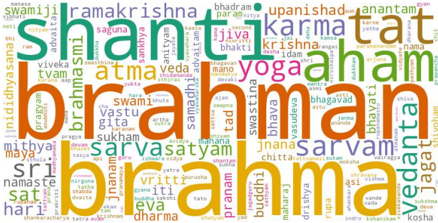
This image is a word cloud visualization composed of numerous Sanskrit words and terms, primarily related to Hindu philosophy, spirituality, and metaphysics. The words are displayed in varying sizes, orientations (horizontal and vertical), and colors (green, orange, yellow, and brown) against a white background. The size of each word likely corresponds to its frequency, importance, or thematic weight within a source text or conceptual framework.
### Components/Axes
* **Type:** Word Cloud (Text Visualization)
* **Primary Language:** Sanskrit (Devanagari script transliterated into Latin characters).
* **Color Palette:** Words are rendered in four distinct colors: a medium green, a burnt orange, a golden yellow, and a dark brown.
* **Layout:** Words are densely packed, overlapping, and oriented both horizontally and vertically to fill the rectangular space. There are no traditional axes, legends, or numerical scales.
### Detailed Analysis / Content Details
The following is a comprehensive list of the distinct terms visible in the word cloud, grouped by approximate visual prominence (size). The spatial location is described relative to the image frame.
**Largest & Most Prominent Terms (Central and Dominant):**
* **brahman** (Orange, Horizontal): Appears twice in very large font. Once centrally, and once slightly lower and to the left. This is the most visually dominant term.
* **aham** (Green, Horizontal): Large, located in the upper-right quadrant.
* **tat** (Orange, Horizontal): Large, positioned in the upper-right, adjacent to "aham".
* **shanti** (Green, Horizontal): Large, located in the upper-left quadrant.
* **karma** (Brown, Horizontal): Large, positioned in the upper-center area.
* **yoga** (Yellow, Horizontal): Large, located in the center-right area.
* **sarvam** (Orange, Horizontal): Large, positioned in the lower-right quadrant.
* **sarvasatyam** (Orange, Horizontal): Large, located in the lower-center area.
**Medium-Sized Terms:**
* **atma** (Green, Horizontal): Upper-center.
* **veda** (Yellow, Horizontal): Upper-center, below "atma".
* **jiva** (Green, Horizontal): Upper-center, near "karma".
* **krishna** (Brown, Horizontal): Upper-right.
* **gita** (Yellow, Horizontal): Center-left.
* **Vidya** (Yellow, Horizontal): Center-left, near "gita".
* **sukham** (Orange, Horizontal): Center-left.
* **jnana** (Yellow, Horizontal): Center-right.
* **bhava** (Brown, Horizontal): Center-right.
* **dharma** (Yellow, Horizontal): Lower-center.
* **prana** (Yellow, Horizontal): Lower-center, near "dharma".
* **buddhi** (Yellow, Horizontal): Lower-center.
* **vedanta** (Brown, Vertical): Right edge, running vertically.
* **sri** (Orange, Horizontal): Lower-left.
* **namaste** (Orange, Horizontal): Lower-left.
* **hari** (Orange, Horizontal): Lower-left corner.
* **sati** (Orange, Horizontal): Lower-left.
* **ramakrishna** (Brown, Horizontal): Top edge, center.
* **swamiji** (Brown, Horizontal): Top edge, left.
* **upanishad** (Brown, Horizontal): Top edge, right.
* **anantan** (Brown, Horizontal): Top edge, far right.
* **bhadran** (Brown, Horizontal): Top edge, near "upanishad".
**Smaller & Peripheral Terms (Partial list, as many are small or partially obscured):**
* **Vritti** (Yellow, Horizontal): Center-left.
* **maya** (Yellow, Horizontal): Center-left.
* **Vedas** (Yellow, Horizontal): Center-left.
* **tvam** (Green, Horizontal): Upper-left.
* **asi** (Green, Horizontal): Upper-left.
* **tat** (Green, Horizontal): Upper-left (smaller instance).
* **Vedantic** (Brown, Horizontal): Upper-right.
* **bhagavat** (Brown, Horizontal): Upper-right.
* **chitta** (Brown, Horizontal): Center-right.
* **saguna** (Brown, Horizontal): Center-right.
* **nirguna** (Brown, Horizontal): Center-right.
* **drashta** (Brown, Horizontal): Lower-right.
* **kosha** (Brown, Horizontal): Lower-right.
* **jagat** (Brown, Horizontal): Lower-right edge.
* **Vijnana** (Yellow, Horizontal): Lower-center.
* **ananda** (Yellow, Horizontal): Lower-center.
* **sat** (Orange, Horizontal): Lower-left.
* **chit** (Orange, Horizontal): Lower-left.
* **ananda** (Orange, Horizontal): Lower-left.
* **om** (Orange, Horizontal): Lower-left.
* **bhakti** (Orange, Horizontal): Lower-left.
* **seva** (Orange, Horizontal): Lower-left.
* **prema** (Orange, Horizontal): Lower-left.
* **moksha** (Orange, Horizontal): Lower-left.
* **samsara** (Orange, Horizontal): Lower-left.
* **avidya** (Orange, Horizontal): Lower-left.
* **jnana** (Orange, Horizontal): Lower-left (smaller instance).
* **karma** (Orange, Horizontal): Lower-left (smaller instance).
* **yoga** (Orange, Horizontal): Lower-left (smaller instance).
* **dhyana** (Orange, Horizontal): Lower-left.
* **pranayama** (Orange, Horizontal): Lower-left.
* **asana** (Orange, Horizontal): Lower-left.
* **niyama** (Orange, Horizontal): Lower-left.
* **yama** (Orange, Horizontal): Lower-left.
* **tapas** (Orange, Horizontal): Lower-left.
* **svadhyaya** (Orange, Horizontal): Lower-left.
* **ishvara** (Orange, Horizontal): Lower-left.
* **pranidhana** (Orange, Horizontal): Lower-left.
### Key Observations
1. **Dominant Concept:** The term **"brahman"** (the ultimate, unchanging reality in Hinduism) is the most visually emphasized, appearing twice in the largest font size, anchoring the cloud's center and lower-left.
2. **Thematic Clustering:** Terms are loosely grouped by theme and color. Green words often relate to the self/identity (*aham, atma, jiva*). Orange words in the lower-left form a dense cluster of core spiritual concepts and practices (*sri, namaste, hari, dharma, karma, yoga, moksha*). Brown words are often found at the periphery (top, right edge) and include texts, teachers, and states (*upanishad, ramakrishna, vedanta, saguna, nirguna*).
3. **Philosophical Duality:** The cloud visually represents key dualities and non-dualities: *aham* (I) and *tat* (That) are placed together, referencing the Mahavakya "Tat Tvam Asi" (Thou art That). *Saguna* (with attributes) and *nirguna* (without attributes) appear near each other.
4. **Comprehensive Scope:** The word cloud encompasses a wide range of concepts: metaphysical absolutes (*brahman*), the individual self (*atma, jiva*), ethical principles (*dharma*), spiritual paths (*yoga, jnana, bhakti*), states of being (*sukham, ananda*), and practical disciplines (*pranayama, asana*).
### Interpretation
This word cloud serves as a conceptual map of key terms in the Hindu (particularly Vedantic) philosophical tradition. The visual hierarchy suggests a source or context where **Brahman** is the central, most frequently referenced concept. The prominence of **aham** and **tat** highlights the fundamental inquiry into the relationship between the individual self and the ultimate reality.
The dense clustering in the lower-left corner, filled with orange terms, represents the practical and devotional aspects of the tradition—the "how-to" of spiritual life (*yoga, dharma, bhakti*) and the goals (*moksha*). The placement of textual and teacher-related terms (*upanishad, ramakrishna, vedanta*) at the top and edges suggests they form the foundational or framing context for the core concepts.
The visualization effectively communicates the interconnectedness and richness of this philosophical system, where metaphysical truths, ethical living, and spiritual practice are interwoven. It is not a data chart but a thematic summary, useful for quickly grasping the vocabulary and relative emphasis of ideas within a specific body of spiritual literature or teaching.