## Word Cloud: Sanskrit Philosophical Terms
### Overview
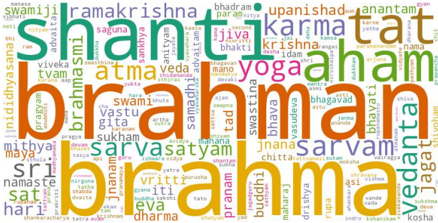
The image is a dense word cloud composed of Sanskrit terms related to Hindu philosophy, spirituality, and yoga. Words vary in size (proportional to frequency/importance) and color, arranged in a grid-like pattern. No explicit axes, legends, or numerical data are present.
### Components/Axes
- **Text Elements**:
- Words are the sole components, with no graphical axes or legends.
- Colors appear arbitrary but may imply categorical grouping (e.g., orange for core concepts like "Brahma," green for practices like "yoga").
- Font sizes correlate with prominence (e.g., "Brahma" is largest, "sati" is smallest).
### Detailed Analysis
- **Key Terms**:
- **Brahma** (orange, largest): Central position, repeated 4x.
- **Karma** (purple), **Yoga** (pink), **Vedanta** (green): Prominent mid-sized terms.
- **Atma** (orange), **Jnana** (yellow), **Sarvam** (blue): Smaller but repeated.
- **Sati** (green), **Hari** (blue): Smallest terms, positioned peripherally.
- **Color Distribution**:
- Orange dominates (core concepts: Brahma, Atma, Jnana).
- Green (practices: Yoga, Vedanta, Sati).
- Purple (abstract concepts: Karma, Dharma).
- Blue/Yellow (secondary terms: Sarvam, Jnana, Hari).
### Key Observations
1. **Hierarchy**: "Brahma" is the most emphasized term, repeated and centrally placed.
2. **Thematic Clusters**:
- Orange cluster: Ontological concepts (Brahma, Atma).
- Green cluster: Practices (Yoga, Vedanta).
- Purple cluster: Abstract principles (Karma, Dharma).
3. **Repetition**: "Brahma" and "Jnana" appear multiple times, suggesting thematic recurrence.
### Interpretation
The word cloud emphasizes **Hindu metaphysics**, with "Brahma" (the supreme creator god) as the focal point. Repeated terms like "Jnana" (knowledge) and "Karma" (action) suggest a focus on spiritual practice and cosmic order. The absence of a legend implies color-coding is intuitive (e.g., orange for foundational concepts). The peripheral placement of smaller terms like "Sati" (ritual suicide, now obsolete) and "Hari" (Vishnu's name) indicates lower thematic priority. This visualization likely serves as a thematic map for a text analyzing Hindu philosophy, prioritizing interconnected concepts over quantitative data.