\n
## Scatter Plot: Relationship between a<sub>j</sub> and (v<sub>i</sub><sup>-1</sup> ⋅ v<sub>i</sub><sup>-1</sup>) / l<sub>i</sub>
### Overview
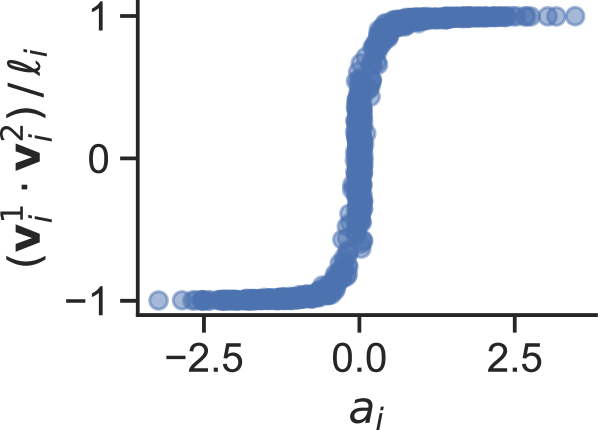
The image presents a scatter plot illustrating the relationship between two variables: a<sub>j</sub> on the x-axis and (v<sub>i</sub><sup>-1</sup> ⋅ v<sub>i</sub><sup>-1</sup>) / l<sub>i</sub> on the y-axis. The plot shows a distinct sigmoidal or "S" shaped curve, indicating a non-linear relationship between the two variables. The data points are clustered, forming a clear pattern.
### Components/Axes
* **X-axis Label:** a<sub>j</sub>
* Scale: Approximately ranges from -2.75 to 2.75.
* Markers: -2.5, 0.0, 2.5
* **Y-axis Label:** (v<sub>i</sub><sup>-1</sup> ⋅ v<sub>i</sub><sup>-1</sup>) / l<sub>i</sub>
* Scale: Approximately ranges from -1.2 to 1.2.
* Markers: -1, 0, 1
* **Data Points:** Blue circles, representing individual data observations.
* **Background:** White.
### Detailed Analysis
The data exhibits a clear transition between two distinct states.
* **Left Side (a<sub>j</sub> < 0):** For values of a<sub>j</sub> less than approximately 0, the value of (v<sub>i</sub><sup>-1</sup> ⋅ v<sub>i</sub><sup>-1</sup>) / l<sub>i</sub> remains relatively constant at approximately -1. There is some scatter, but the points cluster tightly around this value.
* **Transition Region (a<sub>j</sub> ≈ 0):** As a<sub>j</sub> approaches 0, there is a rapid increase in (v<sub>i</sub><sup>-1</sup> ⋅ v<sub>i</sub><sup>-1</sup>) / l<sub>i</sub>. This region is characterized by a high density of data points and a steep slope. The transition appears to occur over a range of approximately -0.5 to 0.5 for a<sub>j</sub>.
* **Right Side (a<sub>j</sub> > 0):** For values of a<sub>j</sub> greater than approximately 0, the value of (v<sub>i</sub><sup>-1</sup> ⋅ v<sub>i</sub><sup>-1</sup>) / l<sub>i</sub> plateaus at approximately 1. Similar to the left side, the points are clustered around this value, with some scatter.
There are no explicit data points listed, but the trend is clear.
### Key Observations
* The plot demonstrates a threshold effect. The value of (v<sub>i</sub><sup>-1</sup> ⋅ v<sub>i</sub><sup>-1</sup>) / l<sub>i</sub> remains near -1 until a<sub>j</sub> reaches a certain threshold (around 0), at which point it rapidly increases to approximately 1.
* The transition is not instantaneous but occurs over a small range of a<sub>j</sub> values.
* The data is relatively clean, with no obvious outliers.
### Interpretation
This plot likely represents a system exhibiting a switching behavior. The variable a<sub>j</sub> could be an input parameter or control variable, and (v<sub>i</sub><sup>-1</sup> ⋅ v<sub>i</sub><sup>-1</sup>) / l<sub>i</sub> could be an output or response variable. The sigmoidal shape suggests that the system transitions between two states based on the value of a<sub>j</sub>.
The variables themselves are not immediately interpretable without further context. However, the form of the equation (v<sub>i</sub><sup>-1</sup> ⋅ v<sub>i</sub><sup>-1</sup>) / l<sub>i</sub> suggests that v<sub>i</sub> represents a velocity or rate, and l<sub>i</sub> represents a length or distance. The inverse squared velocity divided by length could represent a form of energy or power.
The plot could be modeling a physical system, a biological process, or a computational model. The threshold behavior suggests a form of activation or triggering mechanism. The steepness of the transition indicates a sensitive response to changes in a<sub>j</sub> near the threshold.