## Chart/Diagram Type: Model Comparison
### Overview
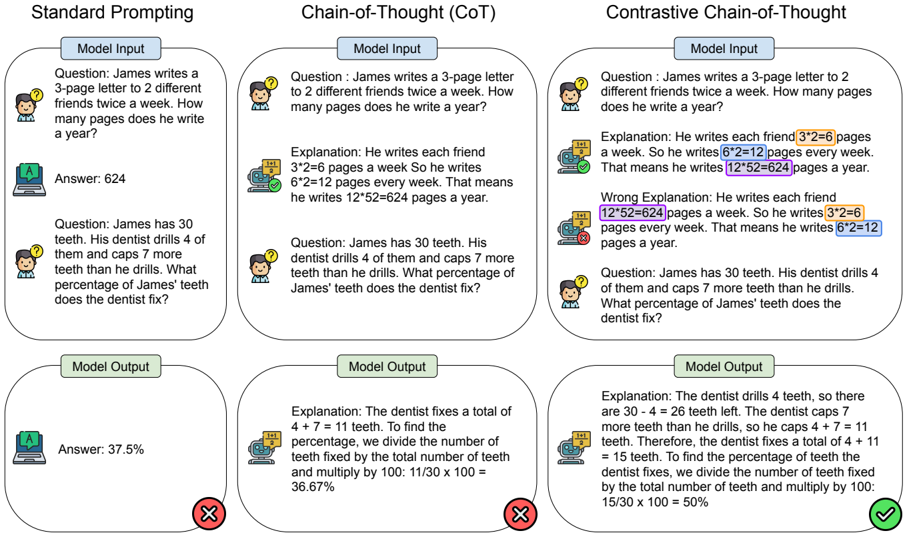
The image presents a comparison of three different prompting methods for a language model: Standard Prompting, Chain-of-Thought (CoT), and Contrastive Chain-of-Thought. Each method is evaluated on two questions. The image shows the model input, the model's reasoning (if any), and the model output, indicating whether the answer is correct or incorrect.
### Components/Axes
* **Titles:**
* Standard Prompting (top-left)
* Chain-of-Thought (CoT) (top-center)
* Contrastive Chain-of-Thought (top-right)
* **Sections (for each method):**
* Model Input (top)
* Model Output (bottom)
* **Elements within each section:**
* Question (text)
* Answer/Explanation (text)
* Correctness indicator (green checkmark or red X)
### Detailed Analysis or ### Content Details
**1. Standard Prompting:**
* **Question 1:** "James writes a 3-page letter to 2 different friends twice a week. How many pages does he write a year?"
* Answer: 624
* Correctness: Correct (implied, no explicit indicator)
* **Question 2:** "James has 30 teeth. His dentist drills 4 of them and caps 7 more teeth than he drills. What percentage of James' teeth does the dentist fix?"
* Answer: 37.5%
* Correctness: Incorrect (Red X)
**2. Chain-of-Thought (CoT):**
* **Question 1:** "James writes a 3-page letter to 2 different friends twice a week. How many pages does he write a year?"
* Explanation: "He writes each friend 3\*2=6 pages a week So he writes 6\*2=12 pages every week. That means he writes 12\*52=624 pages a year."
* Correctness: Correct (Green Checkmark)
* **Question 2:** "James has 30 teeth. His dentist drills 4 of them and caps 7 more teeth than he drills. What percentage of James' teeth does the dentist fix?"
* Explanation: "The dentist fixes a total of 4+7 = 11 teeth. To find the percentage, we divide the number of teeth fixed by the total number of teeth and multiply by 100: 11/30 x 100 = 36.67%"
* Correctness: Incorrect (Red X)
**3. Contrastive Chain-of-Thought:**
* **Question 1:** "James writes a 3-page letter to 2 different friends twice a week. How many pages does he write a year?"
* Explanation: "He writes each friend 3\*2=6 pages a week. So he writes 6\*2=12 pages every week. That means he writes 12\*52=624 pages a year."
* Wrong Explanation: "He writes each friend 12\*52=624 pages a week. So he writes 3\*2=6 pages every week. That means he writes 6\*2=12 pages a year."
* Correctness: Correct (Green Checkmark)
* **Question 2:** "James has 30 teeth. His dentist drills 4 of them and caps 7 more teeth than he drills. What percentage of James' teeth does the dentist fix?"
* Explanation: "The dentist drills 4 teeth, so there are 30 - 4 = 26 teeth left. The dentist caps 7 more teeth than he drills, so he caps 4 + 7 = 11 teeth. Therefore, the dentist fixes a total of 4 + 11 = 15 teeth. To find the percentage of teeth the dentist fixes, we divide the number of teeth fixed by the total number of teeth and multiply by 100: 15/30 x 100 = 50%"
* Correctness: Correct (Green Checkmark)
### Key Observations
* Chain-of-Thought prompting helps the model to correctly answer the first question, while standard prompting fails.
* Contrastive Chain-of-Thought is the only method that correctly answers the second question.
* The "wrong explanation" in Contrastive Chain-of-Thought highlights the model's ability to consider alternative, incorrect reasoning paths.
### Interpretation
The image demonstrates the effectiveness of Chain-of-Thought and Contrastive Chain-of-Thought prompting in improving the reasoning capabilities of language models. By providing intermediate steps and considering alternative explanations, these methods can lead to more accurate and reliable answers, especially for complex problems. The contrastive approach seems particularly effective in avoiding errors in the second question, suggesting that explicitly considering incorrect reasoning paths can help the model arrive at the correct solution.