\n
## Diagram: Visual Representation of Reasoning Steps
### Overview
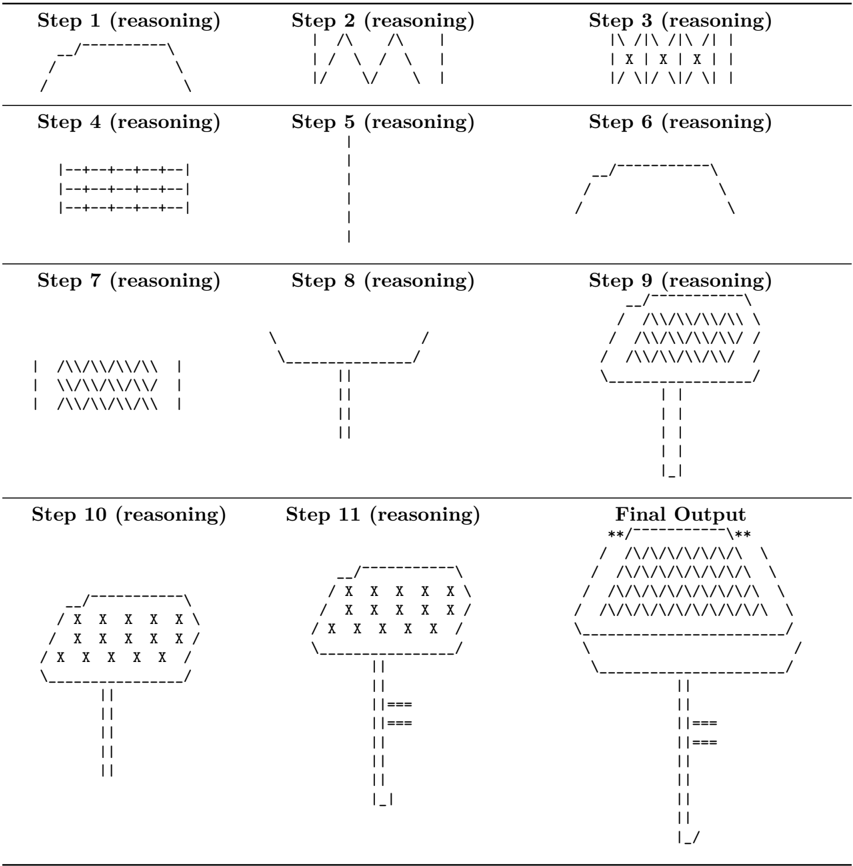
The image presents a diagram illustrating a series of reasoning steps, culminating in a "Final Output". Each step is visually represented by a unique pattern of lines and symbols, accompanied by the label "Step [number] (reasoning)". The diagram appears to demonstrate a progressive refinement or transformation of an initial concept into a more complex and defined result.
### Components/Axes
The diagram is organized into a 3x4 grid of boxes, with a final box positioned to the right of the grid. Each box contains a visual representation of a reasoning step and is labeled accordingly. There are no explicit axes or scales. The diagram's structure is purely spatial, relying on the arrangement of the steps to convey information.
### Detailed Analysis or Content Details
Here's a breakdown of each step's visual representation:
* **Step 1 (reasoning):** A dashed, irregular polygon.
* **Step 2 (reasoning):** A series of upward and downward pointing chevrons.
* **Step 3 (reasoning):** A pattern of 'X' symbols arranged in a staggered, vertical fashion.
* **Step 4 (reasoning):** A horizontal line composed of '+' and '-' symbols.
* **Step 5 (reasoning):** A single vertical dashed line.
* **Step 6 (reasoning):** A dashed polygon with a pointed top.
* **Step 7 (reasoning):** A series of upward-pointing chevrons arranged in a wave-like pattern.
* **Step 8 (reasoning):** A horizontal dashed line.
* **Step 9 (reasoning):** A series of upward-pointing chevrons, more densely packed than in Step 7, with a vertical dashed line extending downwards.
* **Step 10 (reasoning):** A pattern of 'X' symbols arranged in a more complex, layered fashion.
* **Step 11 (reasoning):** A pattern of 'X' symbols, similar to Step 10, but with a horizontal dashed line.
* **Final Output:** A densely packed series of upward-pointing chevrons, with a vertical dashed line and a line of asterisks ("**") above it.
### Key Observations
The diagram shows a progression from simpler, more abstract shapes (Steps 1-3) to more complex patterns (Steps 7-11) and finally to a highly defined output. The repeated use of chevrons and 'X' symbols suggests these may represent fundamental building blocks of the reasoning process. The dashed lines could indicate intermediate or supporting elements. The final output is the most visually complex and defined, suggesting a culmination of the reasoning steps.
### Interpretation
This diagram appears to be a visual metaphor for a computational or logical process. Each "step" represents a transformation of information, building upon the previous step. The increasing complexity of the patterns suggests that reasoning involves combining simpler elements into more sophisticated structures. The "Final Output" represents the result of this iterative process.
The diagram doesn't provide specific data or numerical values. It's a conceptual illustration of a process rather than a representation of quantifiable data. The diagram could be interpreted as a simplified model of machine learning, where each step represents a layer of processing in a neural network, and the final output is the network's prediction. Alternatively, it could represent a problem-solving process, where each step involves refining a hypothesis until a solution is reached. The use of the word "reasoning" in each step label reinforces the idea that this is a cognitive or logical process. The diagram is abstract and open to interpretation, but it effectively conveys the idea of a progressive, iterative process leading to a defined outcome.