## Diagram: Step-by-Step ASCII Art Construction Process
### Overview
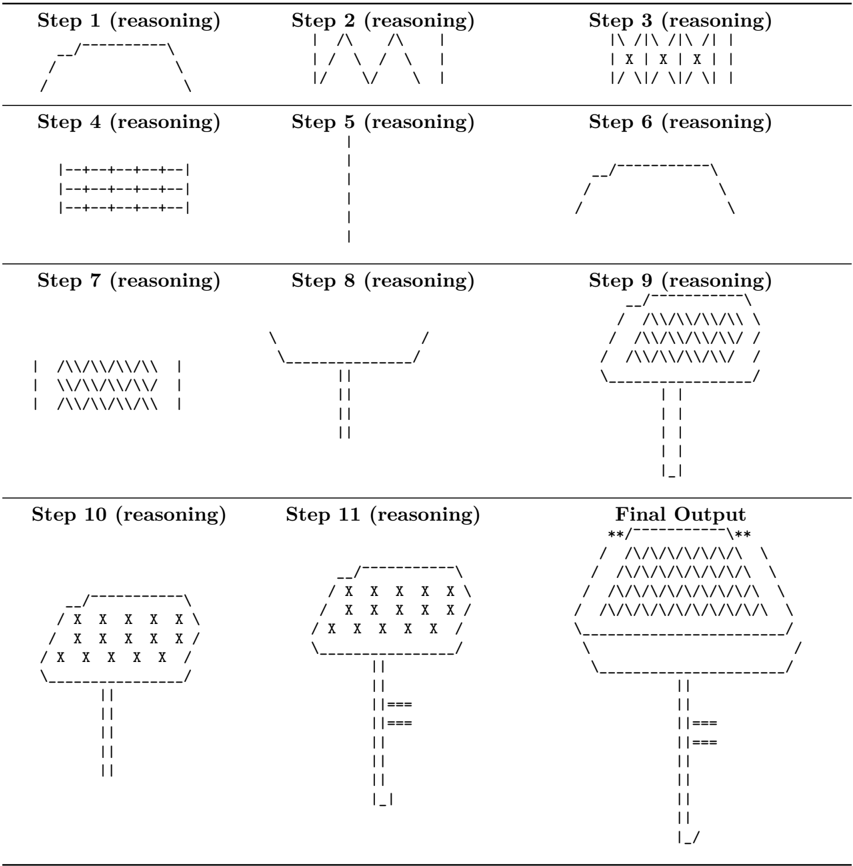
The image displays a 12-panel grid illustrating the sequential, iterative construction of a complex ASCII art figure. The process is broken down into 11 distinct "reasoning" steps, culminating in a "Final Output." Each panel contains a title and a corresponding ASCII art representation, showing the progressive addition and refinement of graphical elements.
### Components/Axes
* **Structure:** A 3-row x 4-column grid of rectangular panels.
* **Panel Labels:** Each panel is titled with a step number and the word "(reasoning)" in parentheses. The sequence runs left-to-right, top-to-bottom: "Step 1 (reasoning)" through "Step 11 (reasoning)", with the final panel labeled "Final Output".
* **Content:** Each panel contains monospaced ASCII art composed of characters including: `/`, `\`, `|`, `-`, `_`, `+`, `X`, `=`, `*`.
### Detailed Analysis
The construction process evolves as follows:
* **Step 1:** A simple, open trapezoidal outline is drawn using `/`, `\`, and `-`.
* **Step 2:** Internal vertical and diagonal lines (`|`, `/`, `\`) are added within the outline.
* **Step 3:** The internal pattern is filled with `X` characters, creating a dense, cross-hatched texture.
* **Step 4:** A completely different pattern is shown: a grid made of `+` and `-` characters.
* **Step 5:** A single vertical line (`|`) is presented.
* **Step 6:** Returns to a trapezoidal outline similar to Step 1, but with a slightly different base.
* **Step 7:** A rectangular block filled with repeating diagonal patterns (`/\/\/\/\`) is shown.
* **Step 8:** Combines a trapezoidal top (similar to Step 6) with a vertical stem (`||`) below it.
* **Step 9:** Elaborates on Step 8 by adding internal diagonal patterns to the trapezoid and extending the stem with a base (`|_|`).
* **Step 10:** Replaces the internal diagonals of the trapezoid with a grid of `X` characters, while retaining the stem from Step 8.
* **Step 11:** Further modifies the stem by adding horizontal bars (`===`) to it.
* **Final Output:** Presents the completed figure. It features:
* A top section with a dense, layered pattern of diagonal lines (`/\/\/\/\`).
* A middle trapezoidal body with a border and internal diagonal fill.
* A lower trapezoidal base.
* A vertical stem extending downward, featuring two sets of horizontal bars (`===`).
* A final base (`|_/`).
* Two asterisks (`**`) are placed at the very top corners.
### Key Observations
1. **Non-Linear Progression:** The steps do not show a simple, linear addition to a single drawing. Steps 4, 5, and 7 introduce seemingly unrelated patterns, suggesting they may represent the reasoning or testing of individual components (a grid, a line, a texture) before integration.
2. **Component Integration:** The final output is clearly a composite of elements previewed in earlier steps: the trapezoidal form (Steps 1, 6, 8), internal `X` fill (Step 3, 10), diagonal line texture (Step 7, 9), and the structured stem with bars (Step 11).
3. **Evolution of Complexity:** The process moves from simple outlines (Steps 1, 6) to filled shapes (Steps 3, 10) and finally to a multi-part, detailed assembly (Final Output).
4. **Spatial Consistency:** The main figure is consistently centered within each panel. The final output is the most complex and occupies the majority of its panel's space.
### Interpretation
This diagram visually documents a **generative or constructive reasoning process** for creating complex ASCII art. It demonstrates a methodology where:
* **Decomposition:** The final form is broken down into fundamental shapes (trapezoids, lines) and textures (diagonal fills, `X` grids).
* **Prototyping:** Individual components or patterns are sketched in isolation (Steps 4, 5, 7).
* **Assembly & Refinement:** Components are combined (Step 8) and iteratively refined with increasing detail (Steps 9, 10, 11) to produce the final, integrated design.
The "reasoning" label implies this could be a visualization of an algorithmic process, a human designer's thought progression, or a tutorial on building complex characters from simple parts. The final output resembles a stylized trophy, chalice, or architectural column, showcasing how basic typographic symbols can be orchestrated into a coherent and detailed graphical representation. The presence of the `**` in the final output may indicate a marker of completion or a decorative flourish.