## Diagram: Binary Classification Visualization
### Overview
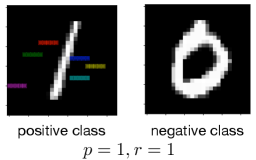
The image depicts a binary classification scenario with two distinct regions labeled "positive class" and "negative class." Each region contains a pixelated shape and associated visual elements. Below both regions, the text "p = 1, r = 1" is displayed, likely indicating precision (p) and recall (r) metrics.
### Components/Axes
- **Left Region (Positive Class)**:
- Label: "positive class" (centered below the region).
- Visual Elements:
- A vertical white line (diagonal orientation) occupying the central portion.
- Five colored horizontal rectangles (red, green, blue, yellow, purple) aligned to the left of the line.
- **Right Region (Negative Class)**:
- Label: "negative class" (centered below the region).
- Visual Elements:
- A pixelated circular shape (white with black background).
- **Text Below**:
- "p = 1, r = 1" (centered below both regions).
### Detailed Analysis
- **Positive Class**:
- The vertical line and colored rectangles suggest a structured or segmented representation, possibly indicating features or attributes.
- No explicit legend or axis markers are present, but the colored rectangles may imply categorical data (e.g., feature importance or thresholds).
- **Negative Class**:
- The circular shape is uniform and lacks additional annotations, suggesting a simpler or more homogeneous representation.
- **Text**:
- "p = 1, r = 1" implies perfect precision and recall, though this is unusual in real-world scenarios and may represent an idealized or synthetic example.
### Key Observations
1. The positive class is visually more complex (line + colored bars) compared to the negative class (single shape).
2. The absence of a legend or axis scales limits quantitative interpretation of the colored rectangles.
3. The text "p = 1, r = 1" is the only explicit numerical data, but its validity depends on context not provided in the image.
### Interpretation
This diagram likely illustrates a simplified binary classification task, where the positive class is represented by a structured pattern (line and colored bars) and the negative class by a circular shape. The "p = 1, r = 1" values suggest an idealized model with no false positives or negatives, which is unrealistic in practice. The colored rectangles in the positive class may symbolize distinct features or decision boundaries, but their exact meaning is unclear without additional context. The image emphasizes visual differentiation between classes rather than quantitative analysis.