## Neural Network Architectures
### Overview
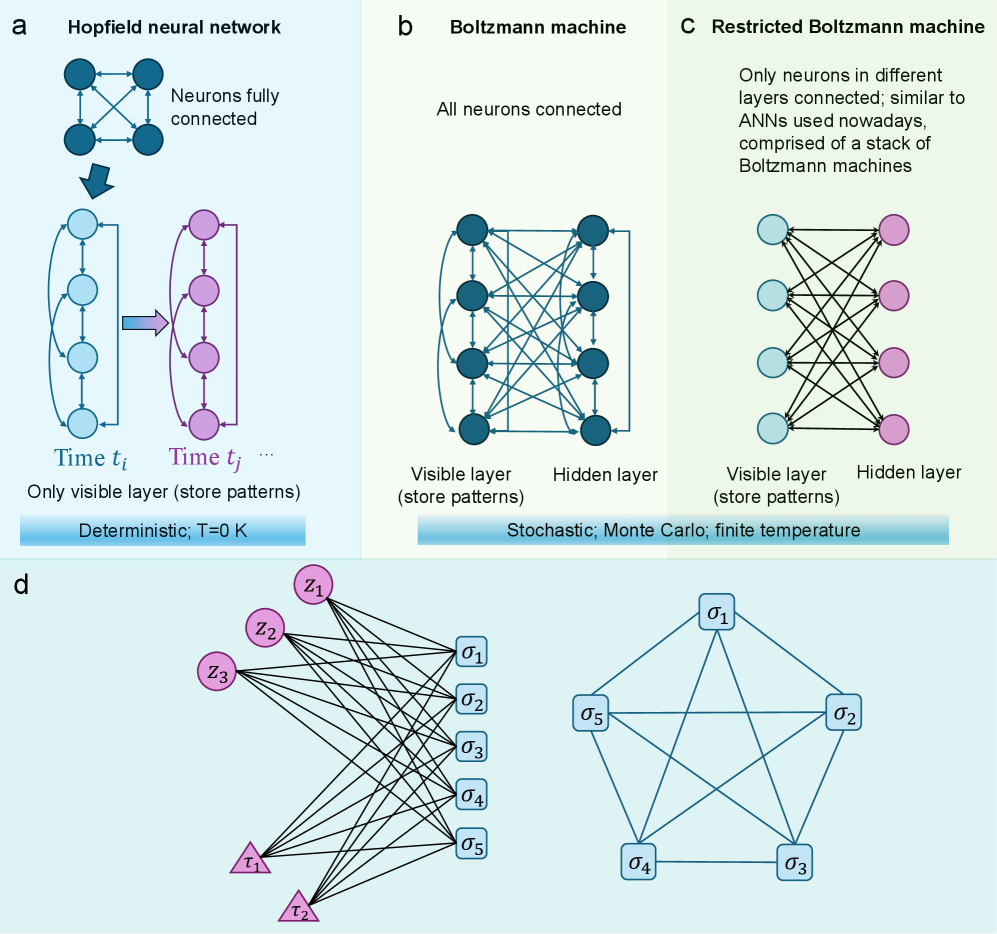
The image presents a comparative overview of different neural network architectures: Hopfield network, Boltzmann machine, Restricted Boltzmann machine, and a final unnamed network. Each architecture is illustrated with a diagram showing the connections between neurons and key characteristics.
### Components/Axes
* **Section a:** Hopfield neural network
* Diagram shows a fully connected network of neurons.
* A downward arrow indicates a transition to a layered structure.
* Two columns of neurons are labeled "Time t\_i" and "Time t\_j".
* Text: "Neurons fully connected", "Only visible layer (store patterns)", "Deterministic; T=0 K"
* **Section b:** Boltzmann machine
* Diagram shows a fully connected network of neurons with self-loops.
* Labels: "Visible layer (store patterns)", "Hidden layer"
* Text: "All neurons connected", "Stochastic; Monte Carlo; finite temperature"
* **Section c:** Restricted Boltzmann machine
* Diagram shows a bipartite network with connections only between layers.
* Labels: "Visible layer (store patterns)", "Hidden layer"
* Text: "Only neurons in different layers connected; similar to ANNs used nowadays, comprised of a stack of Boltzmann machines"
* **Section d:** Unnamed Network
* Two diagrams showing different network structures.
* The left diagram has two layers of nodes, one labeled z1, z2, z3 and the other labeled sigma1, sigma2, sigma3, sigma4, sigma5, and two nodes labeled tau1, tau2.
* The right diagram has nodes labeled sigma1, sigma2, sigma3, sigma4, sigma5.
### Detailed Analysis
* **Hopfield Network (a):**
* Initial state: A fully connected network of approximately 4 neurons.
* Transition: Transforms into a layered structure with two columns, each containing approximately 4 neurons.
* Time t\_i: Neurons are light blue.
* Time t\_j: Neurons are purple.
* The network is deterministic and operates at absolute zero temperature (T=0 K).
* **Boltzmann Machine (b):**
* A fully connected network of approximately 4 neurons in each layer.
* All neurons are interconnected, including self-loops.
* Two layers are labeled "Visible layer" and "Hidden layer".
* The network is stochastic and uses Monte Carlo methods at a finite temperature.
* **Restricted Boltzmann Machine (c):**
* A bipartite network with two layers.
* The "Visible layer" contains approximately 4 light blue neurons.
* The "Hidden layer" contains approximately 4 purple neurons.
* Connections exist only between the visible and hidden layers.
* **Unnamed Network (d):**
* Left Diagram:
* Top layer: 3 purple nodes labeled z1, z2, z3.
* Middle layer: 5 light blue square nodes labeled sigma1, sigma2, sigma3, sigma4, sigma5.
* Bottom layer: 2 purple triangle nodes labeled tau1, tau2.
* All top layer nodes are connected to all middle layer nodes.
* All middle layer nodes are connected to all bottom layer nodes.
* Right Diagram:
* 5 light blue square nodes labeled sigma1, sigma2, sigma3, sigma4, sigma5.
* Each node is connected to two other nodes, forming a pentagon with all diagonals drawn.
### Key Observations
* The diagrams illustrate the evolution from fully connected networks (Hopfield, Boltzmann) to more structured, layered networks (Restricted Boltzmann).
* The transition from deterministic to stochastic models is highlighted.
* The unnamed network in section d shows a more complex architecture with different types of nodes and connections.
### Interpretation
The image provides a visual comparison of different neural network architectures, emphasizing their connectivity, layering, and operational characteristics. The progression from Hopfield to Boltzmann to Restricted Boltzmann machines demonstrates the evolution towards more structured and efficient network designs. The unnamed network in section d suggests further variations in network architecture, potentially involving different types of nodes and connections for specialized tasks. The distinction between deterministic and stochastic models highlights the different approaches to learning and inference in these networks.