## Diagram: Neural Network Architectures Comparison
### Overview
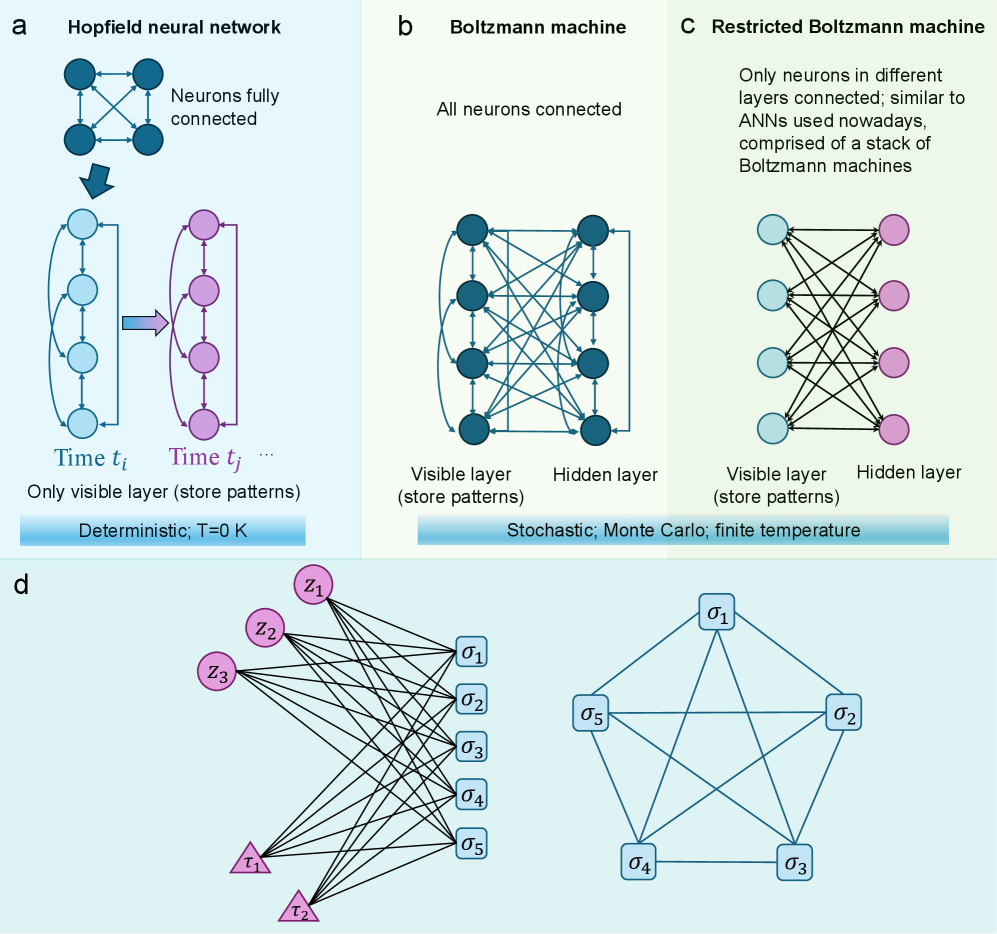
The image compares four neural network architectures: Hopfield neural network (a), Boltzmann machine (b), Restricted Boltzmann machine (c), and a hybrid visible-hidden layer configuration (d). Each section includes diagrams of neuron connections, layer types, and operational characteristics.
### Components/Axes
- **Labels**:
- **a**: Hopfield neural network
- **b**: Boltzmann machine
- **c**: Restricted Boltzmann machine
- **d**: Hybrid visible-hidden layer configuration
- **Diagram Elements**:
- **Nodes**:
- Blue circles (visible layer, store patterns)
- Pink circles (hidden layer, store patterns)
- Blue squares (σ₁–σ₅, hidden layer outputs)
- Pink triangles (τ₁–τ₂, input patterns)
- **Connections**:
- Fully connected (a, b)
- Restricted connections (c, d)
- **Text Annotations**:
- "Deterministic; T=0 K" (a)
- "Stochastic; Monte Carlo; finite temperature" (b)
- "Only neurons in different layers connected" (c)
### Detailed Analysis
#### Section a (Hopfield Neural Network)
- **Structure**: Fully connected neurons with visible and hidden layers.
- **Flow**: Input patterns (τ₁–τ₂) at time *t<sub>i</sub>* propagate to output patterns (σ₁–σ₅) at time *t<sub>j</sub>*.
- **Key Features**:
- Deterministic operation (T=0 K).
- Visible layer stores patterns explicitly.
#### Section b (Boltzmann Machine)
- **Structure**: Fully connected visible and hidden layers.
- **Flow**: Stochastic interactions between layers via Monte Carlo sampling.
- **Key Features**:
- Finite temperature enables probabilistic pattern storage.
- No explicit input/output separation.
#### Section c (Restricted Boltzmann Machine)
- **Structure**: Visible and hidden layers with **only inter-layer connections** (no intra-layer connections).
- **Flow**: Similar to modern ANNs, with visible layer storing patterns.
- **Key Features**:
- Restricted connectivity reduces complexity.
- Stacked RBMs form deep learning architectures.
#### Section d (Hybrid Configuration)
- **Structure**: Visible layer (τ₁–τ₂) connected to hidden layer (σ₁–σ₅) via fully connected edges.
- **Flow**: Input patterns (τ) propagate through hidden layer (σ) with no feedback loops.
- **Key Features**:
- Simplified architecture compared to RBMs.
- No explicit temperature or stochasticity mentioned.
### Key Observations
1. **Deterministic vs. Stochastic**:
- Hopfield (a) operates deterministically (T=0 K), while Boltzmann machines (b, c) use stochastic sampling.
2. **Connectivity**:
- RBM (c) restricts connections to inter-layer, unlike fully connected Boltzmann machines (b).
3. **Pattern Storage**:
- Visible layers (a, c, d) explicitly store patterns, while hidden layers (b, c) learn implicit representations.
### Interpretation
- **Hopfield Networks** (a) are ideal for associative memory tasks but lack scalability due to deterministic dynamics.
- **Boltzmann Machines** (b) introduce stochasticity for better generalization but suffer from high computational cost.
- **RBMs** (c) address this by restricting connections, enabling efficient training and forming the basis of deep belief networks.
- **Section d** illustrates a simplified feedforward architecture, emphasizing direct input-to-output mapping without hidden layer interactions.
The progression from Hopfield to RBM reflects advancements in balancing memory capacity, computational efficiency, and scalability in neural networks.