## 3D Rendering: Abstract Geometric Composition
### Overview
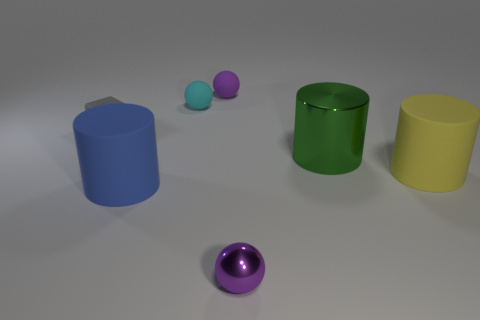
The image depicts a minimalist 3D scene with six distinct objects arranged on a neutral gray surface. The composition emphasizes contrast in color, material, and form, with no textual annotations or contextual labels.
### Components/Axes
- **Objects**:
1. **Blue Cylinder** (left): Large, matte surface, cylindrical shape.
2. **Green Cylinder** (center-right): Large, glossy reflective surface, cylindrical shape.
3. **Yellow Cylinder** (right): Large, matte surface, cylindrical shape.
4. **Purple Sphere** (foreground): Small, highly reflective metallic surface.
5. **Teal Sphere** (background): Small, matte surface.
6. **Gray Cube** (background-left): Small, matte surface, partially obscured.
- **Environment**: Neutral gray background with soft, diffused lighting casting subtle shadows.
### Detailed Analysis
- **Material Properties**:
- The green cylinder’s glossy finish reflects light and surroundings, suggesting a polished or metallic material.
- The purple sphere’s reflective surface mirrors the environment, indicating a polished metal or glass-like material.
- All other objects (blue, yellow, teal, gray) have matte finishes, absorbing light without reflection.
- **Spatial Arrangement**:
- Cylinders are positioned in a linear progression from left (blue) to right (yellow), with the green cylinder slightly offset forward.
- Spheres are placed asymmetrically: the purple sphere is in the foreground, while the teal sphere is near the center-back.
- The gray cube is partially hidden behind the blue cylinder, suggesting depth.
### Key Observations
1. **Material Contrast**: The interplay between glossy (green cylinder, purple sphere) and matte surfaces creates visual hierarchy.
2. **Color Distribution**: Primary colors (blue, green, yellow) dominate, with secondary colors (purple, teal, gray) adding complexity.
3. **Absence of Text**: No labels, legends, or annotations are present, leaving interpretation open to spatial and material relationships.
### Interpretation
This image likely serves as a study in **material rendering** or **geometric abstraction**, emphasizing how light interacts with different surfaces. The lack of textual context suggests it could be used in technical documentation to demonstrate:
- **Lighting Effects**: How shadows and reflections vary with material properties.
- **Spatial Composition**: The use of color and form to create balance or tension.
- **Material Science**: Visualizing differences between matte and reflective surfaces.
Notably, the absence of scale markers or contextual clues (e.g., units, labels) limits quantitative analysis. The scene prioritizes aesthetic and material exploration over functional data representation.