# Technical Document Extraction: AI Agent Framework Diagram
## 1. Document Overview
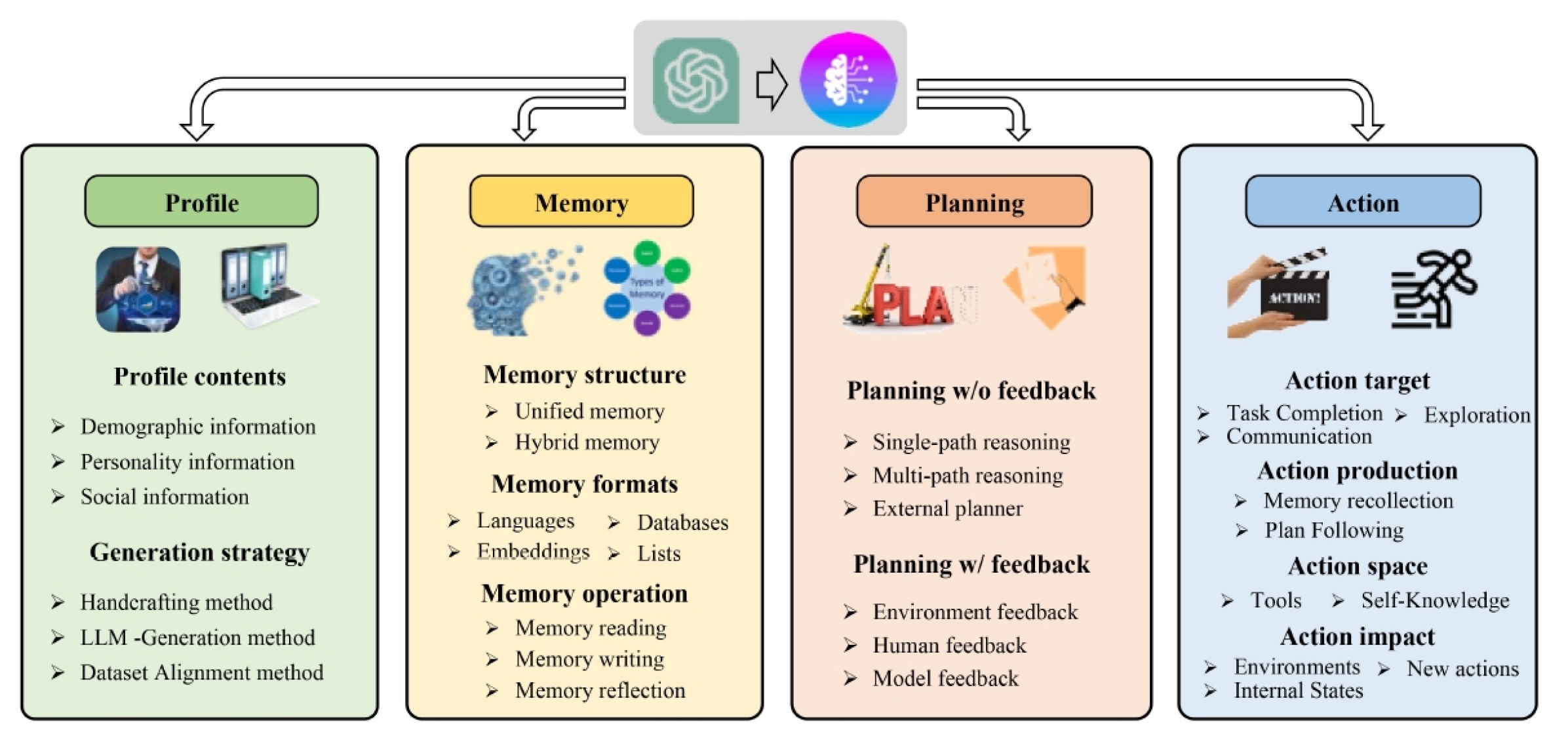
This image is a high-level conceptual diagram illustrating the architectural components of an AI Agent system. The diagram is structured with a central control flow at the top, branching down into four primary functional modules: **Profile**, **Memory**, **Planning**, and **Action**.
## 2. Header and Control Flow
At the top center of the image, there is a header section containing two icons:
* **Left Icon:** The OpenAI logo (green/teal).
* **Right Icon:** A stylized brain icon with digital circuitry (purple/blue gradient).
* **Flow:** An arrow points from the OpenAI logo to the brain icon, suggesting the transition from a Large Language Model (LLM) to an autonomous agent.
* **Distribution:** Four white, hollow arrows originate from this central header and point downward to the four main modules described below.
---
## 3. Module Analysis
### Module 1: Profile (Green Section)
This module defines the identity and characteristics of the agent.
* **Visuals:** Icons of a professional person and a laptop with files.
* **Profile contents:**
* Demographic information
* Personality information
* Social information
* **Generation strategy:**
* Handcrafting method
* LLM-Generation method
* Dataset Alignment method
### Module 2: Memory (Yellow Section)
This module details how the agent stores and retrieves information.
* **Visuals:** A digital head silhouette with data particles and a "Types of Memory" hub-and-spoke diagram.
* **Memory structure:**
* Unified memory
* Hybrid memory
* **Memory formats:**
* Languages
* Embeddings
* Databases
* Lists
* **Memory operation:**
* Memory reading
* Memory writing
* Memory reflection
### Module 3: Planning (Orange Section)
This module describes the cognitive processes for task decomposition and strategy.
* **Visuals:** A construction crane lifting the word "PLAN" and a hand writing on a document.
* **Planning w/o feedback (without feedback):**
* Single-path reasoning
* Multi-path reasoning
* External planner
* **Planning w/ feedback (with feedback):**
* Environment feedback
* Human feedback
* Model feedback
### Module 4: Action (Blue Section)
This module outlines the execution phase and the agent's interaction with its environment.
* **Visuals:** A movie clapperboard labeled "ACTION!" and a stylized icon of a person running.
* **Action target:**
* Task Completion
* Communication
* Exploration
* **Action production:**
* Memory recollection
* Plan Following
* **Action space:**
* Tools
* Self-Knowledge
* **Action impact:**
* Environments
* Internal States
* New actions
---
## 4. Summary of Components and Flow
The diagram represents a cyclical or integrated system where:
1. **Profile** establishes *who* the agent is.
2. **Memory** provides the *context and history* for the agent.
3. **Planning** determines *how* the agent will achieve a goal (either through linear reasoning or iterative feedback loops).
4. **Action** is the *execution* of the plan, which impacts the environment and the agent's own internal state, likely feeding back into the Memory and Planning modules.