# Technical Document Extraction: Cognitive Architecture Diagram
## Overview
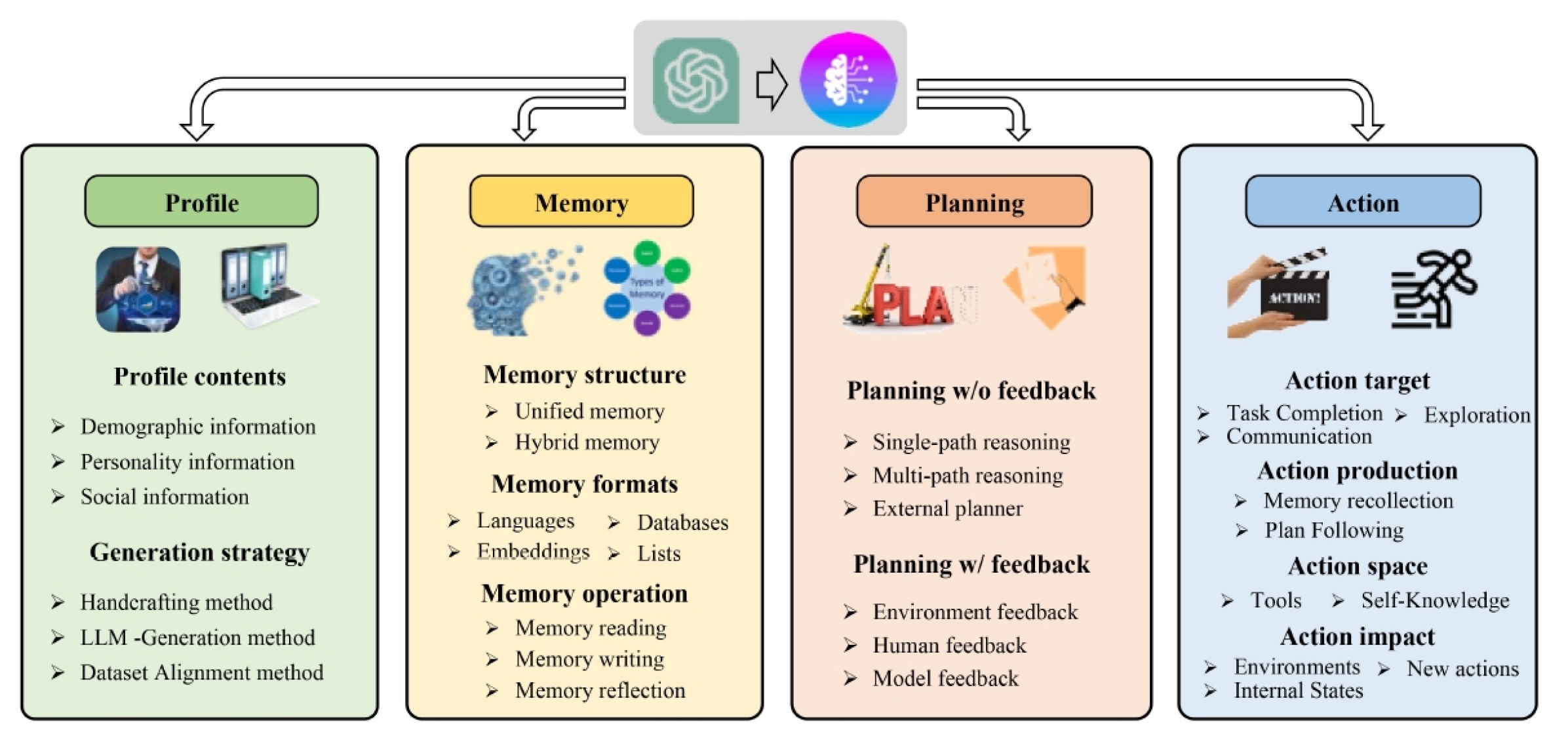
The diagram illustrates a four-stage cognitive architecture workflow: **Profile → Memory → Planning → Action**, with bidirectional feedback loops. Central elements include a green icon (flower-like symbol) and a purple brain icon, connected by arrows indicating system interactions.
---
## Section Breakdown
### 1. Profile (Green)
**Profile contents**
- Demographic information
- Personality information
- Social information
**Generation strategy**
- Handcrafting method
- LLM-Generation method
- Dataset Alignment method
---
### 2. Memory (Yellow)
**Memory structure**
- Unified memory
- Hybrid memory
**Memory formats**
- Languages
- Databases
- Embeddings
- Lists
**Memory operation**
- Memory reading
- Memory writing
- Memory reflection
---
### 3. Planning (Orange)
**Planning w/o feedback**
- Single-path reasoning
- Multi-path reasoning
- External planner
**Planning w/ feedback**
- Environment feedback
- Human feedback
- Model feedback
---
### 4. Action (Blue)
**Action target**
- Task Completion
- Exploration
- Communication
**Action production**
- Memory recollection
- Plan Following
**Action space**
- Tools
- Self-Knowledge
**Action impact**
- Environments
- New actions
- Internal States
---
## Flow and Interactions
- **Profile → Memory**: Profile data informs memory structure/formats.
- **Memory → Planning**: Memory operations feed into planning strategies.
- **Planning → Action**: Planning outputs (with/without feedback) drive action targets.
- **Action → Memory/Profile**: Feedback loops (e.g., Environment feedback, Internal States) update memory and profile.
---
## Color Coding
- **Profile**: Green
- **Memory**: Yellow
- **Planning**: Orange
- **Action**: Blue
Central icons:
- Green flower-like symbol (Profile/Memory interface)
- Purple brain icon (Planning/Action interface)
Arrows: Black, bidirectional where applicable.