## Diagrams: Result Orderings and Error Approximation Relationships
### Overview
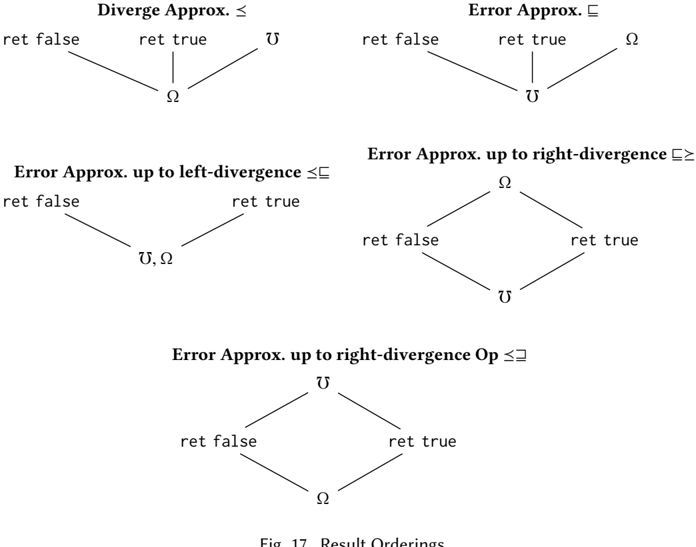
The image contains five interconnected diagrams illustrating relationships between error approximation, divergence, and logical return values (`ret false`/`ret true`). Each diagram uses set theory symbols (Ω, U) and logical operators (⊆, ⊇, ≤, ≥) to represent constraints.
### Components/Axes
- **Diagram Titles**:
1. "Diverge Approx. ≤"
2. "Error Approx. ⊆"
3. "Error Approx. up to left-divergence ⊆"
4. "Error Approx. up to right-divergence ⊇"
5. "Error Approx. up to right-divergence Op ⊇"
- **Key Symbols**:
- `Ω`, `U`: Represent sets or conditions.
- `ret false`, `ret true`: Logical return values.
- Arrows (`→`) indicate directional relationships.
- Operators: ≤, ⊆, ⊇, ≥ denote approximation or inclusion constraints.
### Detailed Analysis
1. **Diverge Approx. ≤**
- Branches:
- `ret false` → `Ω`
- `ret true` → `U`
- Text: "Error Approx. up to left-divergence ⊆"
2. **Error Approx. ⊆**
- Branches:
- `ret false` → `Ω`
- `ret true` → `U`
- Text: "Error Approx. up to right-divergence ⊇"
3. **Error Approx. up to left-divergence ⊆**
- Branches:
- `ret false` → `U, Ω` (combined branch)
- `ret true` → `Ω`
4. **Error Approx. up to right-divergence ⊇**
- Branches:
- `ret false` → `Ω`
- `ret true` → `U`
5. **Error Approx. up to right-divergence Op ⊇**
- Branches:
- `ret false` → `Ω`
- `ret true` → `U`
### Key Observations
- **Logical Flow**:
- `ret false` consistently maps to `Ω` in most diagrams, except in the third diagram where it maps to `U, Ω`.
- `ret true` maps to `U` in all diagrams except the third, where it maps to `Ω`.
- **Set Inclusion**:
- Diagrams use ⊆ and ⊇ to denote subset/superset relationships between error approximations and divergence constraints.
- **Divergence Constraints**:
- Left-divergence (⊆) and right-divergence (⊇) are tied to specific error approximation bounds.
### Interpretation
The diagrams model how error approximations (`Error Approx.`) relate to divergence constraints (`Diverge Approx.`) and logical return values. For example:
- When divergence is bounded by ≤, `ret false` corresponds to `Ω`, while `ret true` corresponds to `U`.
- The third diagram introduces a combined condition (`U, Ω`) for `ret false`, suggesting a broader error approximation scope under left-divergence.
- The use of ⊆ and ⊇ implies hierarchical relationships between error approximations and divergence thresholds, critical for understanding system behavior under varying conditions.
This structure highlights trade-offs between precision (`ret false`/`ret true`) and approximation bounds, likely relevant to formal verification or computational logic systems.