## Line Chart: Surprisal vs. Training Steps for Match and Mismatch Conditions
### Overview
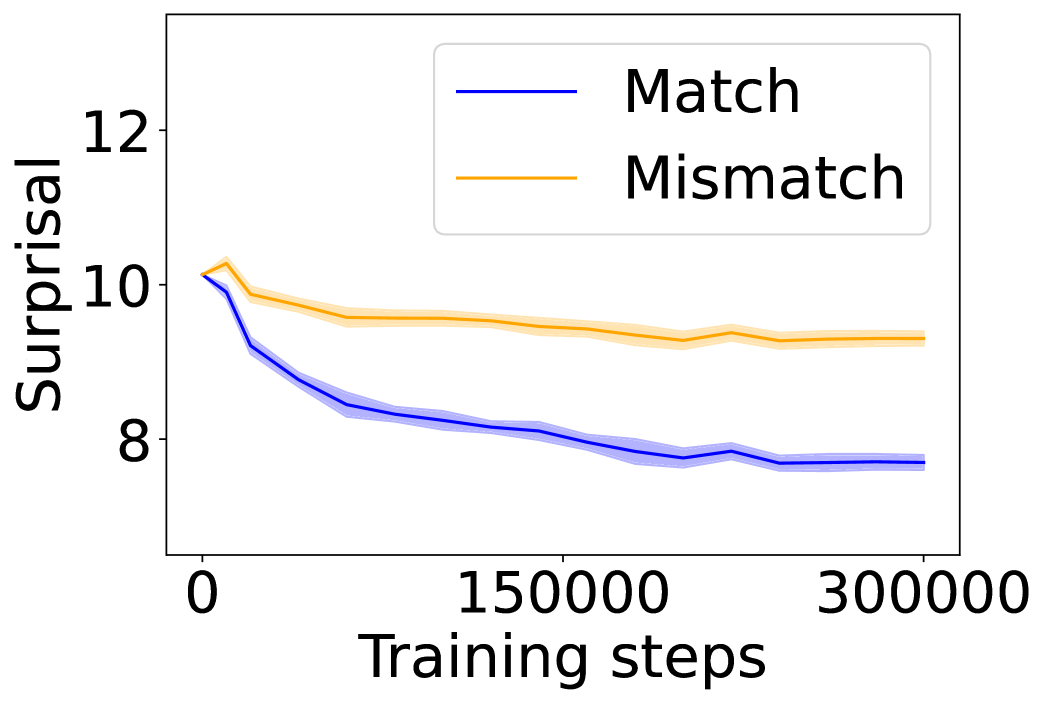
The image is a line chart displaying the relationship between "Surprisal" (y-axis) and "Training steps" (x-axis) for two distinct conditions: "Match" and "Mismatch." The chart illustrates how the surprisal metric evolves over the course of model training for these two conditions.
### Components/Axes
* **Chart Type:** Line chart with shaded confidence/uncertainty bands.
* **X-Axis:**
* **Label:** "Training steps"
* **Scale:** Linear scale.
* **Markers:** Major ticks at 0, 150000, and 300000.
* **Y-Axis:**
* **Label:** "Surprisal"
* **Scale:** Linear scale.
* **Markers:** Major ticks at 8, 10, and 12.
* **Legend:**
* **Position:** Top-right corner of the plot area.
* **Items:**
1. **Blue line:** Labeled "Match"
2. **Orange line:** Labeled "Mismatch"
* **Data Series:**
1. **Match (Blue Line):** Represents the surprisal for the "Match" condition. Includes a lighter blue shaded band around the main line, indicating variance or confidence interval.
2. **Mismatch (Orange Line):** Represents the surprisal for the "Mismatch" condition. Includes a lighter orange shaded band around the main line.
### Detailed Analysis
**Trend Verification & Data Points (Approximate):**
* **Match (Blue Line):**
* **Visual Trend:** The line exhibits a steep, concave-upward decline initially, which gradually flattens into a more linear, gentle downward slope. The overall trend is a strong decrease in surprisal over training.
* **Approximate Values:**
* At step 0: Surprisal ≈ 10.0
* At step ~50,000: Surprisal ≈ 8.5 (steep decline phase ends)
* At step 150,000: Surprisal ≈ 8.0
* At step 300,000: Surprisal ≈ 7.8
* **Uncertainty Band:** The shaded blue band is narrowest at the start and end, and appears slightly wider in the middle (around 50,000-150,000 steps), suggesting more variance in measurements during that phase.
* **Mismatch (Orange Line):**
* **Visual Trend:** The line shows a very slight initial increase, followed by a gradual, shallow decline that plateaus significantly earlier than the Match line. The overall trend is a modest decrease in surprisal, remaining consistently higher than the Match condition.
* **Approximate Values:**
* At step 0: Surprisal ≈ 10.0 (similar starting point to Match)
* At step ~25,000: Surprisal peaks slightly at ≈ 10.2
* At step 150,000: Surprisal ≈ 9.5
* At step 300,000: Surprisal ≈ 9.4
* **Uncertainty Band:** The shaded orange band appears relatively consistent in width throughout the training steps shown.
**Spatial Grounding:** The two lines start at nearly the same point on the y-axis at step 0. They immediately diverge, with the blue (Match) line descending much more rapidly. The orange (Mismatch) line remains above the blue line for the entire duration after the initial point. The gap between them widens until approximately step 100,000 and then remains relatively constant.
### Key Observations
1. **Divergent Learning Trajectories:** The primary observation is the significant divergence in surprisal between the Match and Mismatch conditions as training progresses.
2. **Plateauing Effect:** Both curves show signs of plateauing towards the end of the displayed training steps (200,000-300,000), with the rate of decrease in surprisal becoming very small.
3. **Consistent Gap:** After the initial phase, a consistent gap of approximately 1.5-1.7 surprisal units is maintained between the Mismatch and Match conditions.
4. **Initial Conditions:** Both conditions begin at a similar level of surprisal (~10.0), indicating a common starting point before training differentiates their performance.
### Interpretation
This chart demonstrates a clear and expected learning dynamic in a model training context. "Surprisal" is a measure of how unexpected or difficult to predict an event is. Lower surprisal indicates better prediction.
* **What the data suggests:** The model is successfully learning to predict data from the "Match" condition, as evidenced by the substantial and sustained drop in surprisal. Learning for the "Mismatch" condition is far less effective, showing only a minor improvement.
* **Relationship between elements:** The "Match" condition likely represents data that is consistent with the model's training distribution or prior context, allowing for efficient learning. The "Mismatch" condition represents data that is inconsistent or out-of-distribution, which the model struggles to learn to predict, hence the persistently higher surprisal.
* **Notable patterns/anomalies:** The slight initial *increase* in surprisal for the Mismatch condition is noteworthy. It could indicate a brief period where the model's updates initially make it *worse* at predicting mismatched data before settling into a slow, shallow improvement. The plateau suggests that after a certain point (around 200,000 steps), additional training yields diminishing returns for reducing surprisal in both conditions, but the fundamental performance gap remains.
**In summary, the chart provides visual evidence that the model's ability to reduce prediction error (surprisal) is highly dependent on the match between the training data and the condition, with matched contexts leading to significantly better and faster learning.**