## Prompt Template: Maze Navigation Task
### Overview
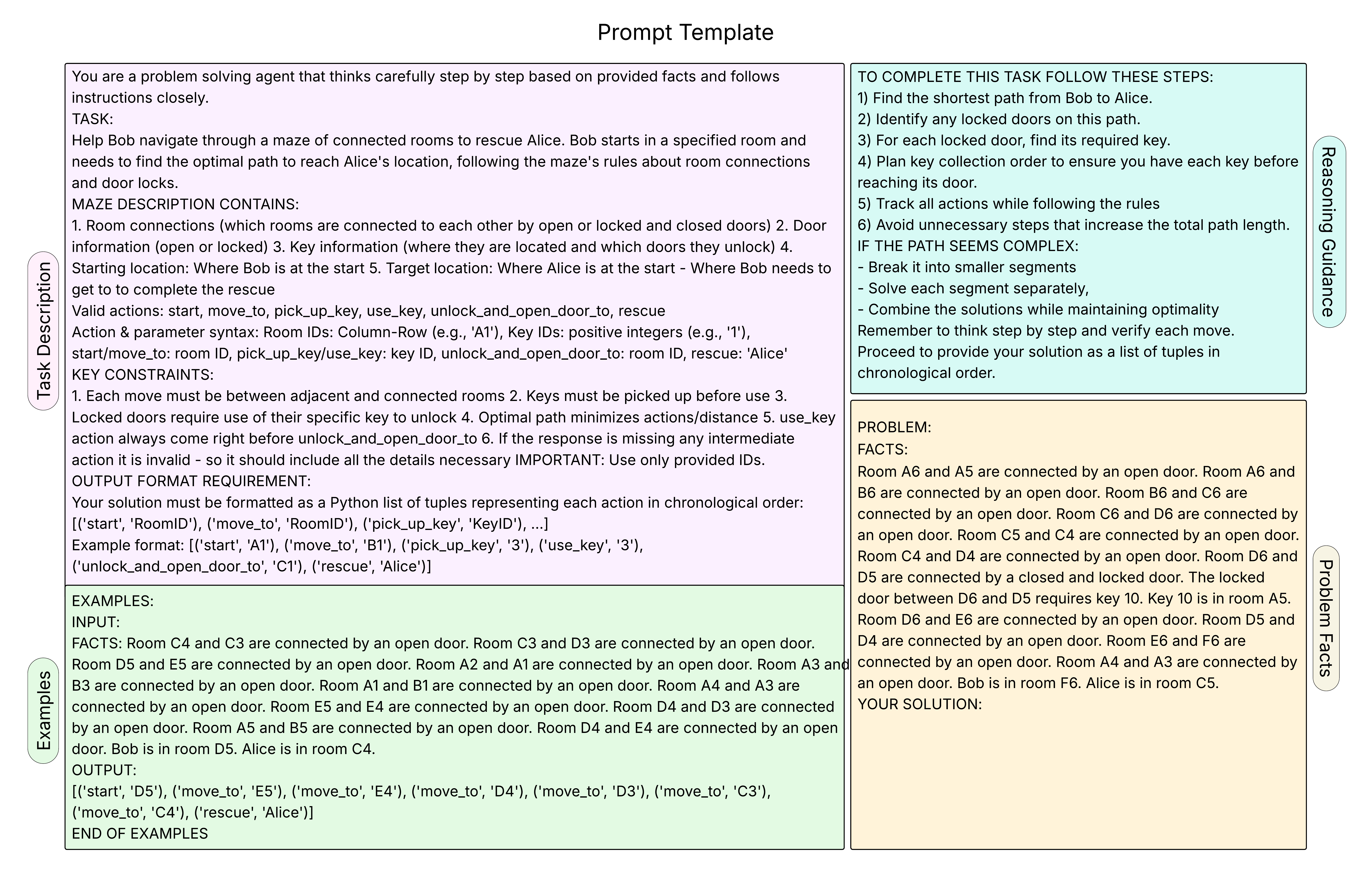
The image presents a prompt template for a problem-solving task involving navigating a maze. It includes a task description, reasoning guidance, problem facts, examples of input and output formats, and key constraints. The goal is to help Bob navigate a maze to rescue Alice, following specific rules about room connections and door locks.
### Components/Axes
* **Task Description** (Left side, top): Provides the problem statement, maze description, valid actions, action syntax, and key constraints.
* **Reasoning Guidance** (Right side, top): Outlines the steps to complete the task, including finding the shortest path, identifying locked doors, planning key collection, and tracking actions.
* **Problem Facts** (Right side, bottom): Lists the specific facts about the maze, including room connections, locked doors, key locations, and the starting and target locations.
* **Examples** (Left side, bottom): Provides input and output examples to illustrate the expected format and solution.
### Detailed Analysis or ### Content Details
**Task Description:**
* **Problem:** Help Bob navigate a maze of connected rooms to rescue Alice.
* **Maze Description:** Includes room connections (open, locked, closed doors), door information, key information, starting location (Bob), and target location (Alice).
* **Valid Actions:** start, move\_to, pick\_up\_key, use\_key, unlock\_and\_open\_door\_to, rescue.
* **Action Syntax:** Room IDs (Column-Row, e.g., 'A1'), Key IDs (positive integers, e.g., '1').
* **Key Constraints:**
1. Each move must be between adjacent and connected rooms.
2. Keys must be picked up before use.
3. Locked doors require use of their specific key to unlock.
4. Optimal path minimizes actions/distance.
5. use\_key action always comes right before unlock\_and\_open\_door\_to.
6. If the response is missing any intermediate action it is invalid.
* **Output Format:** Python list of tuples: \[('start', 'RoomID'), ('move\_to', 'RoomID'), ('pick\_up\_key', 'KeyID'), ...]. Example: \[('start', 'A1'), ('move\_to', 'B1'), ('pick\_up\_key', '3'), ('use\_key', '3'), ('unlock\_and\_open\_door\_to', 'C1'), ('rescue', 'Alice')].
**Reasoning Guidance:**
* Steps to complete the task:
1. Find the shortest path from Bob to Alice.
2. Identify any locked doors on this path.
3. For each locked door, find its required key.
4. Plan key collection order to ensure you have each key before reaching its door.
5. Track all actions while following the rules.
6. Avoid unnecessary steps that increase the total path length.
* If the path seems complex: Break it into smaller segments, solve each segment separately, combine the solutions while maintaining optimality, remember to think step by step and verify each move, proceed to provide your solution as a list of tuples in chronological order.
**Problem Facts:**
* Room A6 and A5 are connected by an open door.
* Room A6 and B6 are connected by an open door.
* Room B6 and C6 are connected by an open door.
* Room C6 and D6 are connected by an open door.
* Room C5 and C4 are connected by an open door.
* Room C4 and D4 are connected by an open door.
* Room D6 and D5 are connected by a closed and locked door. The locked door between D6 and D5 requires key 10.
* Key 10 is in room A5.
* Room D6 and E6 are connected by an open door.
* Room D5 and D4 are connected by an open door.
* Room E6 and F6 are connected by an open door.
* Room A4 and A3 are connected by an open door.
* Bob is in room F6.
* Alice is in room C5.
**Examples:**
* **Input Facts:**
* Room C4 and C3 are connected by an open door.
* Room C3 and D3 are connected by an open door.
* Room D5 and E5 are connected by an open door.
* Room A2 and A1 are connected by an open door.
* Room A3 and B3 are connected by an open door.
* Room A1 and B1 are connected by an open door.
* Room A4 and A3 are connected by an open door.
* Room E5 and E4 are connected by an open door.
* Room D4 and D3 are connected by an open door.
* Room A5 and B5 are connected by an open door.
* Room D4 and E4 are connected by an open door.
* Bob is in room D5.
* Alice is in room C4.
* **Output:** \[('start', 'D5'), ('move\_to', 'E5'), ('move\_to', 'E4'), ('move\_to', 'D4'), ('move\_to', 'D3'), ('move\_to', 'C3'), ('move\_to', 'C4'), ('rescue', 'Alice')].
### Key Observations
* The task requires a structured approach to problem-solving, emphasizing step-by-step reasoning and adherence to specific rules.
* The output format is strictly defined as a Python list of tuples, indicating a computational or programmatic context.
* The problem facts provide a limited scope of information, suggesting that the solution should rely solely on the given data.
### Interpretation
The prompt template is designed to guide a problem-solving agent (likely an AI or a human) through a maze navigation task. The task is framed as a rescue mission, adding a narrative element. The structured format and constraints suggest an environment where precision and adherence to rules are critical. The inclusion of input and output examples serves to clarify the expected behavior and format of the solution. The problem facts provide the necessary information to solve the maze, but the agent must use the reasoning guidance to determine the optimal path and actions. The task is likely intended to test the agent's ability to understand and apply rules, plan a sequence of actions, and format the output correctly.