## Cognitive Architecture Diagram
### Overview
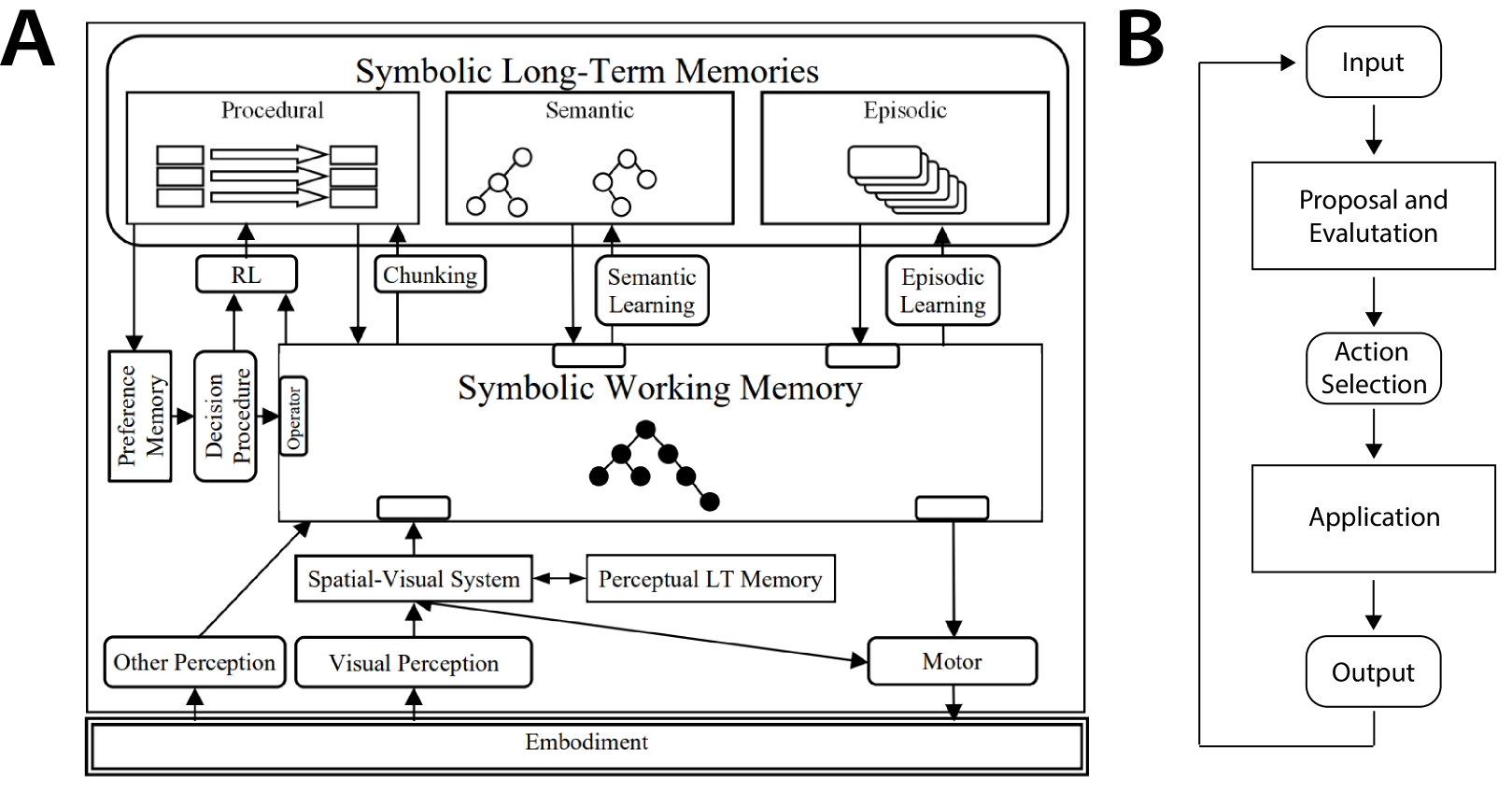
The image presents a cognitive architecture diagram, split into two sections labeled 'A' and 'B'. Section 'A' illustrates the flow of information and processes within a cognitive system, including long-term memories, working memory, perception, and motor control. Section 'B' depicts a cyclical process involving input, proposal/evaluation, action selection, application, and output.
### Components/Axes
**Section A:**
* **Title:** Symbolic Long-Term Memories
* **Sub-categories of Long-Term Memories:**
* Procedural: Represented by three stacked rectangles with arrows indicating flow.
* Semantic: Represented by a network of nodes and connections.
* Episodic: Represented by a stack of rectangles.
* **Symbolic Working Memory:** Central component, connected to various other modules. Contains a network of nodes and connections.
* **Modules connected to Symbolic Working Memory:**
* RL (Reinforcement Learning)
* Chunking
* Semantic Learning
* Episodic Learning
* Preference Memory
* Decision Procedure
* Operator
* **Perception and Action:**
* Spatial-Visual System
* Perceptual LT Memory
* Other Perception
* Visual Perception
* Motor
* **Embodiment:** Bottom layer, connected to Other Perception, Visual Perception, and Motor.
**Section B:**
* **Process Flow:**
* Input
* Proposal and Evaluation
* Action Selection
* Application
* Output
* **Feedback Loop:** An arrow connects Output back to Input, indicating a cyclical process.
### Detailed Analysis or ### Content Details
**Section A:**
* **Long-Term Memories:**
* Procedural memory appears to be structured and sequential.
* Semantic memory is represented as a network of interconnected concepts.
* Episodic memory is represented as a stack of events or experiences.
* **Symbolic Working Memory:** Serves as a central hub, receiving input from various modules and sending output to others.
* **Perception:** Other Perception and Visual Perception feed into the Spatial-Visual System and Perceptual LT Memory.
* **Action:** The Motor module receives input from the Spatial-Visual System and connects to the Embodiment layer.
**Section B:**
* **Process Flow:** The diagram illustrates a sequential process where input is received, proposals are generated and evaluated, an action is selected, the action is applied, and an output is produced.
* **Feedback Loop:** The feedback loop suggests that the output influences subsequent inputs, creating a continuous cycle of perception, action, and learning.
### Key Observations
* **Section A:** The architecture emphasizes the interaction between different types of memory, perception, and action.
* **Section B:** The process flow highlights the cyclical nature of cognitive processing.
### Interpretation
The diagram presents a high-level overview of a cognitive architecture. Section A describes the structural components and their relationships, while Section B illustrates the dynamic processes that occur within the system. The architecture emphasizes the importance of both symbolic and perceptual processing, as well as the interaction between different types of memory. The cyclical process flow in Section B suggests that the system is capable of learning and adapting to its environment. The architecture appears to be designed to simulate or model human cognition.