\n
## Diagram: Cognitive Architecture
### Overview
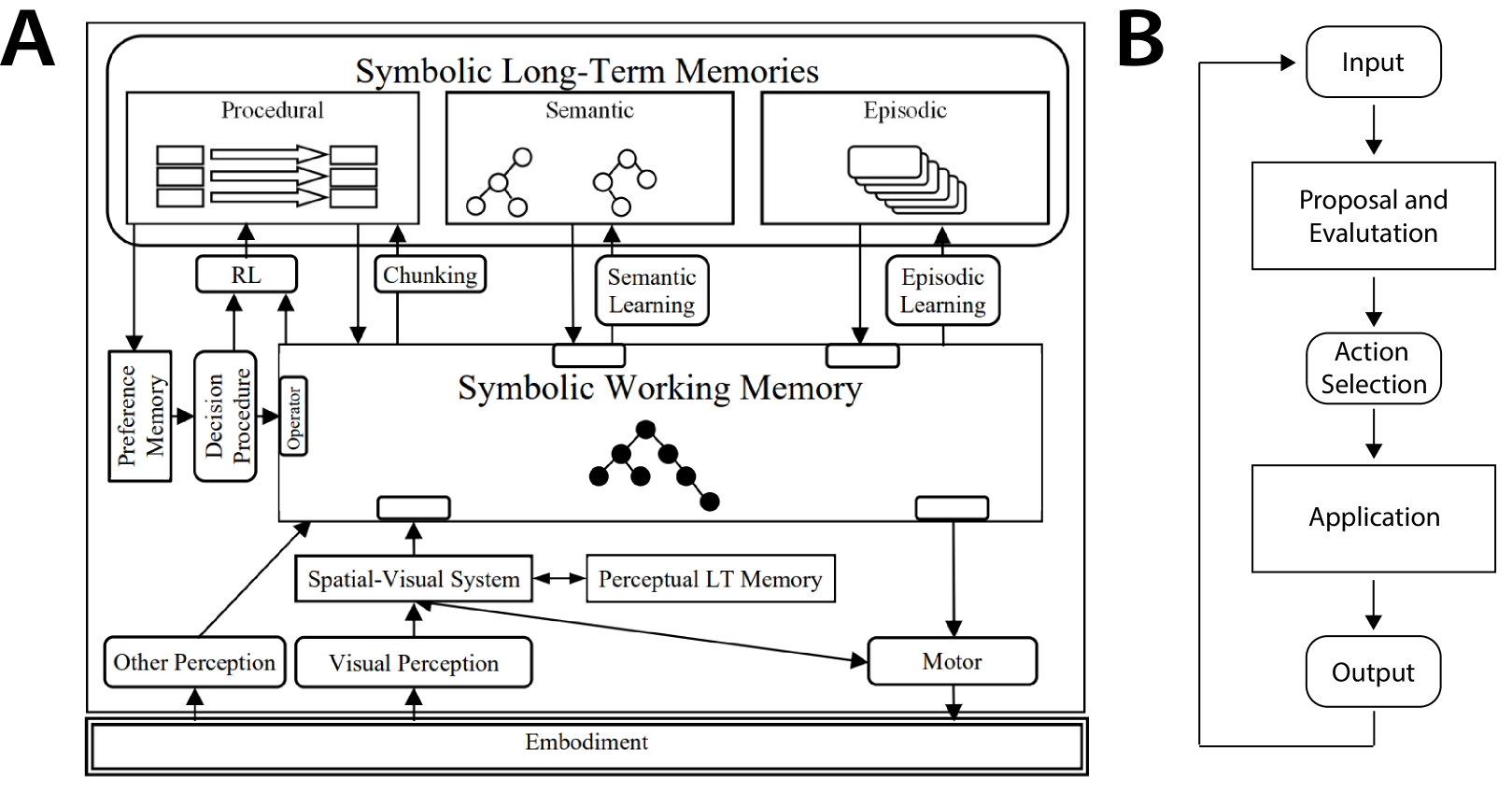
The image presents two diagrams, labeled A and B, illustrating a cognitive architecture. Diagram A depicts a layered system of symbolic long-term memories and symbolic working memory, with connections to perceptual and motor systems. Diagram B shows a sequential process flow from input to output, involving proposal, evaluation, selection, and application.
### Components/Axes
**Diagram A:**
* **Top Layer:** Symbolic Long-Term Memories, divided into Procedural, Semantic, and Episodic.
* **Middle Layer:** Symbolic Working Memory.
* **Lower Layer:** Spatial-Visual System, Perceptual LT Memory, Motor, Embodiment, Other Perception, Visual Perception.
* **Connecting Processes:** RL (Reinforcement Learning), Chunking, Semantic Learning, Episodic Learning, Preference Memory, Decision Procedure, Operator.
**Diagram B:**
* **Sequential Steps:** Input, Proposal and Evaluation, Action Selection, Application, Output.
### Detailed Analysis or Content Details
**Diagram A:**
* **Symbolic Long-Term Memories:**
* **Procedural:** Represented by stacked rectangles, approximately 8-10 in number.
* **Semantic:** Represented by a network of interconnected nodes, approximately 6-8 nodes.
* **Episodic:** Represented by stacked rectangles, similar to procedural, approximately 6-8 in number.
* **Symbolic Working Memory:** Represented by a cluster of interconnected nodes, approximately 10-12 nodes.
* **Spatial-Visual System:** A rectangular block.
* **Perceptual LT Memory:** A rectangular block.
* **Motor:** A rectangular block.
* **Embodiment:** A rectangular block.
* **Other Perception:** A rectangular block.
* **Visual Perception:** A rectangular block.
* **Connections:**
* Procedural Memory connects to RL and the Operator.
* Semantic Memory connects to Chunking and Semantic Learning.
* Episodic Memory connects to Episodic Learning.
* All long-term memories connect to Symbolic Working Memory.
* Symbolic Working Memory connects to Spatial-Visual System, Perceptual LT Memory, and Motor.
* Spatial-Visual System and Visual Perception connect to Symbolic Working Memory.
* Embodiment connects to Other Perception and Visual Perception.
* Preference Memory and Decision Procedure connect to the Operator.
**Diagram B:**
* **Input:** An oval shape labeled "Input".
* **Proposal and Evaluation:** A rectangular block labeled "Proposal and Evaluation".
* **Action Selection:** A rectangular block labeled "Action Selection".
* **Application:** A rectangular block labeled "Application".
* **Output:** An oval shape labeled "Output".
* **Flow:** Arrows indicate a sequential flow from Input to Proposal and Evaluation, then to Action Selection, then to Application, and finally to Output.
### Key Observations
* Diagram A illustrates a hierarchical cognitive architecture with distinct memory systems and perceptual/motor interfaces.
* Diagram B presents a simplified, sequential processing model.
* The connections in Diagram A suggest a complex interplay between different cognitive components.
* The flow in Diagram B is linear and deterministic.
### Interpretation
Diagram A represents a more detailed and nuanced model of cognition, emphasizing the role of different memory systems and their interactions. The connections between these systems suggest that cognitive processes are not simply linear but involve feedback loops and parallel processing. The inclusion of RL, Chunking, and Learning mechanisms indicates an adaptive and evolving system.
Diagram B, in contrast, provides a high-level overview of a cognitive cycle, from receiving input to generating output. It highlights the key stages involved in decision-making and action execution.
The two diagrams can be interpreted as complementary. Diagram A provides the underlying architecture, while Diagram B describes the functional flow within that architecture. The diagrams together suggest a cognitive system that is both complex and goal-directed. The absence of numerical data or specific parameters limits the ability to perform quantitative analysis, but the diagrams provide a valuable qualitative understanding of the proposed cognitive architecture.