TECHNICAL ASSET FINGERPRINT
75a477818da8298d02a98f05
Click to view fullscreen
Press ESC or click to close
FOUND IN PAPERS
EXPERT: healer-alpha-free VERSION 1
RUNTIME: free/openrouter/healer-alpha
INTEL_VERIFIED
## Diagram: Cognitive Architecture and Decision-Making Flow
### Overview
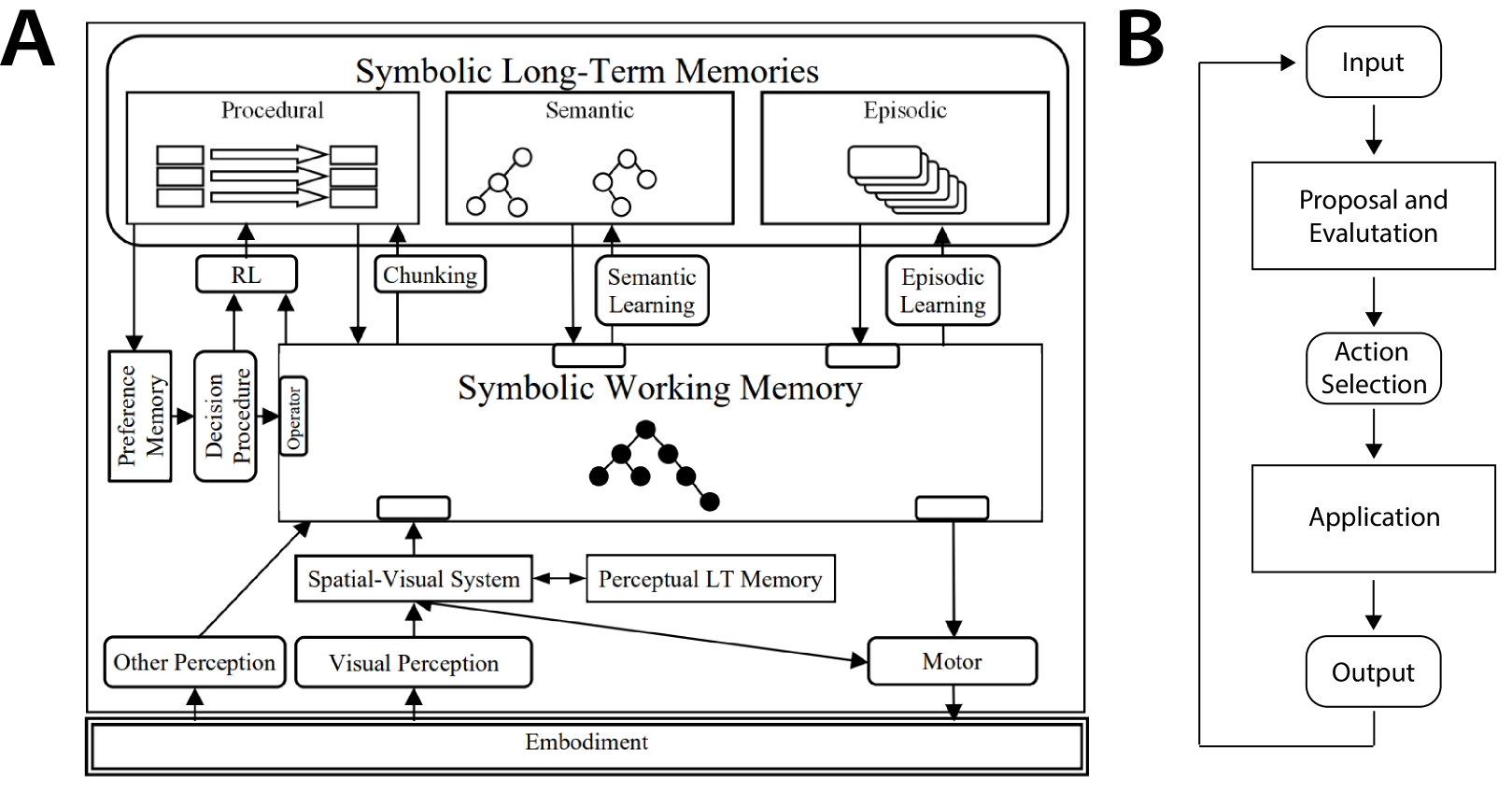
The image contains two distinct black-and-white technical diagrams, labeled **A** and **B**, presented side-by-side. Diagram **A** illustrates a complex cognitive architecture model centered on symbolic memory systems. Diagram **B** depicts a high-level, cyclical decision-making or processing flowchart. Both diagrams use rectangular boxes, rounded rectangles, and arrows to represent components and information flow.
### Components/Axes
**Diagram A: Cognitive Architecture**
* **Title/Top Section:** "Symbolic Long-Term Memories"
* **Long-Term Memory Sub-types (Top Row):**
* **Procedural:** Represented by a box containing three horizontal arrows pointing right, each originating from a stack of three rectangles.
* **Semantic:** Represented by a box containing two separate network/graph icons (nodes connected by lines).
* **Episodic:** Represented by a box containing an icon of stacked documents or pages.
* **Learning/Processing Modules (Middle, connecting to Long-Term Memories):**
* **RL** (Reinforcement Learning): Rounded rectangle, connected to Procedural memory.
* **Chunking:** Rounded rectangle, connected to Procedural memory.
* **Semantic Learning:** Rounded rectangle, connected to Semantic memory.
* **Episodic Learning:** Rounded rectangle, connected to Episodic memory.
* **Central Working Memory:** A large central box labeled "Symbolic Working Memory," containing a network/graph icon.
* **Decision & Preference Components (Left Side):**
* **Preference Memory:** Vertical rectangle.
* **Decision Procedure:** Vertical rectangle.
* **Operator:** Small vertical rectangle.
* **Perception & Sensorimotor Systems (Bottom Section):**
* **Spatial-Visual System:** Rectangle.
* **Perceptual LT Memory:** Rectangle, connected bidirectionally to the Spatial-Visual System.
* **Other Perception:** Rounded rectangle.
* **Visual Perception:** Rounded rectangle.
* **Motor:** Rounded rectangle.
* **Base Layer:** A wide rectangle at the very bottom labeled "Embodiment."
* **Flow/Connections:** Arrows indicate bidirectional and unidirectional information flow between all components. The "Embodiment" layer has upward arrows to "Other Perception" and "Visual Perception." The "Motor" system has a downward arrow to "Embodiment."
**Diagram B: Decision-Making Flowchart**
* **Process Steps (Top to Bottom):**
1. **Input:** Rounded rectangle at the top.
2. **Proposal and Evaluation:** Rectangle.
3. **Action Selection:** Rounded rectangle.
4. **Application:** Rectangle.
5. **Output:** Rounded rectangle at the bottom.
* **Flow:** A single, downward arrow connects each step sequentially from "Input" to "Output."
* **Feedback Loop:** A line originates from the "Output" box, travels left, then up the entire left side of the diagram, and connects back into the "Input" box, creating a closed cycle.
### Detailed Analysis
**Diagram A Component Relationships:**
1. **Memory Hierarchy:** The architecture is layered. The "Symbolic Long-Term Memories" (Procedural, Semantic, Episodic) sit at the top. The "Symbolic Working Memory" is the central hub.
2. **Learning Pathways:** Specialized learning modules mediate between working memory and long-term memory stores: "RL" and "Chunking" for Procedural memory, "Semantic Learning" for Semantic memory, and "Episodic Learning" for Episodic memory.
3. **Decision Loop:** On the left, "Preference Memory" feeds into a "Decision Procedure," which uses an "Operator" to interact with the "Symbolic Working Memory." The "RL" module also feeds back into the "Decision Procedure."
4. **Perceptual Grounding:** The "Symbolic Working Memory" receives input from perceptual systems. The "Spatial-Visual System" is central, interacting with "Perceptual LT Memory" and receiving input from "Visual Perception." "Other Perception" also feeds into the working memory.
5. **Action Output:** The "Symbolic Working Memory" sends commands to the "Motor" system, which acts upon the "Embodiment."
6. **Embodiment:** The "Embodiment" layer is the physical or simulated base, providing sensory input (via perception modules) and receiving motor output.
**Diagram B Process Flow:**
1. The process begins with an **Input**.
2. This input undergoes **Proposal and Evaluation**, suggesting and assessing potential responses.
3. A specific course is chosen during **Action Selection**.
4. The selected action is then executed in the **Application** phase.
5. This results in an **Output**.
6. Crucially, the **Output** feeds back into the system as a new **Input**, making the process iterative and continuous.
### Key Observations
1. **Symbolic Focus:** Both diagrams emphasize symbolic processing ("Symbolic" is explicitly in the titles of the major memory components in A).
2. **Modularity vs. Linearity:** Diagram A shows a highly modular, interconnected system with multiple parallel pathways (e.g., separate learning modules for different memory types). Diagram B shows a strict, linear sequence with a single feedback loop.
3. **Grounding:** Diagram A explicitly includes "Embodiment" and perception systems, highlighting the connection between abstract symbolic processing and sensory-motor interaction with an environment.
4. **Memory Specialization:** Diagram A makes a clear distinction between different types of long-term memory (Procedural, Semantic, Episodic), each with its own learning mechanism.
5. **Cyclical Nature:** Diagram B's feedback loop defines it as a closed-loop control system, where the system evaluates new proposals based on the results of previous actions.
### Interpretation
These diagrams together likely represent a comprehensive model for an intelligent agent or cognitive architecture.
* **Diagram A** details the agent's internal "mind" – its memory structures, learning processes, and how perception, decision-making, and action are integrated. It suggests that intelligence arises from the interaction of specialized memory systems (knowing how, knowing what, knowing when) grounded in perception and action. The presence of "RL" (Reinforcement Learning) indicates the system learns from rewards and penalties.
* **Diagram B** abstracts this complexity into a universal decision cycle. It represents the agent's interaction loop with the world: perceive (Input), think (Proposal/Evaluation), decide (Action Selection), act (Application), and observe the result (Output), which then informs the next cycle. This is a classic sense-think-act paradigm with learning implied by the feedback loop.
**Relationship:** Diagram B can be seen as the external, behavioral manifestation of the internal processes shown in Diagram A. The "Input" in B corresponds to data from the "Perception" systems in A. The "Proposal and Evaluation" and "Action Selection" in B occur within the "Symbolic Working Memory" and "Decision Procedure" of A. The "Application" in B is executed by the "Motor" system in A, affecting the "Embodiment." The "Output" feeds back to update the perceptual state and potentially the memories in A.
**Notable Implication:** The architecture is designed for an agent that learns and operates in a real or simulated environment ("Embodiment"). It is not a disembodied language model but a model for embodied AI or cognitive robotics, where learning (Semantic, Episodic, RL) is continuous and driven by interaction.
DECODING INTELLIGENCE...