\n
## Diagram: Sentence Alignment/Dependency Visualization
### Overview
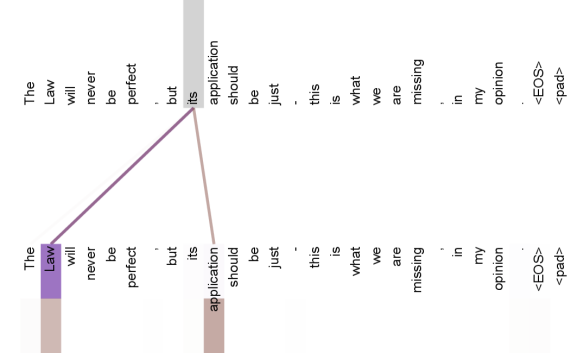
The image depicts a diagram illustrating a potential alignment or dependency relationship between two sentences. The sentences are presented horizontally, and a purple line connects words in the first sentence to corresponding words in the second sentence. The diagram appears to be related to natural language processing or computational linguistics, specifically focusing on how words in one sentence relate to words in another.
### Components/Axes
The diagram consists of two identical sentences positioned one above the other. Each sentence is broken down into individual words. A purple line connects the word "Law" in the first sentence to the word "Law" in the second sentence, and the word "application" in the first sentence to the word "application" in the second sentence. The sentences are:
"The Law will never be perfect but its application should be just - this is what we are missing in my opinion EOS pad>"
### Detailed Analysis or Content Details
The diagram highlights a direct correspondence between the words "The Law" and "application" in both sentences. The sentences are identical. The words "EOS" and "pad>" appear at the end of each sentence, likely representing end-of-sentence and padding tokens used in a computational context.
### Key Observations
The diagram focuses on a limited subset of words within the sentences, suggesting that these words are considered particularly important for the relationship being visualized. The connection between "Law" and "application" could indicate a focus on the practical implementation or consequences of the law. The presence of "EOS" and "pad>" suggests this is a representation used in a machine learning or NLP pipeline.
### Interpretation
The diagram likely represents a simplified view of a more complex process, such as machine translation, text summarization, or semantic analysis. The purple lines indicate a strong alignment or dependency between the corresponding words in the two sentences. This could be used to train a model to identify similar relationships in other texts. The fact that the sentences are identical suggests the diagram is illustrating a baseline or self-alignment scenario, perhaps as a starting point for more complex comparisons. The inclusion of "EOS" and "pad>" tokens indicates that the sentences are being treated as sequences of data for a computational model. The diagram is not presenting data in the traditional sense, but rather a visualization of relationships between textual elements. It's a representation of linguistic structure, not a statistical chart.