## Diagram: Textual Analysis with Highlighted Emphasis
### Overview
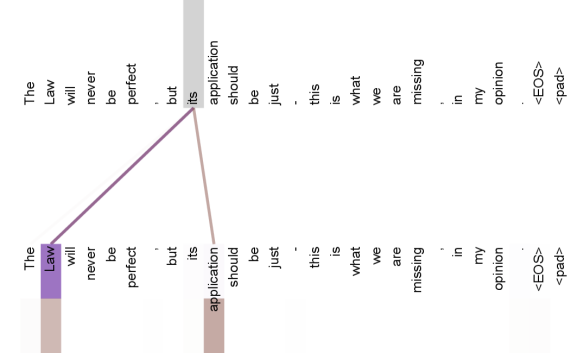
The image displays a diagram consisting of two identical blocks of text, positioned one above the other. Each block contains the same sentence. Specific words within each sentence are highlighted with colored rectangular bars. Two diagonal lines connect the highlighted words between the upper and lower text blocks, suggesting a relationship or mapping between them. The background is a plain, light gray.
### Components
1. **Text Blocks:**
* **Upper Block:** Located in the top half of the image.
* **Lower Block:** Located in the bottom half of the image, directly below the upper block.
* **Content:** Both blocks contain the exact same sentence: `The Law will never be perfect , but its application should be just . this is what we are missing . in my opinion <EOS> <pad>`
2. **Highlighted Elements & Connecting Lines:**
* **Upper Block Highlights:**
* The word "Law" is highlighted with a **purple** bar.
* The word "application" is highlighted with a **light brown/tan** bar.
* **Lower Block Highlights:**
* The word "Law" is highlighted with a **purple** bar.
* The word "application" is highlighted with a **light brown/tan** bar.
* **Connecting Lines:**
* A **purple** line connects the purple-highlighted "Law" in the upper block to the purple-highlighted "Law" in the lower block. The line runs diagonally from the upper-left to the lower-left.
* A **light brown/tan** line connects the tan-highlighted "application" in the upper block to the tan-highlighted "application" in the lower block. The line runs diagonally from the upper-center to the lower-center.
3. **Special Tokens:** The sentence ends with the tokens `<EOS>` and `<pad>`, which are common in natural language processing to denote "End Of Sequence" and a padding token, respectively.
### Detailed Analysis
* **Text Transcription (Exact):**
`The Law will never be perfect , but its application should be just . this is what we are missing . in my opinion <EOS> <pad>`
* **Spatial Grounding:**
* The purple highlight on "Law" is positioned at the start of the second word in both text blocks.
* The tan highlight on "application" is positioned on the seventh word in both text blocks.
* The connecting lines create a visual "V" shape, converging from the two points in the upper text block down to their corresponding points in the lower block.
### Key Observations
1. **Identical Repetition:** The core content (the sentence) is duplicated exactly, suggesting the diagram is illustrating a process applied to the same input, or a comparison between two states of the same data.
2. **Selective Emphasis:** Only two content words ("Law" and "application") are highlighted out of the entire sentence. This draws specific attention to the relationship between the abstract concept ("Law") and its practical implementation ("application").
3. **Color-Coded Mapping:** The use of matching colors for the highlights and connecting lines creates a clear, unambiguous visual mapping between the two instances of the same words in the upper and lower blocks.
4. **NLP Context:** The presence of `<EOS>` and `<pad>` tokens strongly indicates this diagram is related to computational linguistics, machine learning, or text processing, possibly illustrating attention mechanisms, word alignment, or feature extraction.
### Interpretation
This diagram visually represents a **selective focus or alignment process** within a textual analysis pipeline. The data suggests the following:
* **Core Argument:** The sentence itself argues that while laws are inherently imperfect, the critical failing lies in their just application. The diagram isolates and emphasizes the two key nouns in this argument: the rule ("Law") and its execution ("application").
* **Process Illustration:** The structure implies a transformation or analysis step. The upper text could be the "input" and the lower text the "output" or "analyzed version." The connecting lines show that the system has successfully identified and preserved the relationship between these two specific concepts across the process.
* **Underlying Pattern:** The diagram likely demonstrates a model's ability to track or attend to semantically crucial word pairs. The "V" shape of the connections might symbolize a narrowing of focus from a broader statement down to its foundational components.
* **Anomaly/Notable Detail:** The inclusion of punctuation marks (commas, periods) as separate tokens in the transcription is a technical detail common in tokenization for NLP models, reinforcing the diagram's technical context. The fact that only nouns are highlighted, and not the verbs or adjectives, suggests the analysis is focused on entities and their relationships rather than actions or qualities.
In essence, the image is a technical schematic showing how a specific analytical process isolates and maps the relationship between a principle and its practice within a given statement.