## Text Analysis: Math Problem and Step Probabilities
### Overview
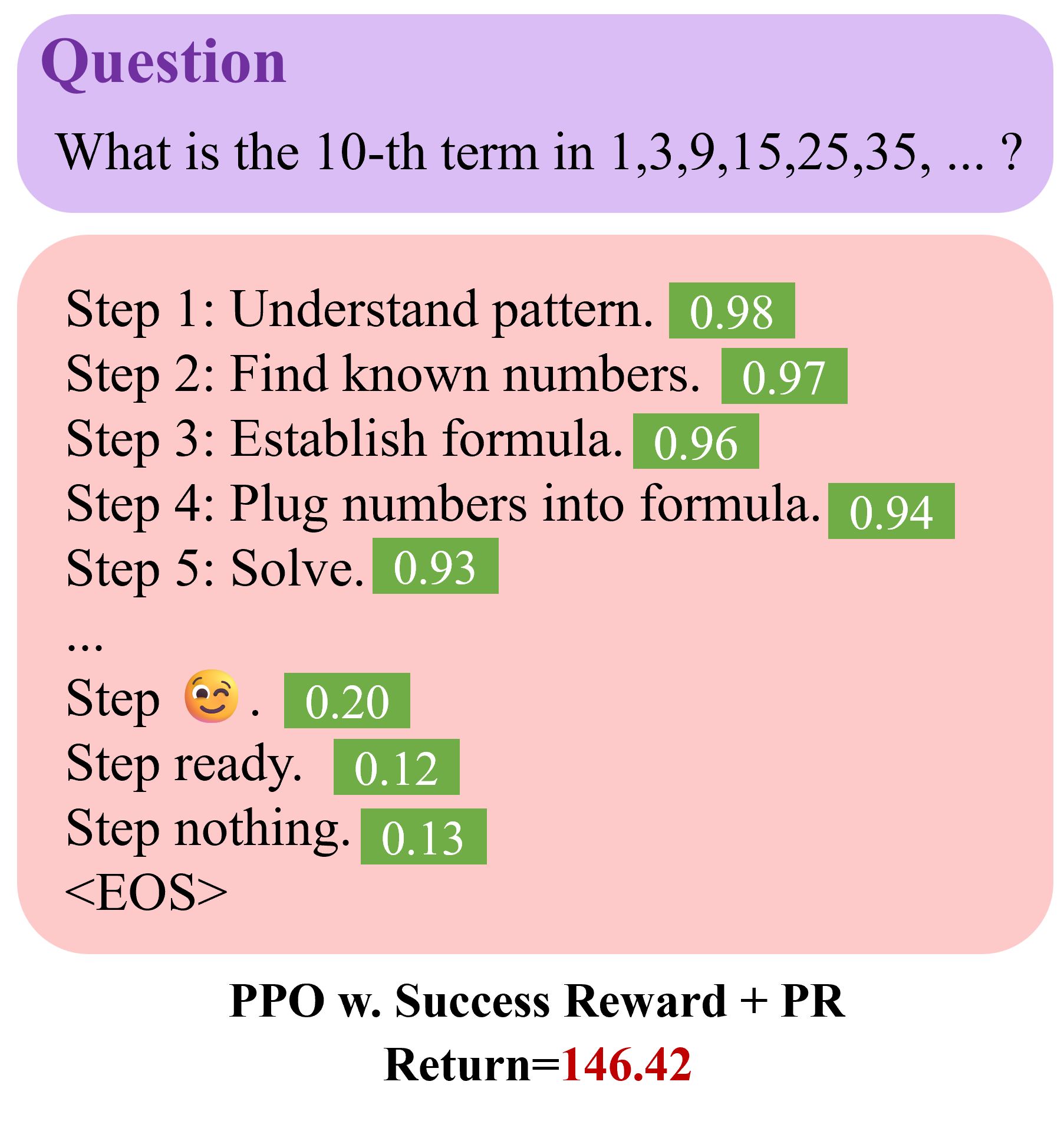
The image presents a math question and a list of steps, each associated with a probability value. It also includes information about the PPO algorithm used and the return value.
### Components/Axes
* **Question:** "What is the 10-th term in 1,3,9,15,25,35, ... ?"
* **Steps:** A list of steps involved in solving the problem, each with an associated probability.
* **Probabilities:** Numerical values (between 0.12 and 0.98) indicating the likelihood or confidence associated with each step.
* **Algorithm:** PPO w. Success Reward + PR
* **Return:** 146.42
### Detailed Analysis or ### Content Details
The image is divided into three sections:
1. **Question Section (Top):**
* Contains the title "Question" and the math problem itself.
2. **Step Section (Middle):**
* Lists the steps to solve the problem, each followed by a probability value in a green box.
* Step 1: Understand pattern. 0.98
* Step 2: Find known numbers. 0.97
* Step 3: Establish formula. 0.96
* Step 4: Plug numbers into formula. 0.94
* Step 5: Solve. 0.93
* ...
* Step 🧐. 0.20 (The emoji is a thinking face)
* Step ready. 0.12
* Step nothing. 0.13
* <EOS> (End of Sequence)
3. **Algorithm and Return Section (Bottom):**
* Specifies the algorithm used (PPO w. Success Reward + PR) and the return value (146.42).
### Key Observations
* The probabilities associated with the initial steps (1-5) are significantly higher than those of the later steps.
* The "Step 🧐" has a relatively low probability of 0.20.
* The "Step ready" and "Step nothing" have the lowest probabilities, 0.12 and 0.13 respectively.
* The return value is 146.42.
### Interpretation
The image likely represents the output of a reinforcement learning model (PPO) trained to solve math problems. The probabilities associated with each step could indicate the model's confidence in taking that step towards solving the problem. The high probabilities for the initial steps suggest that the model is good at understanding the problem and setting up the solution. The lower probabilities for the later steps might indicate difficulties in the final stages of solving the problem. The return value (146.42) represents the reward the model received for solving the problem.