## Textual Information Display: Problem-Solving Steps with Associated Scores
### Overview
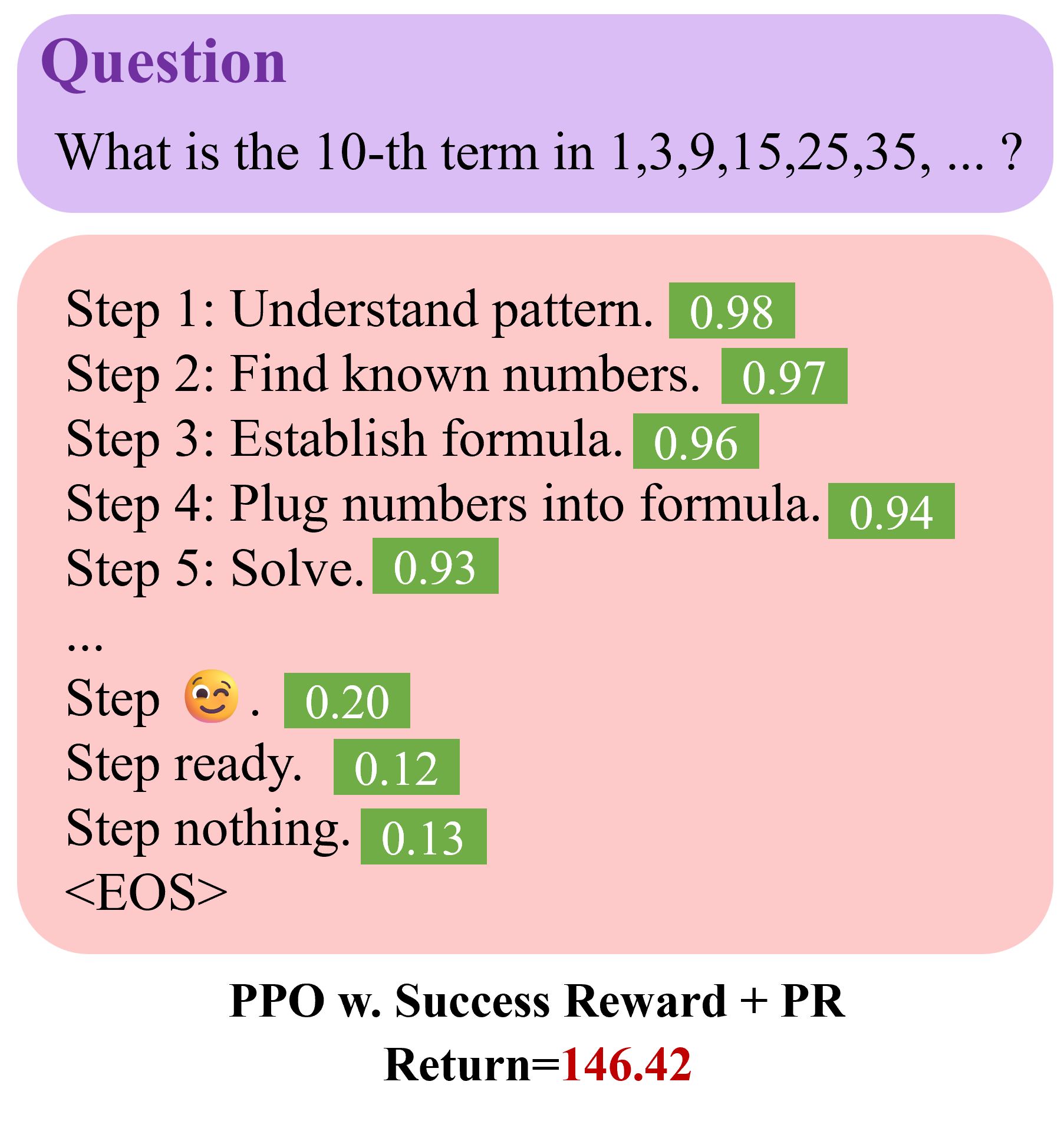
This image presents a multi-part display, likely illustrating a problem-solving process or a sequence of actions with associated numerical scores. It begins with a mathematical question, followed by a list of "steps" each paired with a numerical value in a green box. The display concludes with a summary line indicating a "Return" value. The overall context appears to be related to an AI or machine learning task, specifically mentioning "PPO w. Success Reward + PR".
### Components/Axes
The image is segmented into three main visual regions:
1. **Top Header (Purple Rounded Rectangle)**: Contains the main question.
* **Title**: "Question" (large, bold, purple text, positioned top-left).
* **Problem Statement**: "What is the 10-th term in 1,3,9,15,25,35, ... ?" (black text, centered below the title).
2. **Middle Content Area (Pink Rounded Rectangle)**: Lists a series of steps with associated numerical values.
* Each "Step" is a textual description.
* Each numerical value is presented in a distinct green rectangular box, right-aligned with its corresponding step.
3. **Bottom Footer (Grey Area)**: Provides contextual information and a final metric.
* **Contextual Label**: "PPO w. Success Reward + PR" (bold black text, left-aligned).
* **Result Metric**: "Return=146.42" (bold black text, with the numerical value "146.42" in red, left-aligned below the contextual label).
### Detailed Analysis
The middle content area presents a sequence of steps, each with an associated numerical value:
* **Step 1: Understand pattern.**
* Associated Value: `0.98` (in a green box)
* **Step 2: Find known numbers.**
* Associated Value: `0.97` (in a green box)
* **Step 3: Establish formula.**
* Associated Value: `0.96` (in a green box)
* **Step 4: Plug numbers into formula.**
* Associated Value: `0.94` (in a green box)
* **Step 5: Solve.**
* Associated Value: `0.93` (in a green box)
* **...** (Ellipsis, indicating a break or continuation)
* **Step 😊 .** (Includes a smiling face emoji)
* Associated Value: `0.20` (in a green box)
* **Step ready.**
* Associated Value: `0.12` (in a green box)
* **Step nothing.**
* Associated Value: `0.13` (in a green box)
* **<EOS>** (End of Sequence marker)
**Trend Verification (for numerical values):**
The initial five steps show a slight downward trend in their associated values: 0.98 -> 0.97 -> 0.96 -> 0.94 -> 0.93. These values are relatively high.
After the ellipsis, the values drop significantly to 0.20, 0.12, and 0.13, which are much lower than the initial set.
### Key Observations
* The problem statement is a sequence completion task: "What is the 10-th term in 1,3,9,15,25,35, ... ?"
* The first five steps describe a logical, sequential approach to solving such a mathematical problem. Their associated values are consistently high (ranging from 0.93 to 0.98).
* There is a clear visual and numerical separation between the initial problem-solving steps and the subsequent, less descriptive "steps" (e.g., "Step 😊 .", "Step ready.", "Step nothing.").
* The values associated with these later, less descriptive steps are significantly lower (0.12 to 0.20), suggesting they might represent less optimal, irrelevant, or incorrect actions/states.
* The "<EOS>" marker indicates the termination of a sequence of steps or actions.
* The footer explicitly mentions "PPO w. Success Reward + PR" and "Return=146.42", which are terms commonly found in Reinforcement Learning (RL) contexts. PPO stands for Proximal Policy Optimization, a popular RL algorithm. "Success Reward" and "PR" (likely Policy Reward or similar) are reward mechanisms, and "Return" is a cumulative reward metric.
### Interpretation
This image likely illustrates the output or a snapshot of an AI agent (specifically, one trained with PPO) attempting to solve the given mathematical sequence problem.
1. **Problem-Solving Strategy**: The initial five steps (Understand pattern, Find known numbers, Establish formula, Plug numbers, Solve) represent a coherent and logical strategy for tackling the sequence problem. The high associated values (0.93-0.98) suggest that these steps are highly probable, highly rewarded, or represent high confidence actions/states within the agent's policy. This implies the agent has learned an effective approach.
2. **Alternative/Undesirable Actions**: The steps "Step 😊 .", "Step ready.", and "Step nothing." with their significantly lower values (0.12-0.20) likely represent alternative, less effective, or even undesirable actions or states that the agent *could* take but is less likely to, given its learned policy. The emoji in "Step 😊 ." might indicate a non-standard or less formal action.
3. **Reinforcement Learning Context**: The "PPO w. Success Reward + PR" and "Return=146.42" strongly indicate that this is a demonstration of a Reinforcement Learning agent's performance. The "Return" value of 146.42 is the cumulative reward obtained by the agent over an episode or a series of interactions, suggesting a successful outcome, possibly achieved by following the high-value steps. The numerical values next to each step could be the immediate reward received for taking that step, the probability of taking that step, or a value function estimate for that state. Given the context of "Success Reward", these values are most likely related to the reward or probability of successful progression.
4. **Overall Narrative**: The image tells a story of an AI agent being presented with a problem, demonstrating a learned sequence of high-value actions to solve it, and achieving a positive overall return. The inclusion of low-value alternative steps highlights the agent's ability to differentiate between effective and ineffective actions. The "<EOS>" marks the end of the agent's thought process or action sequence for this particular problem instance.