## Line Graph: critic/score/mean
### Overview
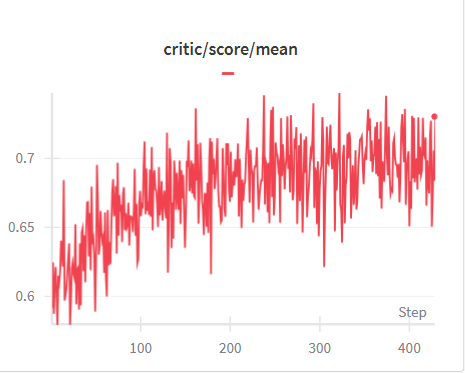
The image is a line graph depicting the "critic/score/mean" metric over a series of steps. The graph shows a red line with significant fluctuations, starting near 0.6 and ending at approximately 0.73. The x-axis represents "Step" (0–400), and the y-axis represents the "critic/score/mean" value (0.6–0.75). The line exhibits high variability, with sharp peaks and troughs throughout the range.
### Components/Axes
- **Title**: "critic/score/mean" (centered at the top).
- **X-axis**: Labeled "Step" with increments of 100 (0, 100, 200, 300, 400).
- **Y-axis**: Labeled "critic/score/mean" with increments of 0.05 (0.6, 0.65, 0.7, 0.75).
- **Legend**: A red line labeled "critic/score/mean" (positioned at the top-center of the graph).
- **Line**: A single red line with jagged, irregular fluctuations.
### Detailed Analysis
- **Starting Point**: The line begins at approximately 0.6 (step 0) with a sharp initial rise.
- **Trend**: The line fluctuates wildly between 0.6 and 0.75, with no consistent upward or downward trajectory. Notable peaks occur near steps 100, 200, and 400.
- **Ending Point**: The line concludes at approximately 0.73 (step 400), with a final upward spike.
- **Uncertainty**: Values are approximate due to the jagged nature of the line. For example, the peak at step 400 is estimated at 0.73 ± 0.02.
### Key Observations
- **High Variability**: The line shows extreme fluctuations, suggesting instability or noise in the "critic/score/mean" metric.
- **Final Value**: The metric ends higher than its starting value, indicating a net increase over the 400 steps.
- **Peaks and Troughs**: Sharp drops (e.g., near step 150) and rises (e.g., near step 300) suggest abrupt changes in the metric.
### Interpretation
The data suggests that the "critic/score/mean" metric is highly volatile, with no clear pattern of improvement or decline. The final value of ~0.73 implies a marginal improvement over the initial ~0.6, but the fluctuations may indicate inconsistent performance or external factors influencing the metric. The lack of a smooth trend could point to issues in data collection, model instability, or dynamic conditions affecting the critic's evaluation. The red line’s prominence in the legend confirms it represents the primary data series, and its erratic nature highlights the need for further investigation into the underlying causes of variability.