\n
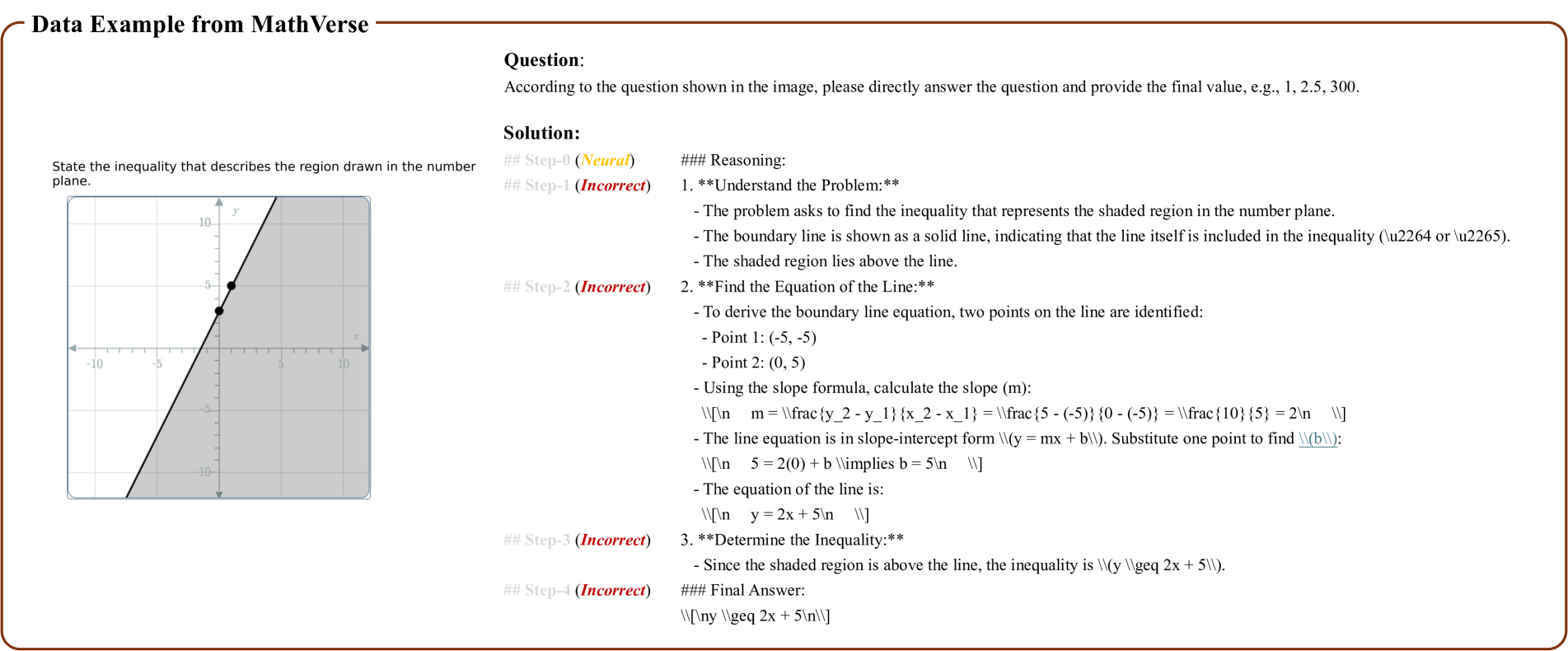
## Chart/Diagram Type: Number Plane with Inequality Shading & Solution Steps
### Overview
The image presents a number plane (Cartesian coordinate system) with a shaded region representing an inequality. Alongside the plane, a step-by-step solution process is provided to determine the inequality. The solution steps are marked as "Step-1 (Neural)", "Step-2 (Incorrect)", "Step-3 (Incorrect)", and "Step-4 (Incorrect)". The question posed is: "According to the question shown in the image, please directly answer the question and provide the final value, e.g., 1, 2, 5, 300."
### Components/Axes
* **Number Plane:**
* X-axis: Ranges from approximately -15 to 15.
* Y-axis: Ranges from approximately -10 to 10.
* Origin: Located at (0, 0).
* Gridlines: Present for both axes, aiding in coordinate identification.
* **Shaded Region:** The area above a solid line is shaded.
* **Line:** A solid line passes through the points (-5, -5) and (0, 5).
* **Solution Steps:** A series of text blocks outlining the reasoning and calculations.
* **Question:** Text block at the top-left corner.
* **Header:** "Data Example from MathVerse" at the top-center.
### Detailed Analysis or Content Details
**Number Plane:**
* The line intersects the x-axis at approximately x = -5 and the y-axis at y = 5.
* The shaded region extends infinitely upwards from the line.
**Solution Steps (Transcribed):**
* **Step-1 (Neural):**
* **Reasoning:**
* "The problem asks to find the inequality that represents the shaded region in the number plane."
* "The boundary line is shown as a solid line, indicating that the line itself is included in the inequality (≤ or ≥)."
* "The shaded region lies above the line."
* **Step-2 (Incorrect):**
* **Find the Equation of the Line:**
* "To derive the boundary line equation, two points on the line are identified:"
* "Point 1: (-5, -5)"
* "Point 2: (0, 5)"
* "Using the slope formula, calculate the slope (m):"
* `m = (y₂ - y₁) / (x₂ - x₁) = (5 - (-5)) / (0 - (-5)) = (10) / (5) = 2`
* "The line equation is in slope-intercept form (y = mx + b). Substitute one point to find b:"
* `5 = 2(0) + b implies b = 5`
* "The equation of the line is:"
* `y = 2x + 5`
* **Step-3 (Incorrect):**
* **Determine the Inequality:**
* "Since the shaded region is above the line, the inequality is y > (geq 2x + 5)."
* **Step-4 (Incorrect):**
* **Final Answer:**
* `y (geq 2x + 5)`
**Question:**
* "According to the question shown in the image, please directly answer the question and provide the final value, e.g., 1, 2, 5, 300."
### Key Observations
* The solution steps are labeled as "Incorrect" despite providing a seemingly logical process.
* The final answer provided is `y (geq 2x + 5)`, which is incorrect. The correct inequality should be `y ≥ 2x + 5`.
* The slope calculation and line equation derivation are accurate.
* The error lies in the final inequality determination, where ">=" is used instead of "≥".
### Interpretation
The image demonstrates a problem-solving approach to determining the inequality represented by a shaded region on a number plane. The solution attempts to find the equation of the boundary line and then determine the inequality based on the shaded region's position relative to the line. However, the final answer is incorrect, indicating a misunderstanding of the inequality symbols or a typographical error. The question at the top is a meta-question, asking for a numerical answer to a problem that requires an inequality as a solution, which is a mismatch. The "Neural" label on Step-1 suggests this might be output from an AI system, and the subsequent "Incorrect" labels indicate a failure in the AI's reasoning or output. The image serves as a case study in identifying errors in mathematical reasoning and the importance of careful attention to detail. The provided solution is a good attempt, but ultimately flawed.