\n
## Diagram: Neuro-Symbolic Integration and Applications
### Overview
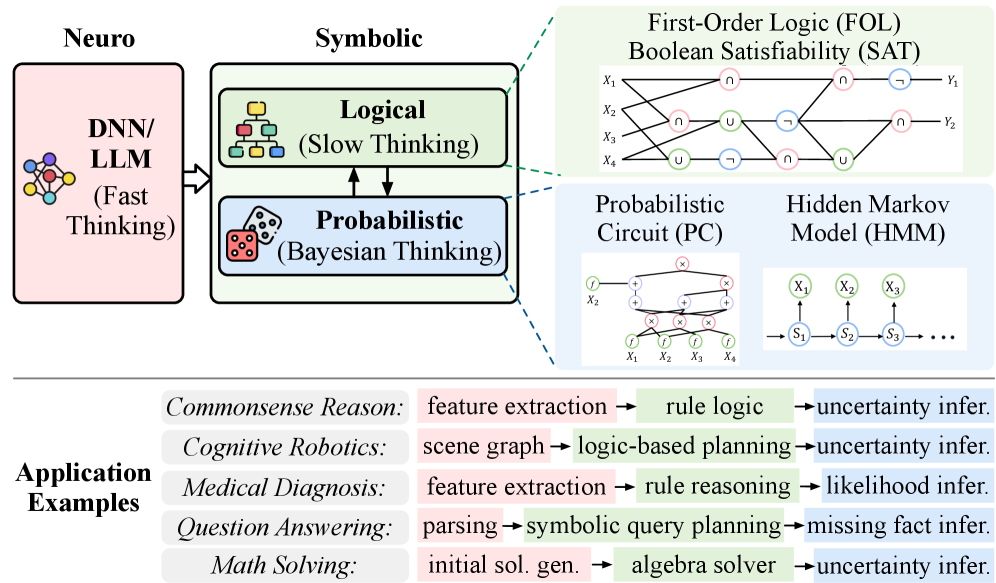
The image is a diagram illustrating the integration of neuro (DNN/LLM) and symbolic reasoning approaches, along with examples of their application. It depicts a flow of information between these two paradigms, and how they connect to specific logical and probabilistic models. The diagram is divided into three main sections: a central integration area, a symbolic reasoning section with model examples, and an application examples section.
### Components/Axes
The diagram consists of the following components:
* **Neuro (DNN/LLM):** Represented by a globe with interconnected nodes and labeled "(Fast Thinking)".
* **Symbolic:** Represented by a rectangular box labeled "Symbolic".
* **Logical (Slow Thinking):** A brain icon within the "Symbolic" box, labeled "(Slow Thinking)".
* **Probabilistic (Bayesian Thinking):** A set of interconnected spheres within the "Symbolic" box, labeled "(Bayesian Thinking)".
* **First-Order Logic (FOL):** A diagram of interconnected nodes labeled x1, x2, x3, x4, and y1, y2. Nodes are connected by symbols '∧' (AND) and '¬' (NOT).
* **Boolean Satisfiability (SAT):** Similar to FOL, a diagram of interconnected nodes labeled x1, x2, x3, x4. Nodes are connected by symbols '∧' (AND) and '¬' (NOT).
* **Probabilistic Circuit (PC):** A diagram of interconnected nodes labeled x1, x2, x3, x4, and a node labeled 'f'. Nodes are connected by symbols '+', 'x', and 'l'.
* **Hidden Markov Model (HMM):** A diagram of interconnected nodes labeled x1, x2, x3, and S1, S2, S3.
* **Application Examples:** A list of applications with corresponding process flows.
### Detailed Analysis or Content Details
The diagram shows a bidirectional flow of information between the "Neuro" and "Symbolic" sections, indicated by arrows. Within the "Symbolic" section, there's a connection between "Logical" and "Probabilistic" thinking.
**Symbolic Reasoning Models:**
* **First-Order Logic (FOL):** The diagram shows a network of variables (x1-x4, y1-y2) connected by logical operators.
* **Boolean Satisfiability (SAT):** Similar to FOL, a network of variables (x1-x4) connected by logical operators.
* **Probabilistic Circuit (PC):** A network of variables (x1-x4, f) connected by arithmetic and logical operators.
* **Hidden Markov Model (HMM):** A sequence of states (S1-S3) connected to observations (x1-x3).
**Application Examples:**
* **Commonsense Reason:** feature extraction → rule logic → uncertainty infer.
* **Cognitive Robotics:** scene graph → logic-based planning → uncertainty infer.
* **Medical Diagnosis:** feature extraction → rule reasoning → likelihood infer.
* **Question Answering:** parsing → symbolic query planning → missing fact infer.
* **Math Solving:** initial sol. gen. → algebra solver → uncertainty infer.
### Key Observations
The diagram highlights the interplay between "fast" (neuro) and "slow" (symbolic) thinking. The application examples demonstrate how this integration can be used in various domains. The consistent presence of "uncertainty infer." in the application examples suggests a focus on handling incomplete or noisy information. The diagram emphasizes the use of rule-based systems and logical reasoning within the symbolic framework.
### Interpretation
The diagram illustrates a modern approach to AI that combines the strengths of neural networks (pattern recognition, fast processing) with symbolic reasoning (logic, explainability). The neuro component provides the initial feature extraction or representation, which is then fed into the symbolic component for reasoning and inference. The applications demonstrate the versatility of this approach, ranging from commonsense reasoning to complex tasks like medical diagnosis and math solving. The inclusion of probabilistic models suggests an attempt to handle uncertainty and noise in real-world data. The diagram suggests that the integration of neuro-symbolic approaches is a promising direction for building more robust and intelligent AI systems. The consistent flow towards "uncertainty infer." suggests that a key goal of this integration is to improve the ability of AI systems to reason under conditions of incomplete or unreliable information.