## Diagram: Cognitive Models and Applications
### Overview
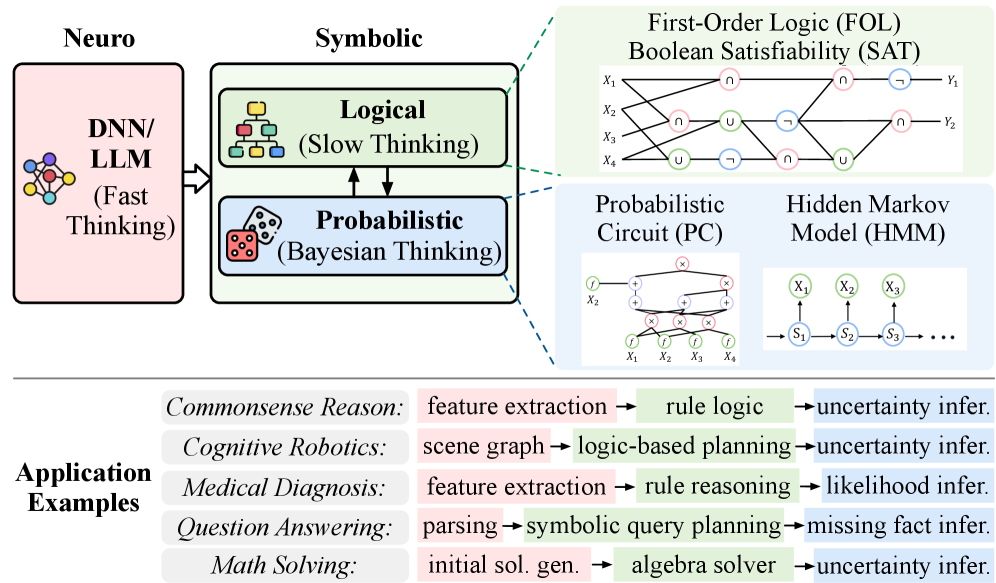
The diagram illustrates a comparison between **Neuro** (data-driven, fast thinking) and **Symbolic** (logic/probabilistic, slow thinking) cognitive models, along with their applications in reasoning tasks. It highlights how different models (e.g., DNN/LLM, FOL, SAT, PC, HMM) are applied to domains like commonsense reasoning, robotics, and math solving.
---
### Components/Axes
1. **Neuro (Fast Thinking)**
- **DNN/LLM**: Represented by a neural network icon.
- **Probabilistic (Bayesian Thinking)**: Represented by dice icons.
2. **Symbolic (Slow Thinking)**
- **Logical (Slow Thinking)**: Includes:
- **First-Order Logic (FOL)**
- **Boolean Satisfiability (SAT)**
- **Probabilistic (Bayesian Thinking)**: Includes:
- **Probabilistic Circuit (PC)**
- **Hidden Markov Model (HMM)**
3. **Application Examples**
- **Commonsense Reasoning**:
- Flow: `feature extraction → rule logic → uncertainty infer.`
- **Cognitive Robotics**:
- Flow: `scene graph → logic-based planning → uncertainty infer.`
- **Medical Diagnosis**:
- Flow: `feature extraction → rule reasoning → likelihood infer.`
- **Question Answering**:
- Flow: `parsing → symbolic query planning → missing fact infer.`
- **Math Solving**:
- Flow: `initial sol. gen. → algebra solver → uncertainty infer.`
---
### Detailed Analysis
- **Neuro Components**:
- DNN/LLM (Fast Thinking) is linked to applications requiring rapid pattern recognition (e.g., feature extraction).
- Probabilistic models (Bayesian Thinking) handle uncertainty via dice icons, suggesting stochastic reasoning.
- **Symbolic Components**:
- **Logical**: FOL/SAT are formal systems for rule-based reasoning (e.g., Boolean circuits in SAT).
- **Probabilistic**: PC/HMM model uncertainty via probabilistic dependencies (e.g., Hidden Markov Models for sequential data).
- **Application Flows**:
- Each application example maps to a specific cognitive pathway. For instance:
- **Medical Diagnosis** uses rule reasoning (symbolic) to infer likelihoods (probabilistic).
- **Math Solving** transitions from symbolic initial solution generation to algebraic solvers and uncertainty inference.
---
### Key Observations
1. **Dual Cognitive Paradigms**:
- Neuro models (fast thinking) prioritize speed and pattern recognition.
- Symbolic models (slow thinking) emphasize structured logic and uncertainty quantification.
2. **Interdisciplinary Applications**:
- All applications integrate both neuro and symbolic components, suggesting hybrid systems (e.g., neuro-symbolic AI).
3. **Uncertainty Handling**:
- Uncertainty inference appears in multiple applications (e.g., robotics, math solving), indicating its cross-domain importance.
---
### Interpretation
The diagram underscores the synergy between neuro and symbolic AI. Neuro models excel at fast, data-driven tasks (e.g., feature extraction), while symbolic models provide rigorous frameworks for logic, planning, and uncertainty. Applications like medical diagnosis and robotics rely on hybrid approaches, combining neuro efficiency with symbolic precision. The emphasis on uncertainty inference across domains highlights its role in real-world decision-making under ambiguity.
**Note**: No numerical data or trends are present; the diagram focuses on conceptual relationships and workflows.