## Diagram: Sorting Network
### Overview
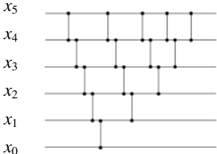
The image depicts a sorting network diagram, a visual representation of a sequence of comparisons that can sort a set of numbers. The diagram consists of horizontal lines representing the numbers to be sorted and vertical connections indicating comparisons and potential swaps.
### Components/Axes
* **Horizontal Lines:** Represent the input numbers x0, x1, x2, x3, x4, and x5. These are labeled vertically on the left side of the diagram.
* **Vertical Connections:** Represent comparators. A comparator connects two horizontal lines, indicating that the numbers on those lines are compared. If they are out of order, they are swapped.
### Detailed Analysis
The diagram shows a series of comparators arranged in columns. The comparators are represented by vertical lines connecting two horizontal lines. The network sorts the input numbers by performing a sequence of comparisons and swaps.
* **Input Lines:** The input lines are labeled x0, x1, x2, x3, x4, and x5 from bottom to top.
* **Comparators:** The comparators are arranged in a specific pattern to ensure that the numbers are sorted correctly.
* The first column of comparators connects x0-x1, x2-x3, and x4-x5.
* The second column connects x1-x2 and x3-x4.
* The third column connects x0-x1, x2-x3, and x4-x5.
* The fourth column connects x1-x2 and x3-x4.
* The fifth column connects x0-x1, x2-x3, and x4-x5.
### Key Observations
The diagram shows a sorting network that sorts six numbers. The network consists of a series of comparators arranged in a specific pattern. The comparators compare pairs of numbers and swap them if they are out of order. The network ensures that the numbers are sorted correctly after all the comparisons have been performed.
### Interpretation
The sorting network diagram illustrates a parallel sorting algorithm. The comparators can operate simultaneously, making the sorting process faster than sequential sorting algorithms. The specific arrangement of comparators determines the efficiency and correctness of the sorting network. This particular network appears to be designed for sorting six elements, and its structure reflects the comparisons needed to achieve a fully sorted output.