## Line Graph: Training Loss Comparison
### Overview
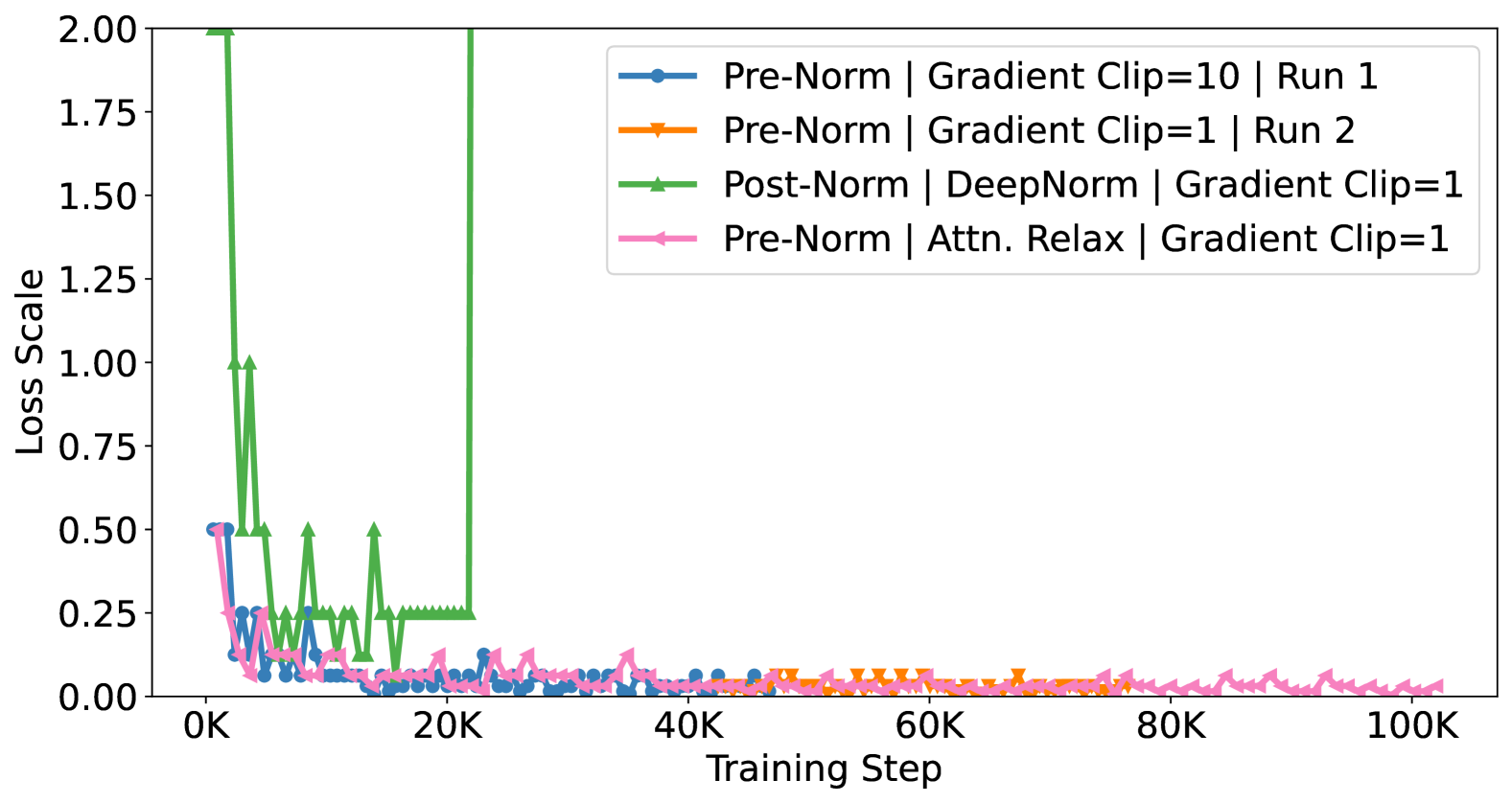
The line graph shows the training loss over 100,000 steps for four different models: Pre-Norm, Pre-Norm with Gradient Clip=1, Post-Norm with DeepNorm and Gradient Clip=1, and Pre-Norm with Attention Relax and Gradient Clip=1. The loss scale is on the y-axis, ranging from 0.00 to 2.00, and the training step is on the x-axis.
### Components/Axes
- **Y-axis**: Loss Scale, ranging from 0.00 to 2.00.
- **X-axis**: Training Step, ranging from 0K to 100K.
- **Legend**: Four lines, each representing a different model.
- **Pre-Norm | Gradient Clip=10 | Run 1**: Blue line with small markers.
- **Pre-Norm | Gradient Clip=1 | Run 2**: Orange line with small markers.
- **Post-Norm | DeepNorm | Gradient Clip=1**: Green line with small markers.
- **Pre-Norm | Attention Relax | Gradient Clip=1**: Pink line with small markers.
### Detailed Analysis
- **Pre-Norm with Gradient Clip=10**: Shows a sharp increase in loss at the beginning, followed by a gradual decline.
- **Pre-Norm with Gradient Clip=1**: Exhibits a more stable loss pattern with minor fluctuations.
- **Post-Norm with DeepNorm**: Displays a consistent loss pattern with slight variations.
- **Pre-Norm with Attention Relax**: Shows a similar trend to Pre-Norm with Gradient Clip=1, with a slight increase in loss at the beginning.
### Key Observations
- **Pre-Norm with Gradient Clip=10** has the highest loss at the beginning, indicating a potential issue with the model's initial training.
- **Pre-Norm with Gradient Clip=1** and **Pre-Norm with Attention Relax** show more stable loss patterns.
- **Post-Norm with DeepNorm** maintains a consistent loss pattern with minor fluctuations.
### Interpretation
The data suggests that the Pre-Norm model with Gradient Clip=10 may be overfitting or experiencing instability during training. The Pre-Norm models with Gradient Clip=1 and Attention Relax show more stable performance, indicating that these models may be better suited for the task at hand. The Post-Norm model with DeepNorm also performs well, suggesting that normalization techniques can be beneficial for the model's training.