## Puzzle Grid: Assorted Puzzle Types
### Overview
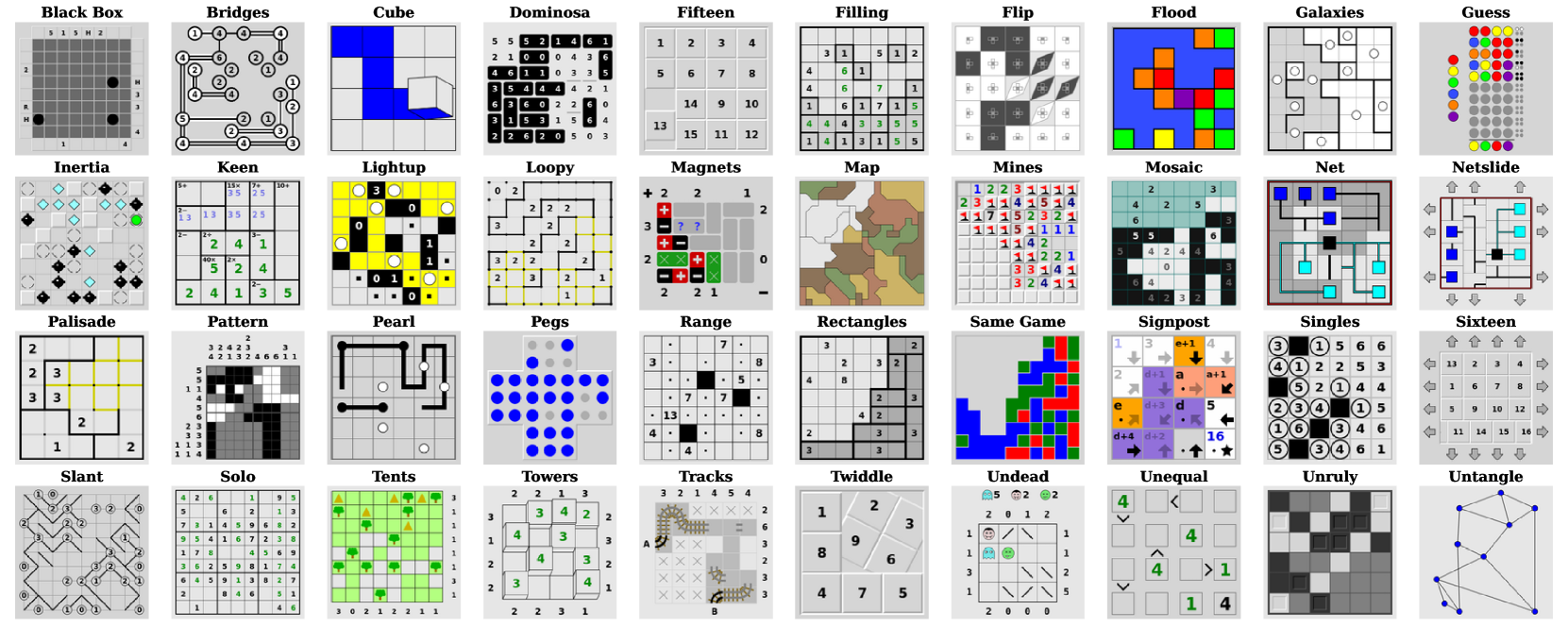
The image presents a grid of 36 different puzzle types, each displayed as a small example or initial state. The puzzles vary in style and mechanics, including grid-based logic puzzles, connection puzzles, and number puzzles.
### Components/Axes
The image is organized as a 6x6 grid of puzzle examples. Each puzzle has a title above it, indicating the puzzle type.
The puzzle types are:
1. Black Box
2. Bridges
3. Cube
4. Dominosa
5. Fifteen
6. Filling
7. Flip
8. Flood
9. Galaxies
10. Guess
11. Inertia
12. Keen
13. Lightup
14. Loopy
15. Magnets
16. Map
17. Mines
18. Mosaic
19. Net
20. Netslide
21. Palisade
22. Pattern
23. Pearl
24. Pegs
25. Range
26. Rectangles
27. Same Game
28. Signpost
29. Singles
30. Sixteen
31. Slant
32. Solo
33. Tents
34. Towers
35. Tracks
36. Twiddle
37. Undead
38. Unequal
39. Unruly
40. Untangle
### Detailed Analysis or Content Details
Here's a breakdown of some of the puzzle examples:
* **Black Box:** A grid with numbers along the edges and black circles inside. The grid is 9x9. Numbers 5, 1, 5, 1, 5, 1, 5, 1, 5, H, 2 are along the top. Numbers 1, 2, 3, 4 are along the bottom. Numbers 1, 2, 3, 4 are along the left. Numbers H, 2, 3, 3 are along the right.
* **Bridges:** A network of circles with numbers inside, connected by lines.
* **Cube:** A 2D representation of a 3D cube.
* **Dominosa:** A grid of numbers, where the goal is to find pairs of numbers that form dominoes.
* **Fifteen:** A sliding tile puzzle with numbers 1 through 15.
* **Filling:** A grid with numbers indicating how many cells in a row or column should be filled.
* **Flip:** A grid with shaded and unshaded cells, where flipping a cell changes the state of adjacent cells.
* **Flood:** A grid of colored squares, where the goal is to make the entire grid one color by changing the color of the top-left square.
* **Galaxies:** A grid with circles, where the goal is to divide the grid into regions, each containing a circle.
* **Guess:** A color-based logic puzzle.
* **Inertia:** A grid with diamonds and squares, where the goal is to move a ball to a target.
* **Keen:** A grid with numbers and cages, where the numbers in each cage must satisfy a given operation.
* **Lightup:** A grid with black and white cells, where the goal is to place light bulbs to illuminate all white cells.
* **Loopy:** A grid of cells, where the goal is to draw a loop that passes through some of the cells.
* **Magnets:** A grid with plus and minus signs, where the goal is to place magnets in the cells.
* **Map:** A puzzle with different colored regions.
* **Mines:** A grid with numbers indicating the number of mines in adjacent cells.
* **Mosaic:** A grid with numbers.
* **Net:** A grid with squares and lines.
* **Netslide:** A grid with squares and arrows.
* **Palisade:** A grid with numbers.
* **Pattern:** A grid with black and white cells.
* **Pearl:** A grid with circles and lines.
* **Pegs:** A grid with blue circles.
* **Range:** A grid with numbers.
* **Rectangles:** A grid with numbers.
* **Same Game:** A grid of colored squares, where the goal is to remove groups of squares of the same color.
* **Signpost:** A grid with arrows and numbers.
* **Singles:** A grid with numbers.
* **Sixteen:** A grid with numbers.
* **Slant:** A grid with lines.
* **Solo:** A grid with numbers.
* **Tents:** A grid with trees and numbers.
* **Towers:** A grid with numbers.
* **Tracks:** A grid with tracks.
* **Twiddle:** A puzzle with numbered tiles.
* **Undead:** A grid with symbols.
* **Unequal:** A grid with numbers and inequality signs.
* **Unruly:** A grid with black and white cells.
* **Untangle:** A graph with nodes and edges.
### Key Observations
The image provides a diverse collection of puzzle types, showcasing different problem-solving skills and game mechanics. The puzzles range from simple logic puzzles to more complex spatial reasoning challenges.
### Interpretation
The image serves as a visual catalog of various puzzle types, demonstrating the breadth and variety within the puzzle genre. It highlights the different approaches to problem-solving and the diverse mechanics used to create engaging and challenging games. The collection could be used to introduce someone to different puzzle styles or to provide a visual reference for puzzle enthusiasts.