\n
## Grid of Puzzle Game Visualizations
### Overview
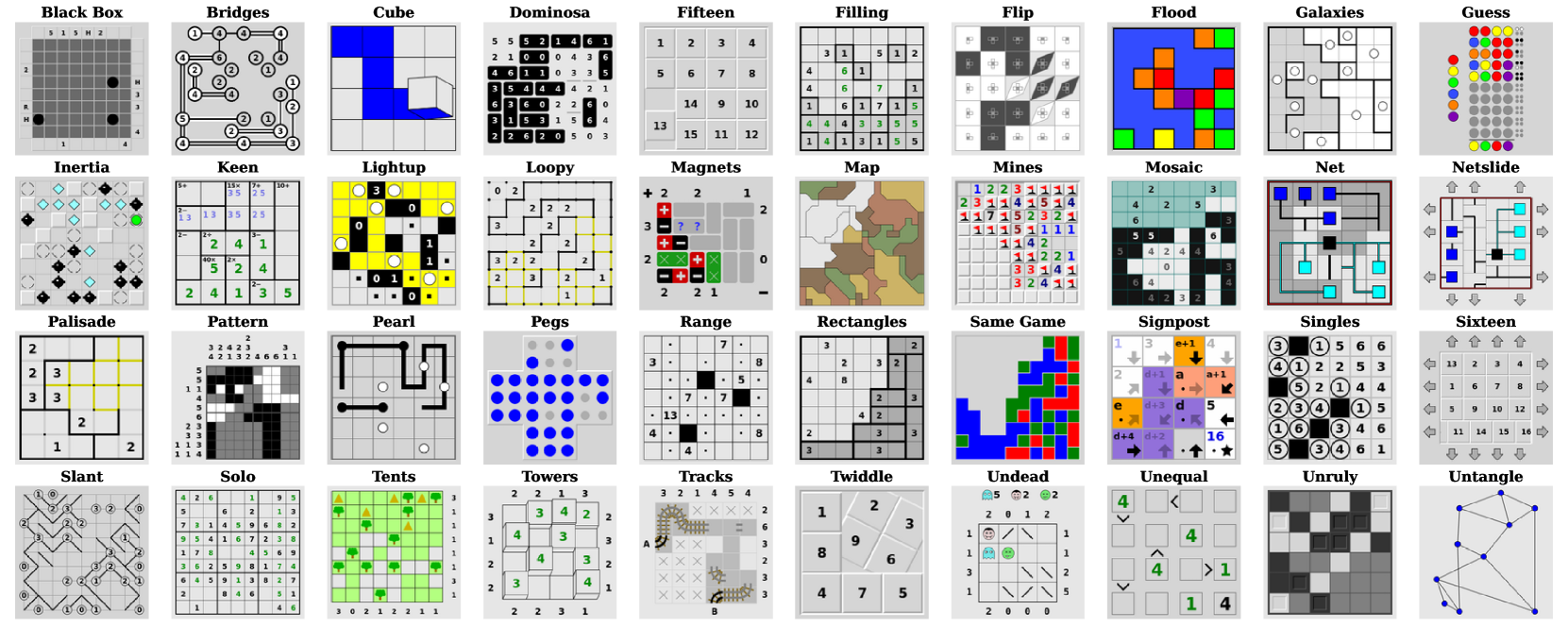
The image presents a grid of 24 distinct puzzle game visualizations. Each visualization appears to represent the initial state or a key element of a specific puzzle. The puzzles are arranged in a 6x4 grid. The image does not contain numerical data in the traditional sense, but rather visual representations of puzzle states.
### Components/Axes
The image is organized as a grid. There are no explicit axes or legends in the traditional chart sense. Each cell in the grid contains a unique puzzle visualization. The puzzles are labeled with names below each image: Black Box, Bridges, Cube, Dominoes, Fifteen, Filling, Flip, Flood, Galaxies, Guess, Inertia, Keen, Lightup, Loopy, Magnets, Map, Mosaic, Net, Netslide, Palisade, Pattern, Pegs, Range, Rectangles, Same Game, Signpost, Singles, Sixteen, Slant, Solo, Tents, Towers, Tracks, Twiddle, Undead, Unequal, Untangle.
### Detailed Analysis or Content Details
Here's a description of each puzzle visualization, moving left to right, top to bottom. Note that these are descriptions of the visual elements, not solutions to the puzzles.
1. **Black Box:** A 3x3 grid with numbered cells (1-9) and lines connecting some of them.
2. **Bridges:** A grid of nodes with lines connecting them, representing bridges.
3. **Cube:** A 3D cube with colored faces.
4. **Dominoes:** A grid with numbered cells and dominoes placed on some of them. Numbers range from 1-6.
5. **Fifteen:** A 4x4 grid with numbered tiles (1-15) and one empty space.
6. **Filling:** A grid with cells of varying shades of gray.
7. **Flip:** A grid with cells colored black and white.
8. **Flood:** A grid with cells colored in various shades, suggesting a flooding pattern.
9. **Galaxies:** A grid of circles, some filled, some empty, representing galaxies.
10. **Guess:** A grid of colored circles. Colors include red, green, blue, yellow, and purple.
11. **Inertia:** A grid with colored shapes and lines.
12. **Keen:** A grid with numbered cells (0-15) and colored regions.
13. **Lightup:** A grid with numbered cells and bulbs.
14. **Loopy:** A grid with numbered cells and lines forming loops.
15. **Magnets:** A grid with numbered cells and plus/minus signs. Numbers range from -2 to 2.
16. **Map:** A grid with cells colored in shades of brown and green, resembling a map.
17. **Mosaic:** A grid with cells colored in various shades of blue and gray.
18. **Net:** A grid with cells colored black and white, forming a net-like pattern.
19. **Netslide:** A grid with colored cells and arrows.
20. **Palisade:** A grid with numbered cells (1-3) and lines forming palisades.
21. **Pattern:** A grid with numbered cells (0-4) and colored regions.
22. **Pegs:** A grid with pegs placed in some cells.
23. **Range:** A grid with numbered cells (1-13) and lines.
24. **Rectangles:** A grid with cells colored black and white, forming rectangles.
25. **Same Game:** A grid with colored squares. Colors include red, green, blue, and yellow.
26. **Signpost:** A grid with numbered cells and arrows. Equations are present: e=1, a+1, a+2, d+4, k=16.
27. **Singles:** A grid with numbered cells (1-6) and colored regions.
28. **Sixteen:** A 4x4 grid with numbered tiles (1-16).
29. **Slant:** A grid with numbered cells (1-2) and lines.
30. **Solo:** A grid with numbered cells (0-4) and colored regions.
31. **Tents:** A grid with numbered cells and tent-like structures.
32. **Towers:** A grid with numbered cells and tower-like structures.
33. **Tracks:** A grid with numbered cells (1-8) and lines forming tracks.
34. **Twiddle:** A grid with numbered cells (1-7) and lines.
35. **Undead:** A grid with numbered cells (1-9) and colored regions.
36. **Unequal:** A grid with numbered cells and colored regions.
37. **Untangle:** A grid with lines and nodes.
### Key Observations
The image showcases a diverse collection of puzzle types. The visual complexity varies significantly between puzzles. Some puzzles rely on numerical clues (e.g., Fifteen, Dominoes), while others are more visually oriented (e.g., Flood, Galaxies). The color palettes used are also diverse, with each puzzle employing a unique set of colors.
### Interpretation
The image serves as a catalog or overview of various logic and spatial reasoning puzzles. It doesn't present data in the traditional sense, but rather visual representations of puzzle states. The arrangement in a grid suggests a classification or categorization of puzzle types. The image is likely intended for someone interested in exploring different puzzle games or for a resource listing available puzzles. The variety of puzzles suggests a broad range of cognitive skills are engaged, from numerical reasoning to pattern recognition and spatial awareness. The inclusion of puzzle names provides a clear identification of each game. The image is a visual index, not a data analysis.