## Diagram: Comparison of Three Methodological Approaches
### Overview
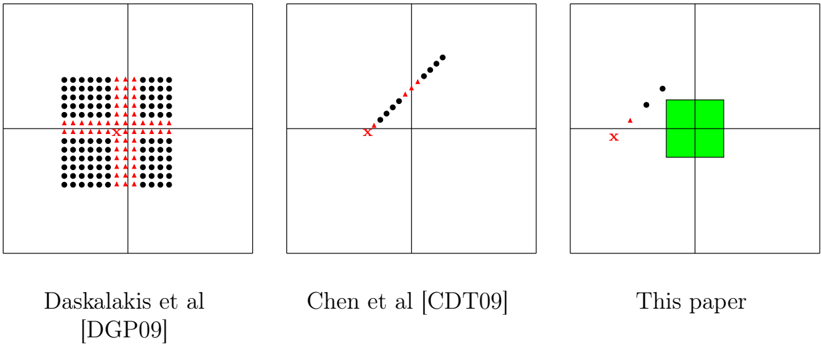
The image displays three horizontally arranged square panels, each containing a schematic diagram with geometric elements. Below each panel is a citation label. The diagrams appear to compare different spatial distributions or sampling patterns, likely from academic papers in a technical field such as computational geometry, machine learning, or statistical sampling.
### Components/Axes
* **Panels:** Three identical square frames, each divided into four quadrants by a central vertical and horizontal line (crosshairs).
* **Symbols:**
* Black dots (•)
* Red triangles (▲)
* Red 'x' (x)
* Green filled square (■) - present only in the third panel.
* **Labels/Citations (Text below each panel):**
* Left Panel: `Daskalakis et al [DGP09]`
* Middle Panel: `Chen et al [CDT09]`
* Right Panel: `This paper`
* **Language:** The text is in English. The citations use standard academic reference format.
### Detailed Analysis
**Panel 1 (Left - Daskalakis et al [DGP09]):**
* **Spatial Grounding:** Centered within the panel.
* **Content:** A dense, uniform grid of black dots forms a square shape. Overlaid on this grid is a cross-shaped pattern of red triangles. A single red 'x' is positioned at the exact center of the panel, where the crosshairs intersect.
* **Trend/Pattern:** Represents a dense, regular, and exhaustive sampling or solution space covering a central region.
**Panel 2 (Middle - Chen et al [CDT09]):**
* **Spatial Grounding:** Elements are aligned along a diagonal from the lower-left to the upper-right quadrant.
* **Content:** A sequence of black dots forms a straight diagonal line. Red triangles are interspersed along this same line. A red 'x' is located at the lower-left end of this diagonal sequence.
* **Trend/Pattern:** Represents a sparse, linear, or one-dimensional set of points or solutions.
**Panel 3 (Right - This paper):**
* **Spatial Grounding:** The green square is centered. Other elements are scattered in the upper-left quadrant relative to it.
* **Content:** A solid green square is centered on the panel's crosshairs. To the upper-left of this square, there are three black dots and two red triangles in a loose, non-linear cluster. A red 'x' is positioned further to the left, isolated from the cluster.
* **Trend/Pattern:** Represents a focused, bounded region of interest (the green square) with a few associated sample points or candidate solutions nearby, and a distinct reference point (the 'x').
### Key Observations
1. **Progression of Density:** The visual density of elements decreases from left (dense grid) to middle (single line) to right (sparse cluster + solid shape).
2. **Introduction of a New Element:** The green square is a unique component introduced in the third panel ("This paper"), suggesting a novel concept like a target region, a feasible set, or an optimal solution area.
3. **Consistent Symbolism:** The red 'x' appears in all three panels, likely serving as a common reference point (e.g., a query point, initial guess, or origin). The red triangles and black dots are also consistent symbols, though their arrangement changes drastically.
4. **Spatial Relationships:** The diagrams emphasize the spatial relationship between the reference point ('x'), the set of points (dots/triangles), and, in the final case, a defined region (green square).
### Interpretation
This image is a conceptual comparison of methodologies from three different research works. It visually argues for the novelty and potential superiority of the approach presented in "This paper."
* **Daskalakis et al [DGP09]** likely represents a brute-force or exhaustive method, checking a dense grid of possibilities.
* **Chen et al [CDT09]** likely represents a more efficient, guided search along a specific line or manifold.
* **"This paper"** proposes a method that identifies a specific, promising region (the green square) and performs a localized, sparse search around it, relative to a reference point. This suggests an approach that is more targeted and potentially more efficient than checking a full grid or a single line, as it focuses computational effort on a relevant subspace. The progression implies an evolution in the field towards smarter, region-based optimization or sampling techniques.