## [Diagram Type]: Knowledge Graph Reasoning Process
### Overview
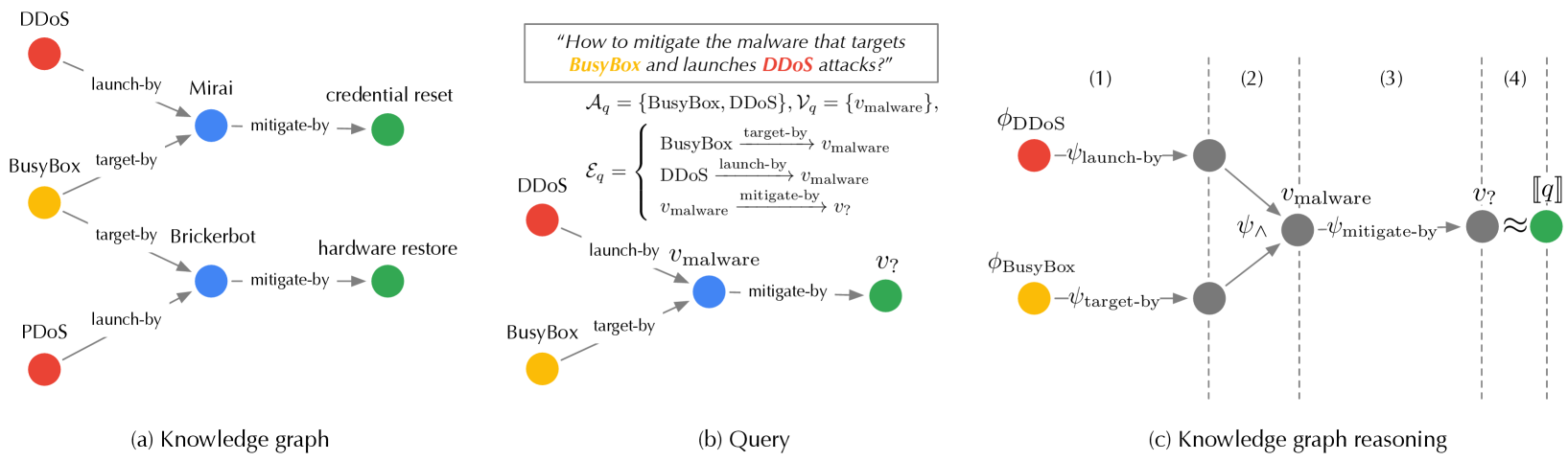
This image illustrates a three-part conceptual framework for performing reasoning over a knowledge graph. It moves from a static knowledge graph representation (a) to a formal query definition (b), and finally to a computational reasoning process (c) that resolves the query. The context is cybersecurity, specifically identifying mitigation strategies for malware targeting "BusyBox" devices.
### Components/Axes
The diagram uses a consistent color-coding scheme for nodes across all three sections:
* **Red Nodes:** Represent attack types (DDoS, PDoS).
* **Yellow Node:** Represents the target device (BusyBox).
* **Blue Nodes:** Represent specific malware instances (Mirai, Brickerbot).
* **Green Nodes:** Represent mitigation strategies (credential reset, hardware restore).
* **Grey Nodes:** Represent abstract variables or intermediate reasoning states.
### Detailed Analysis
#### (a) Knowledge Graph
This section displays the raw data structure.
* **Top Cluster:** A "DDoS" (red) node connects to "Mirai" (blue) via a "launch-by" edge. "BusyBox" (yellow) connects to "Mirai" (blue) via a "target-by" edge. "Mirai" (blue) connects to "credential reset" (green) via a "mitigate-by" edge.
* **Bottom Cluster:** "BusyBox" (yellow) connects to "Brickerbot" (blue) via a "target-by" edge. "PDoS" (red) connects to "Brickerbot" (blue) via a "launch-by" edge. "Brickerbot" (blue) connects to "hardware restore" (green) via a "mitigate-by" edge.
#### (b) Query
This section formalizes the natural language question into a graph-based query.
* **Text:** "How to mitigate the malware that targets BusyBox and launches DDoS attacks?"
* **Formalization:**
* $\mathcal{A}_q = \{\text{BusyBox, DDoS}\}$ (The set of known entities).
* $\mathcal{V}_q = \{v_{\text{malware}}\}$ (The variable to be solved).
* $\mathcal{E}_q = \{ \text{BusyBox} \xrightarrow{\text{target-by}} v_{\text{malware}}, \text{DDoS} \xrightarrow{\text{launch-by}} v_{\text{malware}}, v_{\text{malware}} \xrightarrow{\text{mitigate-by}} v_? \}$
* **Visual Graph:** Shows the query structure: A central variable node $v_{\text{malware}}$ (blue) is targeted by "BusyBox" (yellow) and launched by "DDoS" (red). The result $v_?$ (green) is the mitigation strategy.
#### (c) Knowledge Graph Reasoning
This section illustrates the computational flow, divided into four stages:
* **Stage (1):** Input embeddings $\phi_{\text{DDoS}}$ (red) and $\phi_{\text{BusyBox}}$ (yellow).
* **Stage (2):** Projection of inputs through relations $\psi_{\text{launch-by}}$ and $\psi_{\text{target-by}}$ into intermediate grey nodes.
* **Stage (3):** Intersection/Conjunction ($\psi_{\wedge}$) of the two paths into a single $v_{\text{malware}}$ node, followed by the application of the $\psi_{\text{mitigate-by}}$ relation to reach a final grey node.
* **Stage (4):** The final result $v_?$ is mapped to the green node $[q]$, representing the answer to the query.
### Key Observations
* **Logic Flow:** The diagram demonstrates a transition from symbolic data (a) to a formal query (b) to a vector-space or neural-symbolic reasoning process (c).
* **Conjunction:** The reasoning process in (c) explicitly uses a conjunction operator ($\psi_{\wedge}$) to combine the constraints of "launch-by" and "target-by," effectively filtering the knowledge graph to find the specific malware that satisfies both conditions.
* **Variable Resolution:** The notation $v_?$ represents the unknown entity (the mitigation strategy) that the system is attempting to retrieve.
### Interpretation
This diagram illustrates the architecture of a **Knowledge Graph Question Answering (KGQA)** system.
1. **Semantic Search:** The process demonstrates how a natural language question is decomposed into a subgraph pattern. The system does not just look for keywords; it looks for a specific path structure: `(DDoS) -> (launch-by) -> (Malware) <- (target-by) <- (BusyBox)`.
2. **Reasoning Mechanism:** The "Knowledge graph reasoning" section (c) suggests a neural-symbolic approach where entities and relations are embedded into a vector space ($\phi$ and $\psi$). The reasoning is performed by traversing these embeddings (projection) and intersecting them (conjunction) to isolate the correct answer.
3. **Utility:** This approach is highly effective for complex cybersecurity queries where the answer is not a single attribute but a relationship path. By identifying that "Mirai" is the only malware satisfying both the "DDoS" launch and "BusyBox" target criteria, the system can then traverse the "mitigate-by" edge to provide the correct remediation ("credential reset").