## Diagram: Guidance and Generations in a Language Model
### Overview
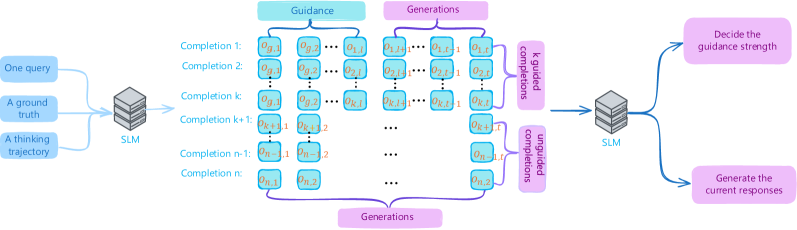
The image is a diagram illustrating the process of guidance and generation within a Statistical Language Model (SLM). It shows how input queries, ground truth, and thinking trajectories are processed by the SLM to produce guided and unguided completions across multiple generations. The diagram highlights the flow of information and the decision-making steps involved in determining guidance strength and generating current responses.
### Components/Axes
* **Input:**
* "One query" (top-left, light blue box)
* "A ground truth" (middle-left, light blue box)
* "A thinking trajectory" (bottom-left, light blue box)
* **SLM (Input):** A multi-layered cube representing the Statistical Language Model (left-center).
* **Guidance:** A light blue box labeled "Guidance" at the top-center.
* Rows labeled "Completion 1", "Completion 2", ..., "Completion k", "Completion k+1", ..., "Completion n-1", "Completion n" (left side of the Guidance section).
* Each completion row contains cells represented as o<sub>g,1</sub>, o<sub>g,2</sub>, ..., o<sub>1,1</sub>, o<sub>2,1</sub>, ..., o<sub>k,1</sub>, o<sub>k+1,1</sub>, ..., o<sub>n-1,1</sub>, o<sub>n,1</sub> and o<sub>g,2</sub>, o<sub>1,2</sub>, o<sub>2,2</sub>, ..., o<sub>k,2</sub>, o<sub>k+1,2</sub>, ..., o<sub>n-1,2</sub>, o<sub>n,2</sub>
* **Generations:** A light purple box labeled "Generations" at the top-right and bottom-center.
* Columns of cells represented as o<sub>1,l+1</sub>, o<sub>2,l+1</sub>, ..., o<sub>k,l+1</sub>, ..., o<sub>n-1,t-1</sub>, o<sub>n,2</sub>
* Each cell in the first k rows has a "1" to its right.
* **k guided completions:** A light purple box on the right side of the "Generations" section, spanning the first k rows.
* **unguided completions:** A light purple box on the right side of the "Generations" section, spanning from row k+1 to row n.
* **SLM (Output):** A multi-layered cube representing the Statistical Language Model (right-center).
* **Output:**
* "Decide the guidance strength" (top-right, light purple box)
* "Generate the current responses" (bottom-right, light purple box)
### Detailed Analysis
* **Input Processing:** The diagram starts with three inputs: "One query", "A ground truth", and "A thinking trajectory". These inputs are fed into the SLM.
* **Guidance and Generations:** The SLM processes these inputs to generate completions. The completions are organized into a grid structure under "Guidance" and "Generations".
* **Completions:** The completions are indexed as o<sub>i,j</sub>, where 'i' represents the completion number (1 to n) and 'j' represents the generation number.
* **Guided vs. Unguided Completions:** The first 'k' completions are labeled as "k guided completions", while the remaining completions (from k+1 to n) are labeled as "unguided completions". The "1" next to each of the first k rows likely indicates that these completions are guided.
* **Output Generation:** The guided and unguided completions are then fed back into the SLM.
* **Decision Making:** The SLM then makes two decisions: "Decide the guidance strength" and "Generate the current responses".
### Key Observations
* The diagram illustrates a feedback loop where the output of the SLM (completions) is fed back into the SLM for further processing.
* The distinction between guided and unguided completions suggests a mechanism for controlling the influence of the input on the generated output.
* The diagram highlights the iterative nature of the generation process, with multiple generations of completions being produced.
### Interpretation
The diagram depicts a system where a language model generates responses based on input queries, ground truth, and a "thinking trajectory." The model uses a guidance mechanism to influence the generated completions. The parameter 'k' seems to control the number of guided completions, suggesting a way to balance the influence of the input with the model's own generative capabilities. The iterative nature of the process, with multiple generations of completions, indicates a refinement or evolution of the responses over time. The final decisions on guidance strength and response generation suggest a control mechanism for tailoring the output to specific requirements.