## Image Type: Comparative Robotic Manipulation Sequences
### Overview
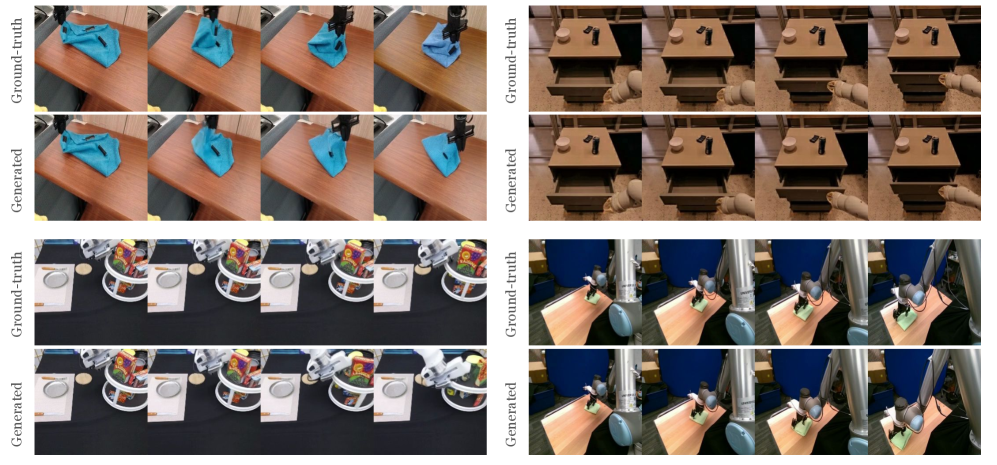
This image is a composite display featuring four distinct sets of comparative visual sequences. Each set illustrates a robotic manipulation task, presenting a "Ground-truth" sequence (actual or simulated real-world execution) alongside a "Generated" sequence (output from a generative model). The primary purpose is to demonstrate the fidelity of the generated sequences to their ground-truth counterparts across various complex manipulation scenarios. The image is structured as a 2x2 grid, with each cell containing a pair of horizontal strips labeled "Ground-truth" and "Generated".
### Components/Axes
The image is divided into four main panels, arranged in two rows and two columns.
* **Vertical Labels (Left side of each panel):**
* "Ground-truth": Denotes the top row of images within each panel, representing the actual or reference sequence of events.
* "Generated": Denotes the bottom row of images within each panel, representing the sequence produced by a generative model.
* **Horizontal Axis (Implicit):** Time or sequential steps in a manipulation task, as each row displays a series of frames progressing from left to right. There are typically 4 frames per sequence in each panel.
### Detailed Analysis
**Panel 1: Top-Left - Cloth Folding Task**
* **Ground-truth (Top Row):** Shows a black robotic gripper interacting with a light blue/cyan cloth on a light brown wooden table.
* Frame 1: The cloth is partially spread out on the table, with the gripper positioned above it.
* Frame 2: The gripper has grasped a corner of the cloth and is beginning to lift and fold it.
* Frame 3: The cloth is actively being folded, taking on a more compact, bunched shape.
* Frame 4: The cloth is neatly folded into a small, compact bundle on the table.
* **Generated (Bottom Row):** Shows a sequence highly similar to the ground-truth.
* Frame 1: The cloth and gripper position closely match the ground-truth.
* Frame 2: The gripper grasps and lifts the cloth in a similar manner.
* Frame 3: The cloth folds, mirroring the ground-truth's deformation.
* Frame 4: The cloth is folded into a compact shape, almost indistinguishable from the ground-truth.
* **Trend Verification:** Both sequences depict a robotic gripper progressively folding a piece of cloth from a spread-out state to a compact bundle. The generated sequence accurately reproduces the complex deformation of the cloth.
**Panel 2: Top-Right - Drawer Manipulation Task**
* **Ground-truth (Top Row):** Features a light beige/white robotic arm interacting with a light brown wooden cabinet that has two drawers. Two light brown cylindrical objects and two black rectangular objects are on top of the cabinet.
* Frame 1: The robotic arm's gripper is positioned near the bottom drawer, which is slightly ajar.
* Frame 2: The arm is pulling the bottom drawer further open.
* Frame 3: The bottom drawer is pulled almost fully open.
* Frame 4: The arm is pushing the bottom drawer back towards a closed position.
* **Generated (Bottom Row):** Presents a sequence that closely mirrors the ground-truth.
* Frame 1: The arm and drawer position match the ground-truth.
* Frame 2: The arm pulls the drawer open.
* Frame 3: The drawer is pulled further open.
* Frame 4: The arm pushes the drawer closed.
* **Trend Verification:** Both sequences show the robotic arm first opening a drawer and then closing it. The generated sequence accurately captures the rigid body motion of the drawer and the arm's interaction.
**Panel 3: Bottom-Left - Kitchen Item Placement Task**
* **Ground-truth (Top Row):** Displays a white/silver robotic arm interacting with various kitchen items on a black surface. Visible items include two white rectangular placemats/boards, each with a silver oval plate, and two white circular stands holding colorful food containers/boxes.
* Frame 1: The robotic arm is positioned above the rightmost silver oval plate.
* Frame 2: The arm's gripper has grasped the rightmost silver oval plate.
* Frame 3: The arm is lifting the grasped plate.
* Frame 4: The arm is moving the plate, having lifted it off the placemat.
* **Generated (Bottom Row):** Shows a sequence highly consistent with the ground-truth.
* Frame 1: The arm's initial position above the plate is replicated.
* Frame 2: The arm grasps the plate.
* Frame 3: The arm lifts the plate.
* Frame 4: The arm moves the plate, maintaining visual fidelity.
* **Trend Verification:** Both sequences illustrate the robotic arm grasping and lifting a silver oval plate from a black surface. The generated sequence accurately reproduces the appearance of the objects and the robotic arm's movement.
**Panel 4: Bottom-Right - Small Object Grasping Task**
* **Ground-truth (Top Row):** Features a silver robotic arm with a blue joint, interacting with a small, light green rectangular object on a light brown wooden surface.
* Frame 1: The robotic arm's gripper is positioned directly above the small green object.
* Frame 2: The gripper has closed around and grasped the green object.
* Frame 3: The arm is lifting the green object off the surface.
* Frame 4: The arm is moving the lifted green object. A thin red outline is visible around the green object, possibly indicating a detected feature or target.
* **Generated (Bottom Row):** Presents a sequence that closely matches the ground-truth.
* Frame 1: The arm's initial position above the object is consistent.
* Frame 2: The arm grasps the object.
* Frame 3: The arm lifts the object.
* Frame 4: The arm moves the object, and the red outline around the green object is also present and accurately reproduced.
* **Trend Verification:** Both sequences show the robotic arm grasping and lifting a small green object. The generated sequence faithfully reproduces the action, including the subtle visual annotation (red outline) in the final frame.
### Key Observations
* **High Fidelity:** Across all four distinct tasks, the "Generated" sequences exhibit remarkable visual fidelity to their "Ground-truth" counterparts. Object appearances, textures, lighting, and background elements are consistently reproduced.
* **Dynamic Reproduction:** The generative model successfully captures complex dynamics, including deformable object manipulation (cloth folding), rigid body interactions (drawer opening/closing), and precise grasping and lifting actions.
* **Consistency in Detail:** Even subtle visual cues, such as the red outline around the green object in Panel 4, are accurately replicated in the generated sequence, suggesting a high level of detail preservation.
* **Variety of Tasks:** The tasks cover a range of complexities and object types, from soft materials to rigid objects and multi-component scenes, indicating the model's versatility.
### Interpretation
This visualization strongly suggests that the generative model being evaluated is highly effective at synthesizing realistic and accurate robotic manipulation sequences. The near-perfect correspondence between the "Ground-truth" and "Generated" frames across diverse scenarios implies that the model has learned to:
1. **Understand object properties:** It can simulate how different materials (e.g., cloth vs. wood) behave under robotic interaction.
2. **Predict physical interactions:** It accurately models the kinematics and dynamics of robotic arms and the objects they manipulate.
3. **Maintain scene consistency:** The background, lighting, and static objects remain consistent and realistic throughout the generated sequences.
This capability is critical for advancements in robotics and artificial intelligence. Such a model could be used for:
* **Data augmentation:** Generating vast amounts of synthetic training data for robot learning algorithms, reducing the need for expensive and time-consuming real-world data collection.
* **Simulation and planning:** Allowing robots to "practice" tasks in a virtual environment before execution, optimizing trajectories and preventing errors.
* **Task generalization:** Training models on a wider variety of scenarios than might be feasible in the real world.
* **Human-robot collaboration:** Providing realistic visual feedback or predictive visualizations to human operators.
The consistent success across different tasks highlights the robustness and generalizability of the underlying generative architecture. The ability to reproduce even subtle annotations (like the red outline) further underscores the model's capacity for detailed visual synthesis, which is crucial for applications where precise visual information is paramount.