## Diagram: Visual-Coordinate-Mapping and Learning/Testing
### Overview
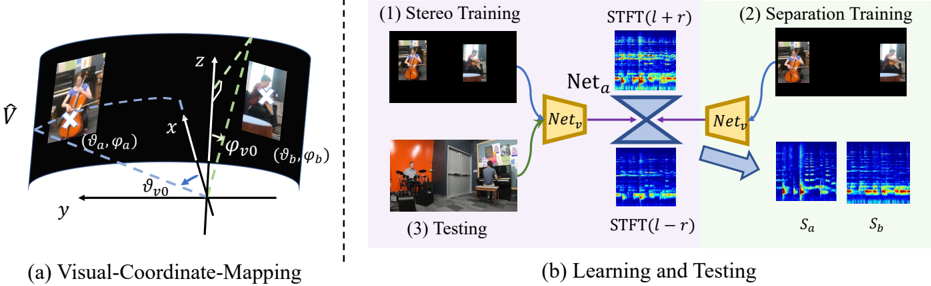
The image presents a diagram illustrating a visual-coordinate-mapping system and a learning/testing process. The diagram is divided into two main sections: (a) Visual-Coordinate-Mapping and (b) Learning and Testing. Section (a) depicts a curved visual field with coordinate axes and object positions, while section (b) outlines a stereo training, separation training, and testing workflow involving neural networks and signal processing.
### Components/Axes
**Section (a) Visual-Coordinate-Mapping:**
* **Axes:** A 3D coordinate system with axes labeled x, y, and z.
* **Visual Field:** A curved surface representing the visual field, labeled with a caret symbol above a V (̂V).
* **Object Positions:** Two images of a person playing a cello are positioned on the curved surface.
* **Angles:**
* θv0: Angle between the y-axis and a dashed blue line connecting the origin to the first cello image.
* φv0: Angle between the z-axis and a dashed green line connecting the origin to the second cello image.
* (θa, φa): Coordinates associated with the first cello image.
* (θb, φb): Coordinates associated with the second cello image.
**Section (b) Learning and Testing:**
* **(1) Stereo Training:** Two images of a person playing a cello.
* **(2) Separation Training:** Two images of a person playing a cello.
* **(3) Testing:** An image of a person playing a piano and drums in a room.
* **Neural Networks:**
* Neta: A neural network.
* Netv: A neural network.
* **Signal Processing:**
* STFT(l + r): Short-Time Fourier Transform of the sum of left (l) and right (r) audio channels.
* STFT(l - r): Short-Time Fourier Transform of the difference of left (l) and right (r) audio channels.
* Sa: Separated audio signal A.
* Sb: Separated audio signal B.
### Detailed Analysis or Content Details
**Section (a) Visual-Coordinate-Mapping:**
* The curved visual field suggests a panoramic or wide-angle view.
* The cello images are positioned at different locations within the visual field, each associated with a specific set of angular coordinates.
* The angles θv0 and φv0 appear to represent the horizontal and vertical angles, respectively, from the origin to the object positions.
**Section (b) Learning and Testing:**
* The workflow starts with stereo training, where two images of a cello player are used as input to the neural networks.
* The output of the stereo training is processed using Short-Time Fourier Transform (STFT) on the sum and difference of the left and right audio channels.
* The STFT outputs are fed into another neural network (Netv), which performs separation training.
* The separation training results in two separated audio signals, Sa and Sb.
* The testing phase involves an image of a person playing piano and drums, which is processed through the neural networks to evaluate the system's performance.
* The arrows indicate the flow of information between the different stages of the process.
### Key Observations
* The diagram illustrates a system that combines visual information with audio signal processing for sound source separation.
* The visual-coordinate-mapping component provides spatial information about the sound sources, which is used to improve the separation performance.
* The use of neural networks suggests a machine learning approach to sound source separation.
### Interpretation
The diagram presents a system for sound source separation that leverages both visual and audio information. The visual-coordinate-mapping component allows the system to estimate the location of sound sources in the visual field, which can be used to guide the separation process. The use of neural networks enables the system to learn complex relationships between visual and audio cues, improving the accuracy and robustness of the separation. The workflow involves stereo training, separation training, and testing, indicating a supervised learning approach. The system aims to separate audio signals from different sources, such as a cello and other instruments, based on their spatial locations and acoustic characteristics.