## Line Chart: Accuracy vs. Attack Ratio for Different Federated Learning Algorithms
### Overview
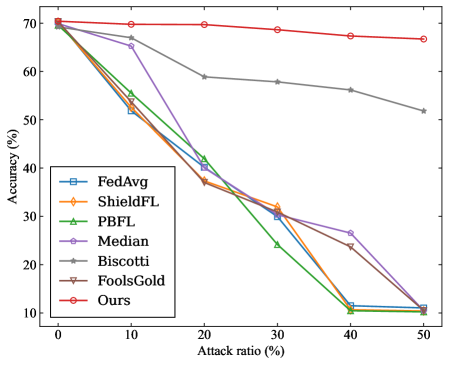
The image is a line chart comparing the accuracy of different federated learning algorithms as the attack ratio increases. The x-axis represents the attack ratio (percentage), and the y-axis represents the accuracy (percentage). Several algorithms are compared, including FedAvg, ShieldFL, PBFL, Median, Biscotti, FoolsGold, and "Ours".
### Components/Axes
* **X-axis:** Attack ratio (%), with markers at 0, 10, 20, 30, 40, and 50.
* **Y-axis:** Accuracy (%), with markers at 10, 20, 30, 40, 50, 60, and 70.
* **Legend:** Located on the left side of the chart, listing the algorithms and their corresponding line colors and markers:
* FedAvg (blue, square marker)
* ShieldFL (orange, diamond marker)
* PBFL (green, triangle marker)
* Median (purple, circle marker)
* Biscotti (gray, star marker)
* FoolsGold (brown, inverted triangle marker)
* Ours (red, circle marker)
### Detailed Analysis
* **FedAvg (blue, square marker):** Starts at approximately 70% accuracy at 0% attack ratio. Decreases to approximately 52% at 10% attack ratio. Further decreases to approximately 41% at 20% attack ratio. Decreases to approximately 32% at 30% attack ratio. Decreases to approximately 11% at 40% and 50% attack ratio.
* **ShieldFL (orange, diamond marker):** Starts at approximately 70% accuracy at 0% attack ratio. Decreases to approximately 54% at 10% attack ratio. Further decreases to approximately 37% at 20% attack ratio. Decreases to approximately 32% at 30% attack ratio. Decreases to approximately 22% at 40% attack ratio. Decreases to approximately 11% at 50% attack ratio.
* **PBFL (green, triangle marker):** Starts at approximately 70% accuracy at 0% attack ratio. Decreases to approximately 53% at 10% attack ratio. Further decreases to approximately 42% at 20% attack ratio. Decreases to approximately 24% at 30% attack ratio. Decreases to approximately 11% at 40% and 50% attack ratio.
* **Median (purple, circle marker):** Starts at approximately 70% accuracy at 0% attack ratio. Decreases to approximately 66% at 10% attack ratio. Further decreases to approximately 41% at 20% attack ratio. Decreases to approximately 31% at 30% attack ratio. Decreases to approximately 22% at 40% attack ratio. Decreases to approximately 11% at 50% attack ratio.
* **Biscotti (gray, star marker):** Starts at approximately 70% accuracy at 0% attack ratio. Decreases to approximately 59% at 20% attack ratio. Further decreases to approximately 57% at 30% attack ratio. Decreases to approximately 55% at 40% attack ratio. Decreases to approximately 52% at 50% attack ratio.
* **FoolsGold (brown, inverted triangle marker):** Starts at approximately 70% accuracy at 0% attack ratio. Decreases to approximately 55% at 10% attack ratio. Further decreases to approximately 37% at 20% attack ratio. Decreases to approximately 32% at 30% attack ratio. Decreases to approximately 22% at 40% attack ratio. Decreases to approximately 11% at 50% attack ratio.
* **Ours (red, circle marker):** Starts at approximately 70% accuracy at 0% attack ratio. Decreases slightly to approximately 69% at 10% attack ratio. Further decreases slightly to approximately 69% at 20% attack ratio. Decreases slightly to approximately 68% at 30% attack ratio. Decreases slightly to approximately 67% at 40% attack ratio. Decreases slightly to approximately 67% at 50% attack ratio.
### Key Observations
* The "Ours" algorithm (red line) consistently maintains the highest accuracy across all attack ratios.
* The Biscotti algorithm (gray line) maintains a relatively high accuracy compared to other algorithms, but is significantly lower than "Ours".
* FedAvg, ShieldFL, PBFL, Median, and FoolsGold all experience significant drops in accuracy as the attack ratio increases, converging to approximately 10% accuracy at a 50% attack ratio.
### Interpretation
The chart demonstrates the impact of increasing attack ratios on the accuracy of various federated learning algorithms. The "Ours" algorithm exhibits the most robustness against attacks, maintaining a high accuracy even at high attack ratios. Biscotti also shows some resilience, while the other algorithms are significantly affected by the increasing attack ratio. This suggests that "Ours" and Biscotti are more effective in mitigating the effects of malicious or compromised participants in the federated learning process. The other algorithms are highly vulnerable to attacks, as their accuracy plummets with increasing attack ratios.