## Sudoku Puzzle: Partially Filled Grid
### Overview
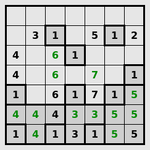
The image shows a partially filled Sudoku puzzle grid. The grid is 9x9, but only some cells contain numbers. Some numbers are black, while others are green, and some cells are shaded gray.
### Components/Axes
* **Grid:** A 9x9 grid of cells.
* **Numbers:** Digits from 1 to 7 are present in the grid.
* **Colors:** Numbers are either black or green. Cells are either white or gray.
### Detailed Analysis or ### Content Details
The grid contains the following numbers:
* **Row 1:** Empty, 3, 1 (gray), Empty, 5, 1 (gray), 2
* **Row 2:** 4, Empty, 6 (green), 1 (gray), Empty, Empty, Empty
* **Row 3:** 4, Empty, 6 (green), Empty, 7 (green), Empty, 1
* **Row 4:** 1, Empty, 6 (green), 1 (gray), 7 (green), 1 (gray), 5 (green)
* **Row 5:** 4 (gray, green), 4 (gray, green), 4 (gray, green), 3 (gray, green), 3 (gray, green), 5 (gray, green), 5 (gray, green)
* **Row 6:** 1 (gray), 4 (green), 1 (gray), 3 (gray), 1 (gray), 5 (gray, green), 5 (gray, green)
### Key Observations
* The grid is not fully populated.
* Some numbers are green, suggesting they might be user-entered or part of a solution process.
* Some cells are gray, possibly indicating pre-filled values or constraints.
* The numbers range from 1 to 7, which is unusual for a standard Sudoku puzzle (which typically uses 1 to 9).
### Interpretation
The image represents a Sudoku puzzle in progress. The green numbers likely represent the player's attempts to solve the puzzle, while the black numbers and gray cells may represent the initial state of the puzzle. The puzzle uses a smaller range of numbers (1-7) than a standard Sudoku. The goal is to fill the remaining cells with numbers such that each row, column, and 3x3 subgrid contains each number exactly once.