## Line Chart: Accuracy vs. Iteration for Two Methods
### Overview
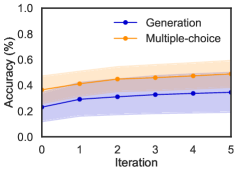
The image is a line chart comparing the accuracy performance of two methods, "Generation" and "Multiple-choice," over a series of iterations. The chart displays the mean accuracy for each method at each iteration, accompanied by shaded regions representing the uncertainty or variance (likely confidence intervals).
### Components/Axes
* **Chart Type:** Line chart with shaded confidence bands.
* **X-Axis (Horizontal):**
* **Label:** "Iteration"
* **Scale:** Linear, from 0 to 5.
* **Markers:** Major ticks at integers 0, 1, 2, 3, 4, 5.
* **Y-Axis (Vertical):**
* **Label:** "Accuracy (%)"
* **Scale:** Linear, from 0.0 to 1.0 (representing 0% to 100%).
* **Markers:** Major ticks at 0.0, 0.2, 0.4, 0.6, 0.8, 1.0.
* **Legend:**
* **Position:** Top-center of the chart area.
* **Items:**
1. **Blue line with circular markers:** Labeled "Generation".
2. **Orange line with circular markers:** Labeled "Multiple-choice".
* **Data Series & Visual Encoding:**
* **Generation (Blue):** A solid blue line connecting blue circular data points. A semi-transparent blue shaded area surrounds the line.
* **Multiple-choice (Orange):** A solid orange line connecting orange circular data points. A semi-transparent orange shaded area surrounds the line.
### Detailed Analysis
**Trend Verification:**
* **Generation (Blue Line):** The line exhibits a clear, steady upward trend from iteration 0 to 5.
* **Multiple-choice (Orange Line):** The line also exhibits a clear, steady upward trend from iteration 0 to 5. It is positioned consistently above the blue line.
**Data Point Extraction (Approximate Values):**
* **Iteration 0:**
* Generation: ~0.25 (25%)
* Multiple-choice: ~0.45 (45%)
* **Iteration 1:**
* Generation: ~0.28 (28%)
* Multiple-choice: ~0.48 (48%)
* **Iteration 2:**
* Generation: ~0.30 (30%)
* Multiple-choice: ~0.50 (50%)
* **Iteration 3:**
* Generation: ~0.32 (32%)
* Multiple-choice: ~0.52 (52%)
* **Iteration 4:**
* Generation: ~0.34 (34%)
* Multiple-choice: ~0.54 (54%)
* **Iteration 5:**
* Generation: ~0.35 (35%)
* Multiple-choice: ~0.55 (55%)
**Uncertainty Bands (Shaded Areas):**
* The shaded regions for both methods are widest at iteration 0 and appear to narrow slightly as iterations increase, suggesting decreasing variance over time.
* The orange band (Multiple-choice) is consistently positioned above the blue band (Generation). The bands do not overlap after iteration 0, indicating a statistically significant performance difference.
### Key Observations
1. **Consistent Performance Gap:** The "Multiple-choice" method maintains a lead of approximately 20 percentage points in accuracy over the "Generation" method at every measured iteration.
2. **Parallel Improvement:** Both methods improve at a very similar, nearly linear rate. The slope of both lines is approximately +0.02 (2%) accuracy per iteration.
3. **No Crossover:** The performance lines do not intersect; the hierarchy established at iteration 0 is maintained throughout.
4. **Diminishing Uncertainty:** The narrowing of the confidence bands suggests that the performance of both methods becomes more consistent (less variable) with more iterations.
### Interpretation
The data demonstrates that for the task measured, the "Multiple-choice" approach is fundamentally more effective than the "Generation" approach, yielding significantly higher accuracy from the outset. The parallel upward trends indicate that both methods benefit from additional iterations (e.g., more training steps, more data, or more refinement cycles) at a comparable rate. This suggests the core advantage of "Multiple-choice" is not in its learning *rate*, but in its *baseline* capability or efficiency for this specific task.
The lack of overlap in the confidence bands after the first iteration strongly implies that the observed performance difference is reliable and not due to random chance. The narrowing variance could indicate that the models are converging toward a stable performance level. From a practical standpoint, if resources (iterations) are limited, "Multiple-choice" provides a better accuracy return at every point. If the goal is to maximize final accuracy, both methods would need to be run for many more iterations to see if the gap closes, widens, or if one method plateaus before the other.