## Code Snippet: WebAssembly Module
### Overview
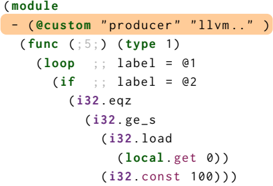
The image presents a snippet of WebAssembly (Wasm) code, likely generated by the LLVM compiler. It shows a module containing a function with a loop and conditional statement, performing integer comparisons and memory access.
### Components/Axes
* **Module:** The outermost container for Wasm code.
* **Custom Section:** A section with metadata, in this case, indicating the code was produced by LLVM.
* **Function:** A block of executable code.
* **Loop:** A control flow structure for repeated execution.
* **If:** A conditional control flow structure.
* **Instructions:** Operations like `i32.eqz` (integer equals zero), `i32.ge_s` (integer greater than or equal, signed), `i32.load` (load integer from memory), `local.get` (get local variable), and `i32.const` (integer constant).
* **Labels:** `@1` and `@2` are labels for the loop and if blocks, respectively.
### Detailed Analysis
The code can be broken down as follows:
1. **(module)**: Starts the definition of a WebAssembly module.
2. **(@custom "producer" "llvm..")**: A custom section indicating the code was generated by LLVM.
3. **(func (;5;) (type 1))**: Defines a function with index 5 and type 1.
4. **(loop ;; label = @1**: Starts a loop block, labeled `@1`.
5. **(if ;; label = @2**: Starts an if block, labeled `@2`.
6. **(i32.eqz ...)**: Checks if the result of the following expression is zero.
7. **(i32.ge\_s ...)**: Checks if the value loaded from memory is greater than or equal to 100.
8. **(i32.load (local.get 0))**: Loads a 32-bit integer from memory at the address stored in local variable 0.
9. **(i32.const 100))**: Pushes the constant integer value 100 onto the stack.
### Key Observations
* The code snippet demonstrates basic control flow (loop, if) and memory access operations in WebAssembly.
* The LLVM producer tag suggests the code was compiled from a higher-level language like C/C++.
* The code appears to be checking a condition based on a value loaded from memory.
### Interpretation
The code snippet represents a small part of a larger WebAssembly module. It shows a function that likely performs some kind of data processing or validation. The loop and conditional statement suggest that the function iterates over data and performs different actions based on the values it encounters. The memory access operation indicates that the function interacts with the module's linear memory. The overall purpose of the code is to perform a conditional check on a value loaded from memory, potentially as part of a larger algorithm or application.