\n
## Code Snippet: LLVM Intermediate Representation (IR)
### Overview
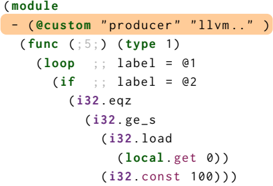
The image displays a snippet of code in LLVM Intermediate Representation (IR). It appears to be a section defining a module and a function within that module, including a loop and conditional statement. The code is syntax-highlighted, with different colors indicating different elements of the IR.
### Components/Axes
The code snippet consists of the following elements:
* `(module)`: Indicates the start of a module definition.
* `@custom "producer" "llvm.."`: A custom metadata annotation.
* `(func (:5) (type 1))`: Defines a function with an argument list (:5) and return type (type 1).
* `(loop :: label = @1)`: Defines a loop with a label @1.
* `(if :: label = @2)`: Defines a conditional statement with a label @2.
* `(i32.eqz)`: Integer comparison for zero.
* `(i32.ge_s)`: Integer greater than or equal to (signed).
* `(i32.load (local.get 0))`: Loads a 32-bit integer from local variable 0.
* `(i32.const 100)`: Defines a 32-bit integer constant with the value 100.
### Detailed Analysis or Content Details
The code snippet can be transcribed as follows:
```
(module
- (@custom "producer" "llvm..")
(func (:5) (type 1)
(loop :: label = @1
(if :: label = @2
(i32.eqz
(i32.ge_s
(i32.load (local.get 0))
(i32.const 100)
)
)
)
)
)
)
```
The code defines a function that contains a loop. Inside the loop, there's a conditional statement (`if`). The condition checks if the result of `i32.ge_s` is zero. `i32.ge_s` compares a value loaded from local variable 0 with the constant 100, checking if the loaded value is greater than or equal to 100. The `i32.eqz` instruction then checks if the result of the comparison is zero (meaning the loaded value was less than 100).
### Key Observations
The code snippet demonstrates a basic control flow structure (loop and conditional) within LLVM IR. The use of `i32` indicates that the code operates on 32-bit integers. The `@custom` annotation suggests that this code might be generated by a specific tool or compiler.
### Interpretation
This code snippet likely represents a part of a larger program being compiled or analyzed using LLVM. The conditional statement suggests a comparison operation, potentially used for loop termination or branching logic. The `local.get 0` indicates that the function has at least one local variable. The overall structure suggests a simple iterative process where a value is loaded, compared to a constant, and potentially used to control the loop's execution. The `producer` metadata could indicate the source of this IR code, such as a specific compiler pass or optimization stage. The `llvm..` part of the metadata is likely a namespace or identifier specific to the LLVM toolchain.